
Our Verdict
Mental health apps can be genuinely useful for building everyday stress-management habits, especially for people who are motivated to engage consistently and are dealing with mild-to-moderate stress rather than clinical conditions. Their accessibility removes real barriers — cost, scheduling, stigma — that prevent many people from getting any support at all. That said, they are not a substitute for professional care when serious symptoms arise, and the variation in evidence quality means consumers should approach them with informed skepticism.
Best for adults seeking structured, low-barrier tools to complement their existing wellness routines for everyday stress — not as a standalone treatment for diagnosed mental health conditions.
What Mental Health Apps Actually Do
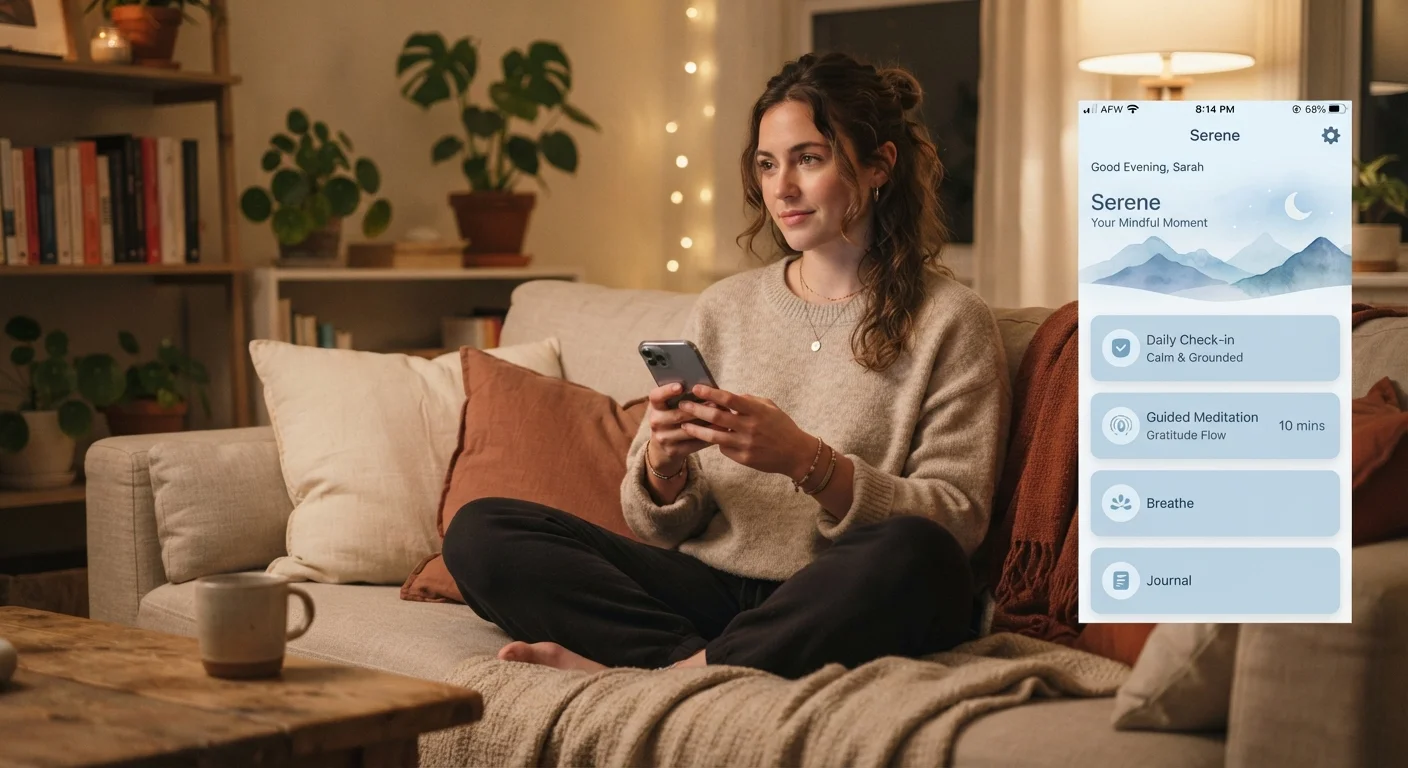
Mental health apps are smartphone-based tools designed to support emotional well-being through features like guided meditation, mood tracking, breathing exercises, cognitive behavioral therapy (CBT)-inspired journaling prompts, and sleep support. Thousands are available across major app stores, ranging from free, ad-supported offerings to subscription-based platforms developed with input from clinical psychologists.
It helps to understand what these apps are built to address: everyday stress, mild anxiety, disrupted sleep, and the kind of emotional friction that most adults experience week to week. They are not diagnostic tools, and they are not designed to treat clinical disorders. If you're unsure where your symptoms fall on that spectrum, our plain-language mental health glossary is a good starting point for making sense of the terms involved.
Apps Are Tools, Not Treatments
Mental health apps are classified as wellness tools, not medical devices, in most cases. They are designed to support healthy habits and mild stress management — not to diagnose, treat, or cure any mental health condition. If you are experiencing persistent or severe symptoms, please speak with a licensed mental health professional rather than relying on an app as your primary support.
The Advantages Worth Knowing
There are concrete, well-documented reasons why millions of people find these tools useful.
Available anytime, anywhere — no appointment needed
Unlike therapy, which requires scheduling and travel, apps are accessible at 2 a.m. during a sleepless night or during a five-minute break at work. This immediacy is especially valuable for managing acute stress in real time.
Lower cost barrier than traditional therapy
Many apps offer free tiers or low monthly subscriptions, making mental wellness tools accessible to people who cannot afford or access regular therapy. This addresses a genuine equity gap in mental health care access.
Reduces stigma around seeking support
Using a wellness app carries far less social stigma than entering a therapist's office, which can make it an easier first step for people who are new to thinking about their mental health proactively.
Builds structured, repeatable habits
Features like daily reminders, streaks, and guided sessions create consistent practice loops that help users build habits around breathing, mindfulness, or mood tracking over time.
Some apps draw on clinically validated methods
A subset of mental health apps are developed in collaboration with licensed clinicians and draw on evidence-based frameworks like cognitive behavioral therapy, giving users structured tools with a credible foundation.
One underappreciated benefit is consistency. Apps create low-friction habit loops — a two-minute breathing exercise before bed or a one-paragraph mood check-in after lunch — that are far easier to maintain than scheduling appointments. For people exploring stress-reduction strategies alongside other lifestyle habits, pairing an app with resources from our Fitness & Movement hub can reinforce a broader wellness routine.
The Limitations You Should Weigh
A balanced assessment requires honesty about where these tools fall short.
Evidence quality varies dramatically across apps
The majority of apps on the market have not been rigorously tested in peer-reviewed clinical trials. Marketing language often overstates what an app can do, making it difficult for consumers to distinguish proven tools from unproven ones.
No substitute for professional care in serious cases
Apps are not designed to manage clinical depression, trauma, panic disorder, or other conditions that require a licensed professional. Relying on an app when symptoms are serious can delay appropriate care.
Privacy and data security risks are real
Mental health apps collect sensitive personal data — mood logs, journal entries, usage patterns — and data-handling practices vary significantly. Some apps share or sell user data to third parties in ways users may not expect.
Engagement and dropout rates tend to be high
Research suggests that a large proportion of users abandon wellness apps within the first two weeks. Without external accountability, the initial motivation that drives downloads often fades before lasting habits form.
Passive use provides minimal benefit
Simply downloading an app or logging moods without engaging thoughtfully with its content produces little meaningful change. The benefit depends almost entirely on intentional, consistent participation.
May not account for individual circumstances
Apps offer generalized programming that cannot adapt to a user's full clinical picture, personal history, or cultural context the way a trained therapist can. One-size-fits-all content has real limits.
Perhaps the most important limitation is the risk of substitution — using an app to avoid seeking care that's actually needed. Our article on self-care vs. professional support outlines the clearer signals that indicate when a licensed therapist or counselor is the more appropriate step.
How Apps Compare to Other Self-Guided Tools
Apps aren't the only game in town for self-managed stress relief. Practices like journaling, physical movement, and social connection each have their own evidence base. Research consistently shows, for instance, that social connection has measurable mental health benefits that no app can fully replicate.
Journaling is another comparison point worth making. Like apps, it's low-cost and flexible; unlike many apps, it requires no screen time and involves no data sharing. Our piece on why journaling works — and where people go wrong explores how the two approaches can complement each other rather than compete.
10,000+
Mental health apps available in major app stores
Estimates from health technology researchers suggest tens of thousands of mental health and wellness apps are listed across iOS and Android platforms, with quality and evidence standards varying widely.
~80%
App dropout rate within two weeks
Studies of digital health app engagement consistently find that the majority of users stop using wellness apps within the first two weeks of downloading them, underscoring the consistency challenge.
The takeaway is that apps work best as one tool among several, not as a complete solution. A structured approach — combining an app with regular movement, social connection, and honest self-reflection — tends to produce better outcomes than any single method alone.
Using Apps Wisely: A Few Practical Principles
If you decide to try a mental health app, a few principles can help you get more out of it:
- Check for evidence-based frameworks. Look for apps that disclose the therapeutic models they draw on — CBT, mindfulness-based stress reduction (MBSR), or acceptance and commitment therapy (ACT) are well-researched approaches.
- Read the privacy policy. Mental health data is sensitive. Understand what is collected, how it is stored, and whether it is shared with third parties before you enter anything personal.
- Set realistic expectations. An app is a practice aid, not a cure. Consistent use over weeks matters more than intensity in any one session.
- Pair it with a self-check routine. Our practical mental well-being self-check can help you monitor whether what you're doing is actually moving the needle.
This article is for general informational and educational purposes only and is not a substitute for professional medical or mental health advice. If you are experiencing significant distress, persistent symptoms, or a mental health crisis, please consult a qualified healthcare professional or contact a crisis support service.
The content on this site is for informational purposes only and is not a substitute for professional advice. Always consult a qualified professional for guidance specific to your situation.