

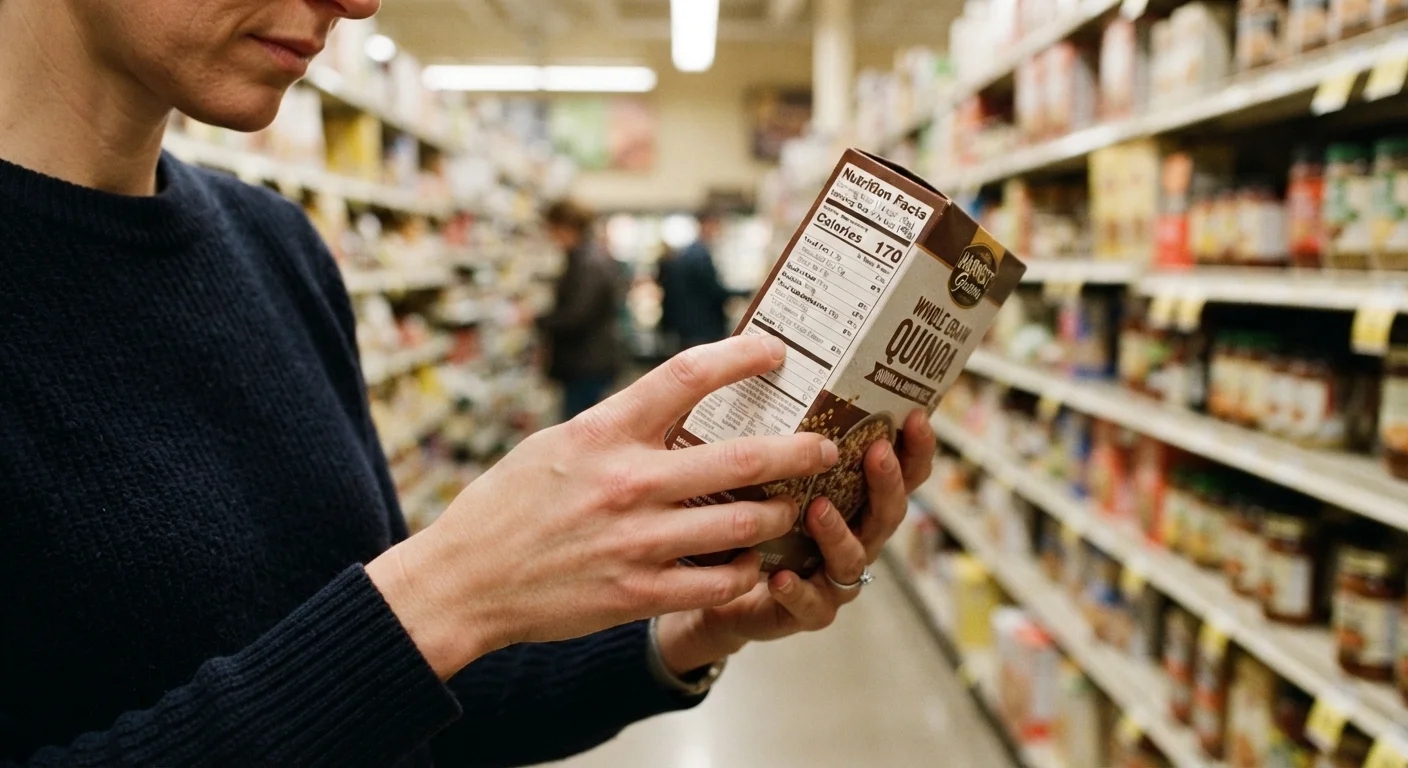
Why Nutrition Labels Matter More Than You Might Think
The Nutrition Facts panel is a federally standardized tool regulated by the U.S. Food and Drug Administration (FDA). Unlike the marketing language on the front of a package, the facts panel follows strict rules about what must be disclosed and how. That makes it one of the most reliable pieces of consumer information available at the grocery store — if you know how to read it.
The label was significantly updated in 2020 to reflect current nutrition science: added sugars now appear as their own line item, serving sizes were revised to better reflect how people actually eat, and vitamin D and potassium replaced vitamins A and C as the micronutrients of public health concern. Knowing these changes helps you use the label accurately.
This Is Educational Information, Not Medical Advice
This article explains how to read and interpret nutrition labels as a general literacy skill. It is not a substitute for personalised dietary guidance. If you have a medical condition, food allergy, or specific nutritional needs, consult a registered dietitian or your healthcare provider before making significant changes to your diet.
Learning to read labels fluently connects directly to broader eating habits. Our article on common nutrition myths and what the evidence shows can help you separate marketing-driven beliefs from sound science before you even reach the label.
Front-of-Package Claims Can Mislead
Terms like 'natural,' 'multigrain,' or 'made with real fruit' are largely unregulated marketing language and do not reflect the full nutritional picture. Always flip to the Nutrition Facts panel and the ingredient list before drawing conclusions about a product's healthfulness.
Step-by-Step: How to Read Any Nutrition Label
Follow these steps the next time you pick up a packaged food. Keep the actual product in hand so you can apply each concept in real time.
What you will need
Start with serving size and servings per container
Every value on a Nutrition Facts label — calories, fat, sodium, everything — applies to one serving, not the entire package. Manufacturers define serving sizes, so a single bag or bottle may contain two, three, or more servings.
Find the serving size at the very top of the panel (listed in both a common household measure and grams) and note the number of servings per container. If you plan to eat the whole package, multiply all the numbers accordingly.
Read the calorie count in context
Calories tell you how much total energy one serving provides. While calorie counts matter, they're only one data point. Two foods with identical calorie counts can differ dramatically in nutritional quality — one may be rich in fiber and protein while the other offers mostly refined starch and sugar.
Use calories alongside other nutrients rather than treating them as the sole measure of a food's value. For context on why macronutrient quality matters as much as quantity, see our guide to what carbs, protein, and fat actually do.
Scan the nutrients to limit
The label highlights nutrients that Americans commonly over-consume: saturated fat, sodium, and added sugars. Each has a %DV shown next to it. Keeping these values lower per serving is generally advisable for most healthy adults, though individual needs vary.
- Saturated fat: Linked to cardiovascular risk when consumed in excess. Learn how different fats compare.
- Sodium: High intake is associated with elevated blood pressure in some individuals.
- Added sugars: Listed separately from naturally occurring sugars since the 2020 label update; high intake is associated with energy spikes and dental health concerns.
Look for nutrients to get enough of
Below the nutrients to limit, the label lists nutrients many Americans under-consume: dietary fiber, vitamin D, calcium, iron, and potassium. Higher %DVs here are generally positive signals.
Fiber deserves particular attention — most Americans fall well short of recommended amounts. Read more in our article on fiber, the nutrient most Americans under-eat. For a broader view of vitamins and minerals, see our plain-English guide to micronutrients.
Decode the ingredient list
Ingredients are listed in descending order by weight — whatever appears first makes up the largest portion of the product. This is one of the most useful pieces of information on any package.
- If a whole grain, vegetable, or lean protein is first, the product is primarily made of that ingredient.
- If sugar (or one of its many aliases — corn syrup, dextrose, maltose, evaporated cane juice) appears in the first three ingredients, the product is predominantly sweetened.
- Long ingredient lists with many unfamiliar chemical names often indicate a more heavily processed product. For a deeper look at what processing means nutritionally, see our article on whole foods vs. processed foods.
Put it all together at the store
Use the label as a comparison tool, not a verdict. When choosing between two similar products, look for the one with more fiber, more protein, lower sodium, and fewer added sugars — all relative to its calorie count. A balanced plate framework can help you think about how packaged items fit alongside whole foods in a realistic daily eating pattern.
No single food needs to be 'perfect.' The goal is a pattern of choices that, over time, delivers the nutrients your body needs.
Use %DV as a Quick Comparison Tool
When comparing two similar products, the %DV column lets you judge nutrient levels at a glance without any math. A %DV of 5% or less is considered low for a nutrient; 20% or more is considered high. Use this to spot products high in fiber or calcium and low in sodium or saturated fat.
This article is for general informational and educational purposes only and is not a substitute for professional medical or dietary advice. Always consult a qualified healthcare provider or registered dietitian for guidance specific to your health needs.
The content on this site is for informational purposes only and is not a substitute for professional advice. Always consult a qualified professional for guidance specific to your situation.