

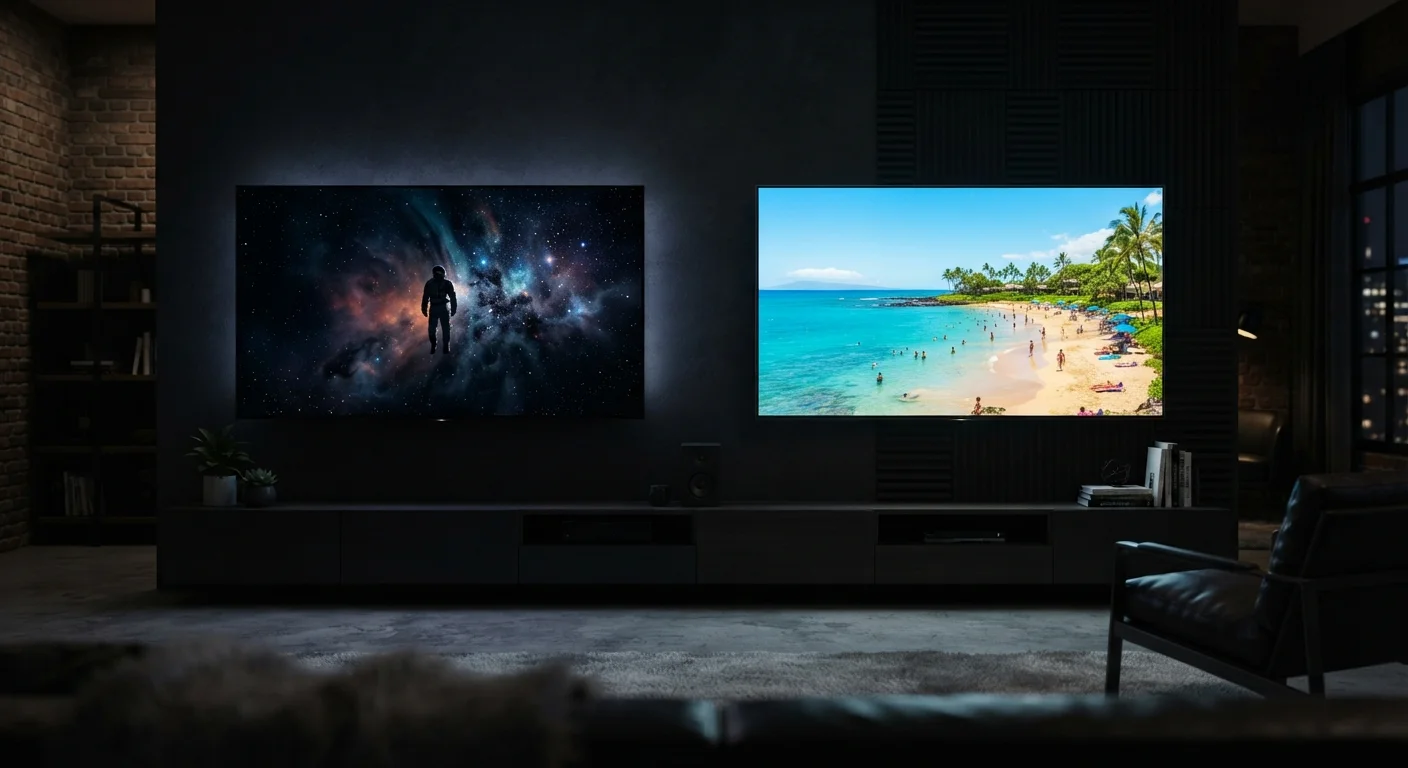
Option A
OLED
The contrast-first, self-emitting display technology.
Best for: Viewers who watch in dim or dark rooms and prioritize deep blacks, wide viewing angles, and cinematic picture quality.
Option B
QLED
The brightness-forward, backlit quantum dot display.
Best for: Viewers in bright or sunlit rooms who want vivid, punchy color and strong peak brightness at a range of price points.
How Each Technology Actually Works
The names sound similar, but OLED and QLED describe fundamentally different engineering approaches to producing an image.
OLED stands for Organic Light-Emitting Diode. Each pixel in an OLED panel contains organic compounds that produce light and color independently when electricity passes through them. There is no separate backlight layer. When a pixel needs to display black, it simply switches off entirely — producing a true, absolute black rather than a dimmed approximation.
QLED — which stands for Quantum Light-Emitting Diode — is not a self-emitting technology. It is an enhancement to conventional LED-backlit LCD panels. A layer of microscopic semiconductor particles called quantum dots sits between the LED backlight and the liquid crystal display layer. These dots are engineered to re-emit light at very precise wavelengths when energized, which expands the panel's color range and increases the accuracy of its color output compared to standard LED-LCD screens.
In plain terms: OLED controls light at the individual pixel level, while QLED controls light at a broader zone or full-panel level, then filters it through a quantum dot layer for improved color. This single difference in architecture explains nearly every practical distinction between the two.
| Criterion | OLED | QLED |
|---|---|---|
| Light source | Self-emitting pixels (no backlight) | LED backlight + quantum dot layer |
| Black levels | True black (pixel off) | Very dark gray (backlight bleed) |
| Contrast ratio | Effectively infinite | High, but finite |
| Peak brightness | Moderate to high | Very high |
| Burn-in risk | Present with static content | Not a known concern |
| Viewing angles | Wide and consistent | Variable (panel-dependent) |
| Best room lighting | Dim or controlled | Bright or mixed |
Contrast, Brightness, and Color: Where Each Excels
Contrast ratio — the difference between a panel's darkest black and its brightest white — is where OLED holds a clear structural advantage. Because individual pixels switch off completely, OLED panels can achieve what the industry describes as an infinite contrast ratio. Dark scenes in films reveal shadow detail that backlit panels struggle to match, because any active backlight bleeds some light into areas meant to appear black.
Peak brightness, on the other hand, is QLED's stronger suit. LED backlights can push significantly higher nit levels (a nit is the standard unit for measuring screen brightness) than OLED panels, which are limited by the efficiency of the organic compounds. In a bright room, that extra luminance makes a measurable difference to perceived image quality and color saturation. For HDR content — which relies on extreme brightness peaks for specular highlights — QLED panels can reproduce certain highlights more dramatically. For more on how HDR interacts with panel technology, see our guide to 4K, 8K, and HDR.
Color volume — the ability to produce accurate, saturated color across a wide range of brightness levels — is competitive between both technologies. Quantum dots enable QLED panels to cover wide color gamuts with considerable accuracy. OLED panels produce excellent color at moderate brightness. Neither has a decisive advantage across every brightness condition.
0 nits
True black output on OLED panels
When an OLED pixel is off, it emits no light at all — a physical property that LCD-based technologies cannot replicate regardless of local dimming quality.
1,000–2,000+ nits
Typical peak brightness range for QLED panels
High-end QLED panels can sustain substantially higher sustained brightness than most OLED panels, according to general panel specifications published by major display manufacturers.
~70°
Approximate OLED consistent-color viewing angle
OLED panels typically maintain accurate color and contrast across a wider off-axis range than most VA-type LCD panels used in many QLED TVs.
Practical Considerations: Burn-In, Longevity, and Viewing Angles
One frequently cited limitation of OLED is image retention, sometimes called burn-in. Because organic compounds degrade slightly with use, pixels that display the same static element for extended periods — such as a news channel logo or a video game's heads-up display — can become permanently dimmer than surrounding pixels over time. Modern OLED panels include pixel-refreshing routines and on-screen shift features that reduce this risk considerably under typical TV-watching conditions. However, it remains a realistic consideration for use cases involving many hours of static imagery daily.
QLED panels do not share this vulnerability. The inorganic quantum dot layer and LED backlight are not subject to the same degradation mechanism, making QLED a lower-risk choice for commercial displays or heavy gaming setups with persistent on-screen elements.
Viewing angles present another practical distinction. OLED panels maintain consistent color and contrast across wide angles — useful if seating is spread across a room. Many QLED panels use VA (Vertical Alignment) LCD technology, which can exhibit color shift and contrast loss when viewed from the side, though some use IPS panels with better off-axis performance.
Display specs like these interact with other factors you may be weighing. Our explainer on refresh rate and input lag covers additional specs that matter particularly for gaming setups. And if you're also thinking through your streaming setup, streaming devices vs. smart TV apps explores how software flexibility can affect long-term satisfaction.
Panel Technology Is One Factor Among Several
OLED vs. QLED is an important distinction, but panel type interacts with processing quality, software support, and physical setup. A well-calibrated QLED in the right room can outperform a poorly calibrated OLED, and vice versa. Before finalizing any decision, consider how you'll actually use the screen — including room lighting, seating distance, and the kinds of content you watch most. For a broader look at what leads to dissatisfaction after purchase, see our overview of common TV buyer regrets.
The content on this site is for informational purposes only and is not a substitute for professional advice. Always consult a qualified professional for guidance specific to your situation.