

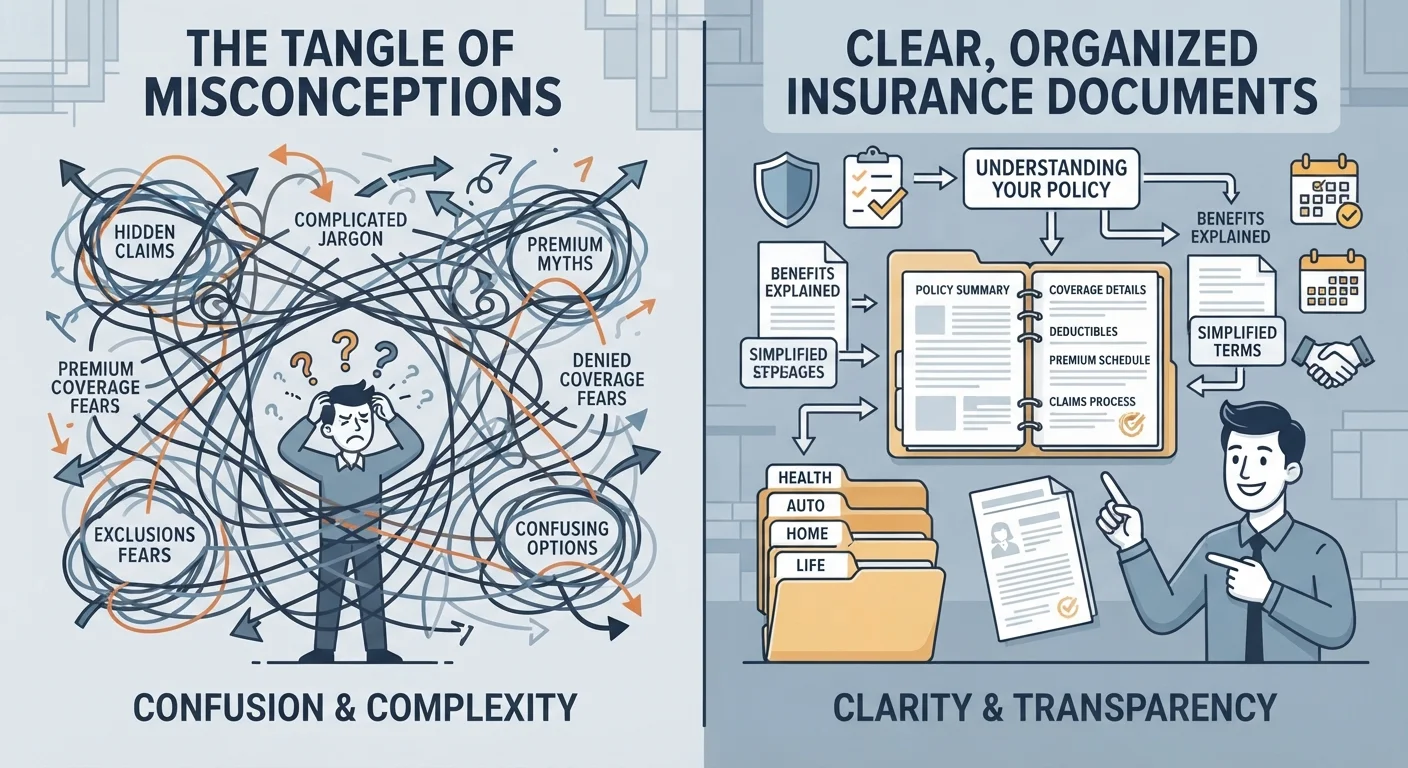
Why Insurance Myths Are So Persistent
Insurance is a product most people buy infrequently, use rarely, and read carefully almost never. That combination creates fertile ground for myths. A neighbor's offhand comment, a half-remembered news story, or a misread summary page can quietly become someone's operating assumption — shaping decisions that affect thousands of dollars of exposure.
The consequences aren't abstract. Choosing the wrong plan based on a myth can mean paying a deductible you can't afford, filing a claim that gets denied, or carrying coverage that duplicates what you already have while leaving a real risk completely unprotected. Understanding core policy concepts is the foundation for making better choices.
This article corrects the most common myths that push everyday consumers toward plans that don't actually fit their lives.
Myth
The plan with the lowest monthly premium is the most affordable choice.
Fact
A low premium often comes paired with a high deductible, higher copays, or narrower coverage — all of which can make the true annual cost far higher.
Premium is only one component of what you actually pay. When you factor in your deductible (the amount you pay out of pocket before coverage kicks in), copayments, coinsurance, and annual out-of-pocket maximums, a lower-premium plan can easily cost more than a higher-premium alternative — especially if you use your coverage regularly. True cost goes beyond sticker price: model a few realistic usage scenarios before deciding.
Myth
My employer's health plan is automatically my best option.
Fact
Employer-sponsored coverage may be cost-effective for many workers, but it isn't universally the right fit — ACA Marketplace plans can be more appropriate depending on income, family size, and health needs.
Employers often subsidize a portion of premiums, which creates real value. But the network of providers, the specific drugs covered, and the deductible structure may not align with a particular worker's needs. Individuals who qualify for Marketplace subsidies or who have family members with distinct coverage requirements should compare both options carefully. Weighing employer vs. Marketplace plans requires examining the full benefit structure, not just the employer contribution.
Myth
Standard homeowners insurance covers all major disasters, including floods.
Fact
Flood damage is explicitly excluded from virtually all standard homeowners policies; it requires a separate flood insurance policy.
This is one of the costliest assumptions in personal insurance. Standard homeowners policies cover many perils — fire, wind, theft, certain water damage from internal sources — but flood from external sources is nearly universally excluded. The same logic applies to earthquake damage in many states. If you live in an area with meaningful flood or seismic risk, separate coverage deserves serious consideration. Review what standard policies actually cover before assuming you're protected.
Myth
Filing a small claim is always worth it — that's what insurance is for.
Fact
Filing frequent small claims can raise your premiums significantly, and some insurers may non-renew a policy after multiple claims within a short period.
Insurance is most valuable as protection against large, financially disruptive losses. For minor repairs or small losses — ones you could absorb without serious hardship — paying out of pocket often makes more financial sense over time. Every claim creates a record, and insurers use that history when calculating future premiums. Understanding when to file and when not to is part of using a policy strategically, not just reactively. See why claims get denied for related policy language pitfalls.
Myth
More coverage types purchased means fewer surprises at claim time.
Fact
What matters is whether each coverage type matches your actual exposures — and whether you understand the exclusions within each.
Stacking multiple coverage types without understanding what each one does — and doesn't — cover can leave you both over-insured in low-risk areas and under-insured in high-risk ones. Calibrating coverage to your actual circumstances is more effective than defaulting to more. Review the gaps most commonly missed when selecting coverage to avoid unpleasant surprises.
How Myths Translate Into Real Coverage Gaps
Myths don't just cause mild inconvenience — they produce specific, documented gaps. Assuming a standard homeowners or renters policy covers flood damage, for instance, is among the most expensive misunderstandings in American insurance. Standard policies routinely exclude flood losses; separate flood coverage typically requires a distinct policy, often through the National Flood Insurance Program or a private carrier.
Similarly, assuming liability limits are automatically sufficient because you bought the policy your agent suggested years ago ignores how circumstances change — a higher net worth, a teenage driver added to an auto policy, or a home-based business can all create liability exposures that standard limits don't fully address. Coverage myths like these are precisely what leave policyholders underprotected when they need their insurance most.
Coverage Gaps Often Surface Only at Claim Time
Most policyholders discover what their plan doesn't cover when they try to file a claim — the worst possible moment. Exclusions, sub-limits, and conditions are embedded in policy language that rarely appears in marketing materials or enrollment summaries. Reviewing your policy before a loss occurs, not after, is the only way to identify and address gaps while you still can.
The antidote to myths is deliberate reading. Before renewing any policy, review the declarations page, the exclusions section, and any endorsements. If the language is unclear, a licensed insurance agent or adviser can walk you through what it means for your specific situation — and that consultation is almost always worth the time.
For a broader framework on approaching these decisions, see principles that hold across plan types and questions to ask before choosing a plan.
This article is for general informational and educational purposes only. It does not constitute personalized insurance, financial, or legal advice. Coverage terms, exclusions, and regulations vary by provider, policy, and state. Always read your actual policy documents and consult a licensed insurance professional for guidance specific to your situation.
The content on this site is for informational purposes only and is not a substitute for professional advice. Always consult a qualified professional for guidance specific to your situation.