

Option A
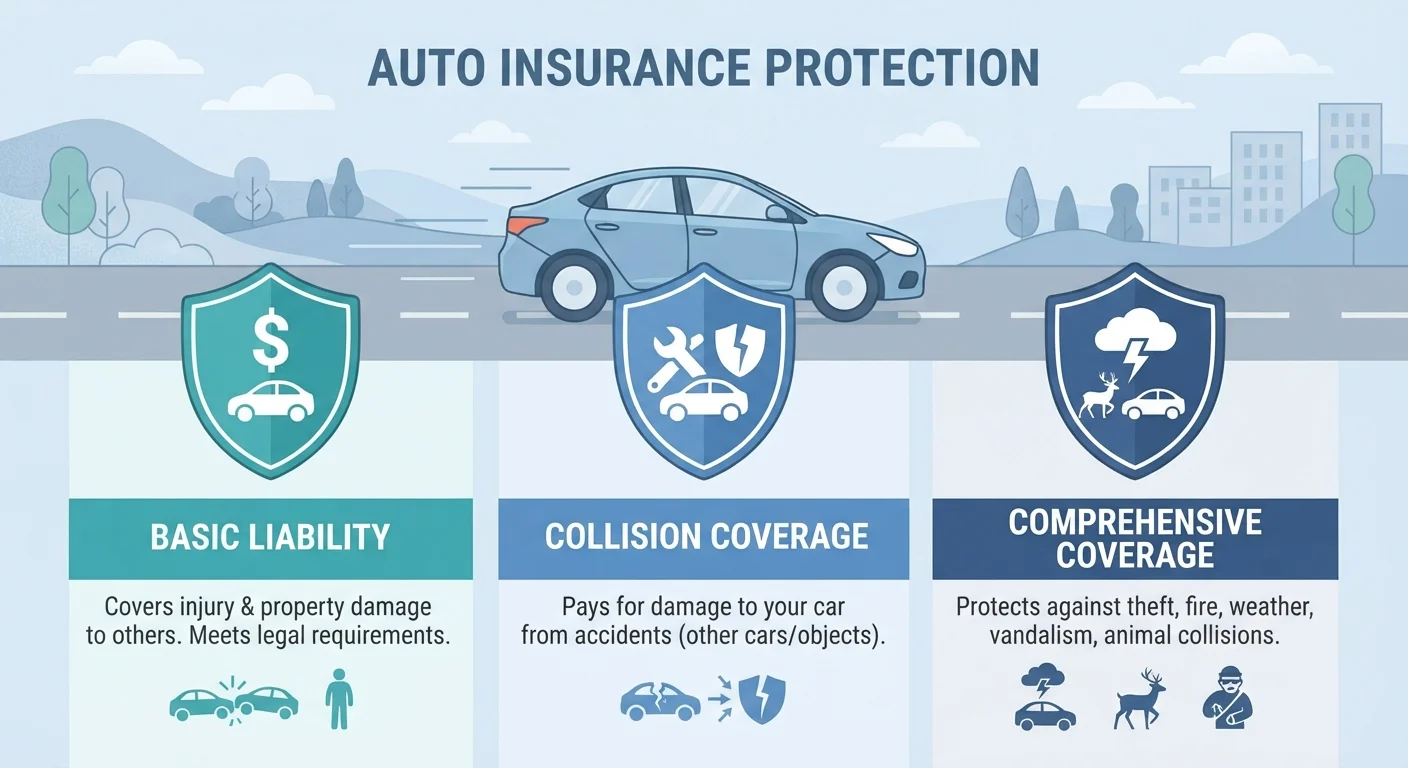
Liability Coverage
The legally required foundation of auto insurance.
Best for: Covering costs you owe to others when you cause an accident — their injuries and property damage.
Option B
Comprehensive & Collision Coverage
The optional layers that protect your own vehicle.
Best for: Paying to repair or replace your car after accidents, theft, weather damage, or other physical losses.
How the Three Coverage Types Are Structured
Most auto insurance policies are assembled from distinct coverage modules rather than one blanket protection. Understanding what each module actually does — and what it doesn't — is essential before you can evaluate whether your policy fits your situation. For a broader grounding in how coverage is defined in any policy, see what 'coverage' actually means in an insurance policy.
The three primary layers are liability, collision, and comprehensive. They operate independently: paying into one coverage type does not activate the others. Each carries its own limit — the maximum the insurer will pay — and, in the case of collision and comprehensive, its own deductible, which is the amount you pay before the insurer contributes.
| Criterion | Liability | Comprehensive & Collision |
|---|---|---|
| What it protects | Other people's property and bodies | Your own vehicle |
| State-mandated | Yes, in nearly all states | No (but lenders may require it) |
| Deductible applies | No | Yes, per coverage type |
| Pays if you're at fault | Yes — for others' losses | Yes — for your vehicle damage |
| Covers theft or weather | No | Yes — via comprehensive only |
| Covers crash damage to your car | No | Yes — via collision only |
Liability: What You Owe Others After an Accident
Liability coverage is the legal and financial backbone of auto insurance. Almost every state mandates a minimum level, though the specific dollar amounts vary widely. It breaks into two parts:
- Bodily injury liability — pays for medical expenses, lost wages, and legal costs if you injure someone else in an accident you caused.
- Property damage liability — covers repair or replacement costs for another person's vehicle or property that you damage.
Crucially, liability does not pay anything toward your own medical bills or your own vehicle's repairs. If the damages you cause exceed your policy limits, you are personally responsible for the remainder. This is one reason many financial advisers suggest carrying limits well above state minimums. For context on how liability fits within the broader insurance picture, the four pillars of personal insurance article explains how auto coverage relates to health, home, and life policies.
49 of 50
U.S. states requiring liability coverage
New Hampshire is the only state that does not mandate auto liability insurance, though drivers there must still demonstrate financial responsibility.
~78%
Insured drivers carrying comprehensive coverage
According to the Insurance Information Institute, roughly three-quarters of insured U.S. drivers opt for comprehensive coverage, often because their vehicle is financed.
Collision and Comprehensive: Protecting Your Own Vehicle
Collision coverage pays to repair or replace your vehicle when it is damaged in a crash — whether you hit another car, a guardrail, or a stationary object. Fault generally does not determine whether collision pays out; your insurer covers the vehicle damage and may seek reimbursement from the at-fault party's insurer through a process called subrogation.
Comprehensive coverage handles losses that aren't the result of a collision. Common examples include theft, vandalism, fire, hail, flooding, falling objects, and strikes involving animals. If a deer hits your car or a tree falls on it during a storm, comprehensive is the relevant coverage — not collision.
Both coverages are subject to a deductible you choose at policy purchase. A higher deductible lowers your premium but increases what you pay at claim time. The hidden costs inside every auto insurance policy explains how deductibles, coverage gaps, and add-ons interact with what you'll actually spend after an incident.
The 'Actual Cash Value' Factor
When comprehensive or collision pays out, most standard policies reimburse the actual cash value (ACV) of your vehicle — its market value at the time of loss, minus depreciation — not the cost to buy a replacement at today's prices. If your car is totaled, the payout may be less than you expect. Some policies offer 'agreed value' or gap coverage as add-ons to address this difference, which is particularly relevant for newer or financed vehicles.
Deciding whether to carry comprehensive and collision on a paid-off vehicle is a common calibration question. Choosing coverage types without buying more than you need offers practical principles for matching coverage to your actual circumstances.
Coverage Gaps Worth Understanding
None of these three coverage types is all-encompassing. Liability won't help if an uninsured driver hits you — that scenario requires separate uninsured/underinsured motorist coverage. Your own medical bills after a crash may need personal injury protection (PIP) or medical payments coverage, depending on your state's rules. Rental car reimbursement and roadside assistance are typically add-ons, not automatic inclusions.
If you want protection above your liability limits for catastrophic at-fault accidents, why umbrella insurance exists and what gap it fills is worth reviewing. For a complete reference of policy terminology used across all coverage types, the coverage type glossary defines the key terms you'll encounter when reading your own policy documents.
This article provides general insurance education and is not personalized insurance, legal, or financial advice. Coverage terms, limits, exclusions, and state requirements vary by provider and location. Always read your actual policy documents and consult a licensed insurance agent or adviser for guidance specific to your situation.
The content on this site is for informational purposes only and is not a substitute for professional advice. Always consult a qualified professional for guidance specific to your situation.