

The Math Most People Never Run
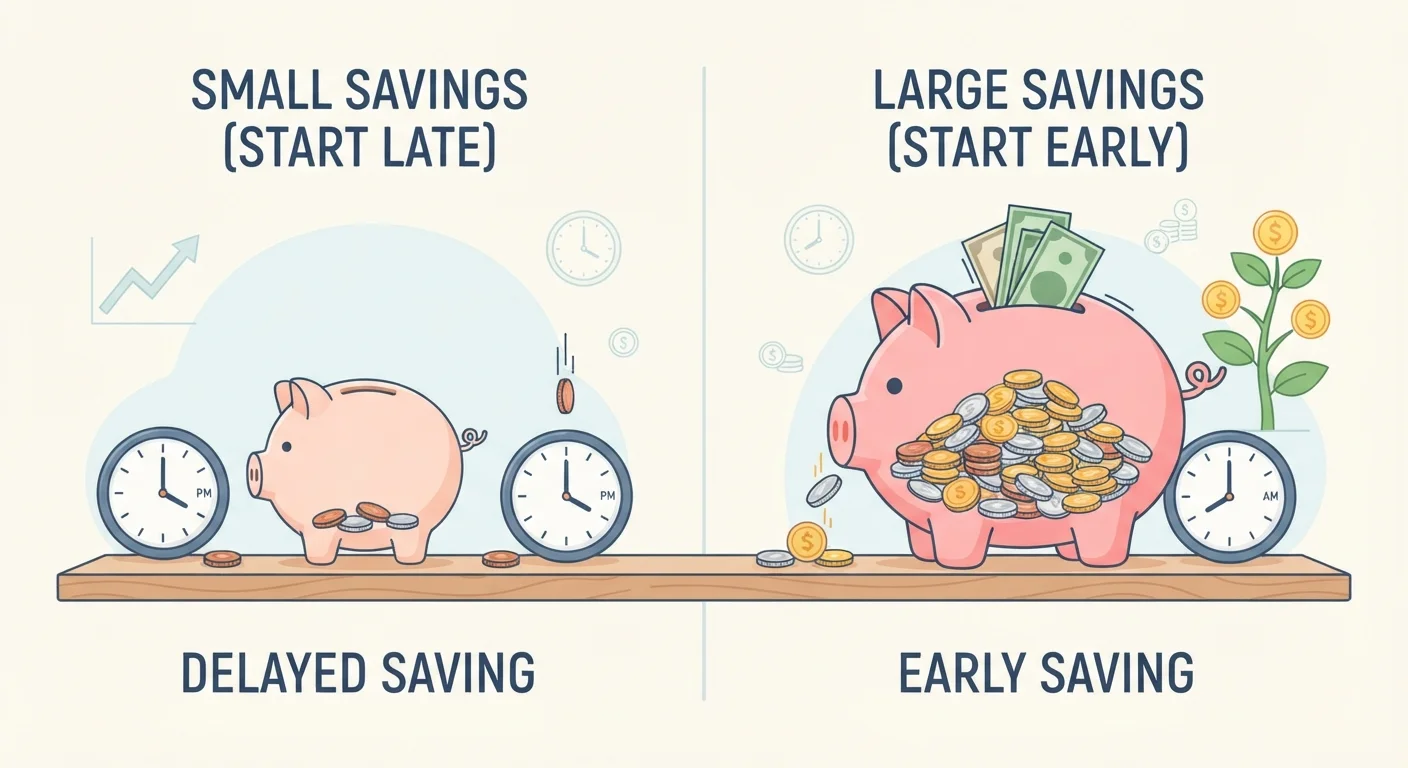
Compound growth — the process by which returns generate their own returns — is well-known in theory but routinely underestimated in practice. The reason is intuitive: in the early years, the dollar amounts look unimpressive. It is only over a decade or more that the curve bends dramatically upward.
Consider two hypothetical savers. One begins contributing at age 25; the other waits until 35 and contributes the same monthly amount. By conventional retirement age, the early starter can end up with a substantially larger balance — not because they contributed more, but because their money had more time to work. That ten-year gap is not recoverable through higher contributions alone.
10 yrs
Compounding head start advantage
Illustrative projections consistently show that a saver who begins ten years earlier — even contributing less overall — can end up with a materially larger balance at retirement age.
~30%
Americans with no retirement savings
Federal Reserve surveys have found that roughly three in ten non-retired American adults report having no retirement savings or pension, highlighting how widespread delayed saving is.
This is not a reason for despair if you've already waited — it's a reason to start now rather than wait further. Each additional year of delay extends the gap. The best moment to start was earlier; the second-best moment is today.
If you're still building the framework to make saving possible, building a budget with saving in mind is a practical first step before tackling contribution amounts.
Behavioral Traps That Keep Savers on the Sidelines
The mathematics of delayed saving are straightforward enough. The harder challenge is behavioral: understanding why so many people know they should save earlier but don't. Several predictable patterns account for most of the delay.
Time Is the Most Valuable Saving Asset
Compound growth — earning returns on previous returns — depends entirely on how long money stays invested. Every year of delay permanently reduces the compounding runway available to you. No amount of catch-up saving can fully restore the time lost in the early years.
Present bias — the tendency to assign more weight to immediate costs than future benefits — makes a current spending decision feel more real than a retirement balance decades away. Optimism bias convinces people that their future income will be high enough to make saving easy later. And decision paralysis leads many would-be savers to postpone starting until they've fully researched the 'best' account or strategy — a search that can take years.
Waiting for 'Extra Money' Often Means Never Starting
Many people plan to start saving once they earn more, pay off a debt, or reach a financial milestone. In practice, expenses tend to grow alongside income, and that milestone never triggers action. Setting any amount aside now — even a modest sum — beats waiting indefinitely for ideal conditions.
Recognizing these patterns is the first step to bypassing them. The mistakes below cover the most common forms these delays take — along with concrete ways to act instead.
Common Saving Mistakes — and How to Move Past Them
Treating saving as something to begin 'later' once finances feel more stable.
Why it happens: Many people assume the benefits of saving are primarily proportional to how much they save, not how long they save. The compounding timeline — which begins at day one — is easy to underestimate.
Assuming a high income will compensate for starting late.
Why it happens: Earning more money creates confidence that future saving will 'catch up' — but catch-up contributions cannot restore the years of compounding already missed.
Waiting until debt is completely paid off before saving anything.
Why it happens: Paying down debt feels concrete and productive, making saving seem like it can wait. This binary thinking overlooks the benefit of doing both simultaneously — even at a small scale.
Not automating savings contributions, leaving them dependent on willpower each month.
Why it happens: Manual saving requires a deliberate choice every pay period. Life gets busy, and that choice is easily skipped, postponed, or reduced.
Believing that investing requires a large initial sum before it's worthwhile.
Why it happens: Popular culture often portrays investing as something wealthy people do, creating a psychological barrier for those with modest starting amounts.
Spotting the error is only half the equation. Each of the situations above has a workable path forward that doesn't require a windfall or perfect timing — only a decision to act on imperfect but real conditions.
What an Earlier Start Actually Gives You
Starting earlier doesn't just produce a larger number at retirement. It also provides options that late starters rarely have: the flexibility to reduce contributions during financial hardship without derailing the overall plan, the capacity to take on appropriately managed risk when young and absorb volatility over time, and the psychological benefit of watching a savings balance grow — which research consistently links to greater financial confidence and continued saving behavior.
None of this requires a large income or financial expertise. It requires consistency and time — two things that are genuinely available to most people who haven't yet started.
This article is for general informational and educational purposes only. It does not constitute personalized financial, tax, investment, or legal advice. Consult a qualified financial professional before making decisions about your individual situation.
The content on this site is for informational purposes only and is not a substitute for professional advice. Always consult a qualified professional for guidance specific to your situation.