

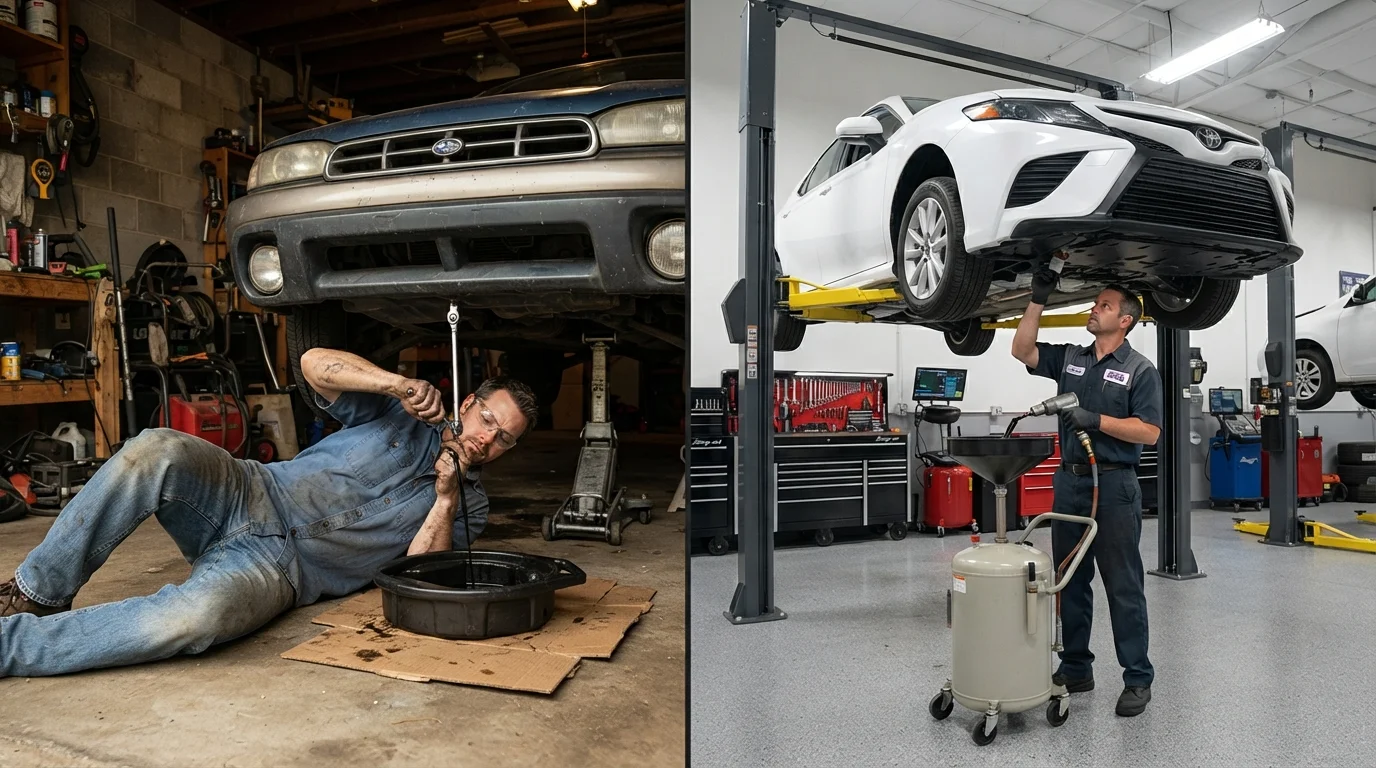
Our Verdict
DIY maintenance makes sense for routine, low-risk tasks where the margin for error is small and the tools are accessible. For anything that affects vehicle safety, emissions compliance, or requires specialized diagnostic equipment, professional service is the more prudent choice. Most drivers land somewhere in the middle - handling easy jobs themselves while relying on a shop for complex work.
| Best for | Recommended |
|---|---|
| Drivers comfortable with basic tools and simple procedures | DIY maintenance for routine tasks |
| Jobs involving brakes, steering, or advanced electronics | Professional shop service |
| Vehicles still under manufacturer or powertrain warranty | Professional shop service |
| Drivers new to car ownership or without garage space | Professional shop service to start |
Where the Line Actually Falls
The DIY vs. shop debate isn't about pride - it's about risk and practicality. Some maintenance tasks are genuinely straightforward: the tools are inexpensive, the steps are well-documented, and a minor mistake won't endanger anyone. Others involve your vehicle's safety-critical systems, require specialized equipment, or carry legal and warranty implications that make professional service the only sensible path.
Understanding that distinction is what separates a smart home mechanic from a liability. See our full overview of car ownership upkeep for the broader maintenance landscape before deciding what to tackle yourself.
| Task | DIY Friendly | Shop Recommended | |
|---|---|---|---|
| Engine / cabin air filter | Yes - simple swap | Not necessary for most vehicles | |
| Windshield wipers | Yes - owner's manual guides it | Not necessary | |
| Oil change | Possible with proper setup | Preferred if no safe lift point | |
| Brake pads & rotors | Not recommended - safety critical | Yes - required | |
| Suspension / alignment | No - needs calibrated equipment | Yes - required | |
| Airbag / SRS system | Never - injury risk | Yes - trained technicians only | |
| Diagnostic scan (check-engine light) | Code read only - free at many retailers | Full diagnosis recommended |
Tasks Most Drivers Can Safely Handle at Home
Several routine jobs require no special training, no hydraulic lift, and no diagnostic computer. These include:
- Engine air filter replacement - typically a clip-and-swap job that takes under 10 minutes.
- Cabin air filter replacement - usually accessible behind the glove box without tools.
- Windshield wiper blades - straightforward and covered in any owner's manual.
- Checking and topping off fluids - coolant, washer fluid, and power steering fluid are simple visual checks.
- Replacing bulbs - exterior lighting on many vehicles, though some modern designs require disassembly.
Oil changes sit in a gray zone. While the task itself is learnable, it requires safely raising the vehicle, disposing of used oil properly, and knowing the correct oil grade and filter for your specific engine. For guidance on what's due and when, our routine maintenance intervals reference breaks it down clearly.
Start Small to Build Confidence
If you're new to DIY maintenance, air filters and wiper blades are genuinely good starting points. They're low-stakes, clearly instructed in owner's manuals, and give you a feel for working with your specific vehicle. Attempting a brake job as your first project is a different category of risk entirely - build from the ground up.
When the Shop Is the Safer Call
Certain jobs should stay with professionals, regardless of your confidence level:
- Brake system work - pad and rotor replacement can seem approachable, but improper installation of brake hardware, calipers, or brake lines can cause catastrophic failure. This is not a recoverable mistake at highway speeds.
- Suspension and steering components - alignment requires calibrated equipment; worn ball joints or tie rods improperly installed affect vehicle control directly.
- Airbag and SRS systems - accidental deployment can cause serious injury. These systems must only be serviced by trained technicians.
- Transmission service - fluid changes are sometimes DIY-friendly, but internal transmission work is not.
- Emissions-related repairs - catalytic converters and O2 sensors interact with your vehicle's engine management system; incorrect repairs can trigger persistent fault codes or inspection failures.
If your vehicle is still under a manufacturer or powertrain warranty, check the terms carefully. Some warranties require service at authorized facilities, or at minimum that repairs use approved parts and fluids. When a repair estimate grows large enough to prompt a broader financial question, our article on when a repair bill signals a bigger decision walks through the key factors to weigh.
Never Use Jack Stands Rated Below Your Vehicle's Weight
Working under an improperly supported vehicle is one of the most preventable causes of serious injury in home garages. Always confirm the weight rating of your jack stands against your vehicle's curb weight, and never rely on a floor jack alone to support a vehicle you're working beneath. If you don't have the right equipment, this is a job for the shop.
Practical Factors to Weigh Before You Start
Even for jobs that are technically within reach, a few honest questions help clarify the right call:
- Do you have the right tools?
- A basic socket set goes far, but some jobs require torque wrenches, specialty sockets, or scan tools that cost more than the repair itself.
- Do you have a safe workspace?
- Working under a car supported only by a floor jack is dangerous. Jack stands rated for your vehicle's weight are non-negotiable; a flat, stable surface is essential.
- Is the vehicle drivable if something goes wrong?
- Attempting a repair mid-process and discovering you need a part can leave the vehicle immobile for days. Factor that disruption in.
- What does the diagnostic say?
- A check-engine light might point to something simple or something systemic. Many auto parts retailers offer free OBD-II code reads, but interpreting those codes accurately still requires mechanical context.
If you're newer to ownership and building your maintenance knowledge, keeping up with maintenance without mechanical experience is a practical starting point. And before acting on any commonly repeated advice, it's worth consulting common car maintenance myths - some widely held beliefs are simply wrong.
The content on this site is for informational purposes only and is not a substitute for professional advice. Always consult a qualified professional for guidance specific to your situation.