

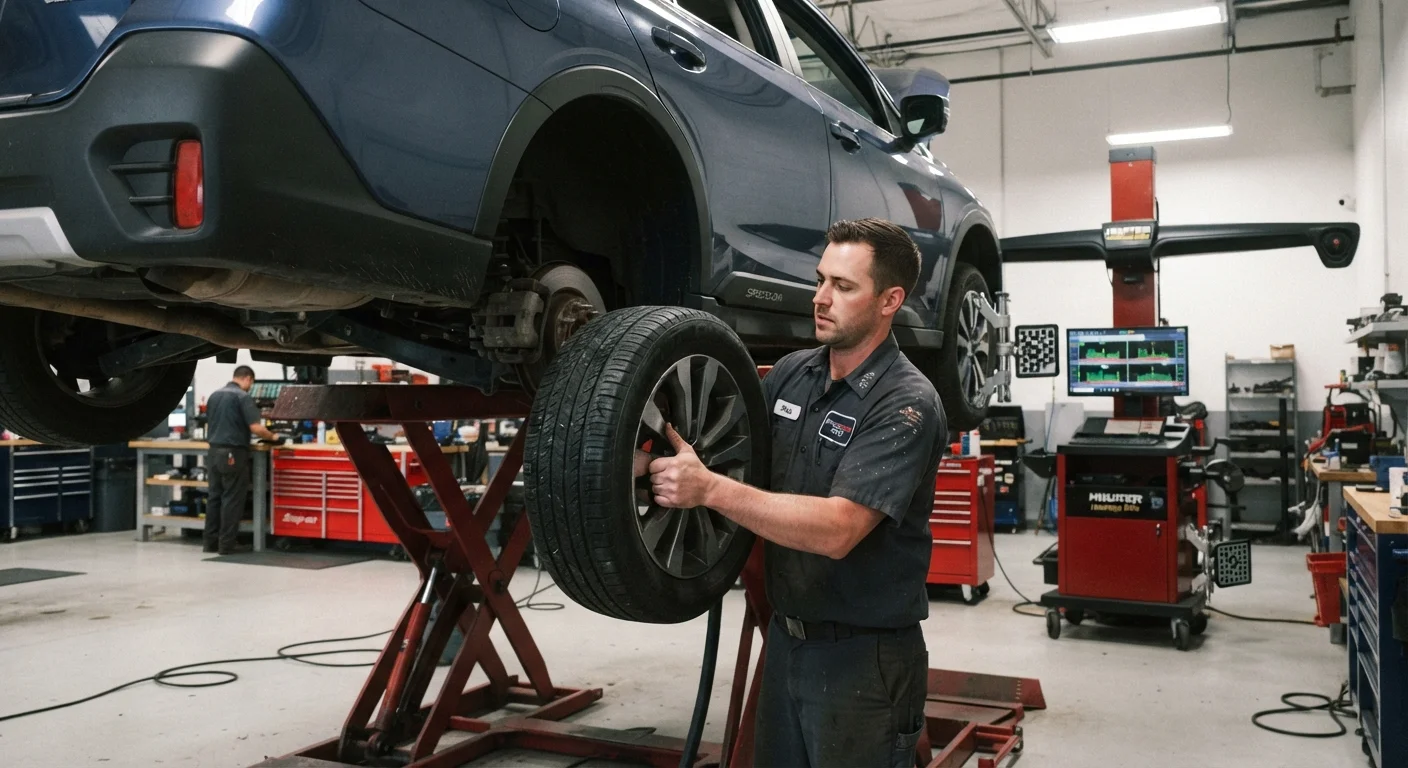
Tire Rotation: Balancing the Workload Across All Four Tires
Tires wear at different rates depending on their position on your vehicle. On a front-wheel-drive car, the front tires handle steering, braking, and the bulk of propulsion - so they wear significantly faster than the rears. Rotation addresses this by periodically moving tires to new positions so no single tire bears a disproportionate burden.
The most common pattern moves front tires straight back and crosses the rears to the front, though the correct pattern for your vehicle depends on whether tires are directional, whether your car has a staggered fitment, and whether a full-size spare is included. Your owner's manual is the authoritative source here.
Skipping rotation doesn't just shorten tire life - it can also mask uneven wear caused by alignment or suspension issues that a technician would otherwise catch during the service. Think of rotation appointments as a built-in inspection opportunity. For a broader view of where this fits in your overall maintenance schedule, see the full picture of car ownership upkeep.
Check Your Owner's Manual First
Rotation patterns aren't universal. Some performance vehicles use different-sized tires front and rear, which means standard rotation patterns don't apply. Some spare tires also aren't rated for regular highway use. Always confirm the correct rotation procedure for your specific vehicle before assuming a standard cross-pattern is appropriate.
Tire Balancing: Eliminating the Wobble You Can Feel
Every tire and wheel assembly has minor weight variations - tiny imperfections in rubber distribution or the wheel casting itself. When a tire spins at speed, these imbalances create vibration. Balancing corrects this by attaching small weights to the wheel rim to offset heavy spots.
The clearest sign of an imbalance is a vibration felt through the steering wheel or seat, typically appearing or worsening at highway speeds. This isn't just a comfort issue: sustained vibration stresses wheel bearings and suspension components, accelerating wear on parts that are expensive to replace.
~$600-$800
Average cost of a full set of mid-range replacement tires
Industry estimates from tire retailers suggest most consumer tire sets fall in this range, making proper maintenance a meaningful way to protect the investment.
Up to 25%
Potential reduction in tire life from chronic misalignment
Automotive maintenance literature commonly cites significant premature wear as a direct consequence of sustained misalignment, though the exact figure varies by severity.
Balancing should be performed whenever a new tire is mounted, after a tire repair, or any time noticeable vibration develops. It's a quick, inexpensive service - but one that's easy to defer until the symptoms become hard to ignore.
Wheel Alignment: Getting the Angles Right
Alignment refers to the angles at which your tires contact the road - and whether all four wheels are pointed in the geometrically correct direction. When alignment is off, tires scrub against the pavement at a slight angle with every mile you drive, causing rapid and uneven tread wear. A vehicle that pulls to one side, a steering wheel that sits crooked on a straight road, or tires wearing heavily on one edge are all common signs of misalignment.
Alignment drifts gradually through normal driving, but can shift suddenly after hitting a pothole, curb, or road debris. Even a minor impact can knock suspension geometry out of spec. Most mechanics recommend an alignment check at least once a year and after any significant impact - and whenever new tires are installed, to protect that investment from day one.
Understanding what your tire sidewall actually tells you is useful context here. See how to read your tire sidewall for a breakdown of the numbers and what they mean for your vehicle.
Alignment vs. Steering Feel: A Common Confusion
Drivers sometimes confuse poor alignment with a steering or suspension problem, and vice versa. While symptoms overlap - such as pulling or wandering - alignment is one of several possible causes. A technician will typically inspect suspension components alongside alignment angles to rule out worn parts that would cause alignment to go out again quickly after adjustment.
Why All Three Matter Together
Each service addresses a distinct problem: rotation manages positional wear, balancing eliminates vibration from weight distribution, and alignment corrects the angles at which tires meet the road. None substitutes for the others. A freshly aligned vehicle can still have an imbalance that causes vibration. A balanced tire will still wear unevenly if alignment is off. And rotating tires on a misaligned vehicle just spreads the problem to more tires.
Together, these three services protect your tire investment, support fuel efficiency, and keep your vehicle handling predictably - which directly affects safety. Drivers who stay consistent with all three tend to get significantly more life out of a set of tires than those who address only one or two.
If you're building out a maintenance routine from scratch, the seasonal car maintenance checklist is a practical place to start. And if mechanical tasks feel unfamiliar, keeping up with maintenance without mechanical experience offers a straightforward starting point for newer owners.
Frequently Asked Questions
Balancing corrects weight imbalances within the tire and wheel assembly, which typically causes vibration. Alignment adjusts the angles of all four wheels relative to each other and the road, which affects steering and how evenly tires wear. They address completely different problems.
Most manufacturers recommend rotation every 5,000-7,500 miles, though some vehicles with staggered tire sizes may not support rotation at all. Always check your owner's manual for the interval specific to your vehicle.
Uneven wear isn't always visible until it's advanced. Front tires on front-wheel-drive vehicles take on extra stress from steering and acceleration and wear faster than rears - often before any visible difference is apparent. Regular rotation prevents this from going unnoticed.
Unbalanced tires cause vibration that worsens at highway speeds. Over time, this stresses wheel bearings, suspension components, and the tires themselves, leading to premature wear and a rougher, less controlled ride.
Yes. A significant impact - from a pothole, curb strike, or minor collision - can knock your wheels out of alignment. If your vehicle pulls to one side or your steering wheel sits off-center after an impact, have the alignment checked promptly.
Coverage varies by manufacturer and dealer. Some new-vehicle warranties or service packages include alignment checks or tire rotations for a set period. Check your warranty documentation and ask your dealer for specifics.
The content on this site is for informational purposes only and is not a substitute for professional advice. Always consult a qualified professional for guidance specific to your situation.