

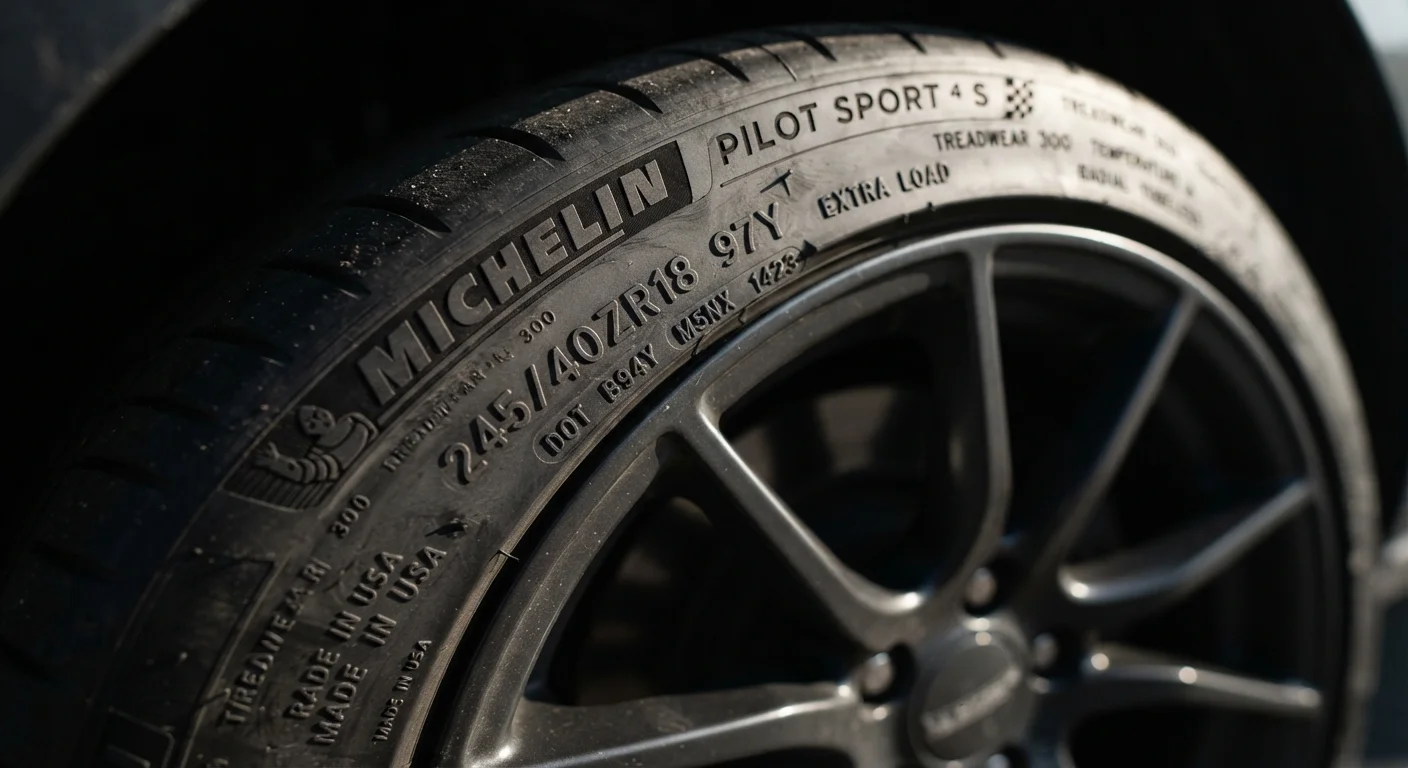
Breaking Down the Code: What Each Segment Means
Take a tire marked P215/65R17 98H. That string contains at least six distinct pieces of information. Here's what each one tells you.
Service Type (P, LT, ST, T)
The optional letter before the numbers indicates the tire's intended vehicle class. P stands for passenger vehicle. LT means light truck. ST is for special trailer use, and T denotes a temporary spare. Some tires carry no prefix - these are built to European "Euro-metric" standards and have slightly different load-capacity calculations.
Section Width - The First Number
The three-digit number (215 in the example) is the tire's section width in millimeters, measured across the tire's widest point when mounted on a specified rim. A wider number means more rubber contact with the road.
Aspect Ratio - After the Slash
The two-digit number following the slash (65) is the aspect ratio - the sidewall's height as a percentage of the section width. So a 215/65 tire has a sidewall height of about 140 mm (65% of 215). Lower aspect ratios (40, 45) mean shorter sidewalls, which generally improve cornering stiffness but can produce a harsher ride.
Construction Type - The Letter After Aspect Ratio
R stands for radial construction, which is the overwhelming standard for modern passenger tires. You may occasionally see D (diagonal/bias-ply) on older vehicles or specialty trailers.
Rim Diameter - The Last Number in the Size String
The number after the construction letter (17) is the rim diameter in inches. This must match your wheel exactly - a 17-inch tire cannot seat safely on a 16-inch or 18-inch rim.
| Standard tire code format | P215/65R17 98H (Tire Industry Association (TIA)) |
| Section width unit | Millimeters |
| Rim diameter unit | Inches |
| Tire age replacement guideline | 6-10 years from DOT date code (National Highway Traffic Safety Administration (NHTSA)) |
| DOT date code location | Last 4 digits of DOT string (week + year) (NHTSA) |
For related maintenance context, see our article on tire rotation, balancing, and alignment - three services that work in tandem with choosing the right tire.
Load Index, Speed Rating, and the DOT Code
Load Index
The number after the rim diameter (98 in our example) is the load index. Each number maps to a maximum weight capacity per tire. Index 98 equals 1,653 lbs. You should never install tires with a load index lower than your vehicle's door-jamb placard specifies - doing so risks structural tire failure under normal load conditions.
738
Pounds at load index 120
Load index numbers map to specific weight capacities; index 120 corresponds to 3,086 lbs - illustrating how dramatically ratings scale.
149 mph
Speed rating W maximum
According to standardized tire speed rating charts published by the Tire and Rim Association.
Speed Rating
The final letter (H) is the speed rating - a design specification indicating the maximum sustained speed the tire structure can handle. Common ratings include S (112 mph), T (118 mph), H (130 mph), V (149 mph), and W (168 mph). Downgrading your speed rating below the manufacturer's minimum is not recommended, even if you don't plan to drive at those speeds - the rating also reflects heat-management and structural design thresholds.
Always Match Your Vehicle's Specifications
Changing tire size, load index, or speed rating without consulting your vehicle owner's manual or a qualified tire professional can affect handling, speedometer accuracy, and load capacity. When in doubt, reference the placard found on your driver's door jamb - it lists the tire size your vehicle was engineered to use.
The DOT Code and Tire Age
Somewhere on the sidewall you'll also find a DOT code - a string beginning with "DOT" followed by a series of letters and numbers. The last four digits are the most actionable: the first two indicate the week of manufacture, and the last two indicate the year. A tire reading 2319 was made in the 23rd week of 2019. NHTSA recommends consulting your vehicle manufacturer's guidelines on tire replacement age, with many automakers suggesting replacement after six to ten years regardless of visible tread depth. Rubber degrades internally over time.
If your dashboard shows a tire pressure warning, see our guide on dashboard warning lights decoded to understand what action is needed. And just as you'd read a nutrition label to make informed food choices - see how nutrition labels work for a parallel look at decoding standardized information - your tire sidewall rewards a few minutes of attention with better-informed maintenance decisions.
Aspect Ratio
The ratio of a tire's sidewall height to its section width, expressed as a percentage. A lower number means a shorter sidewall and typically a firmer ride.
Load Index
A numerical code indicating the maximum weight a tire can safely support when properly inflated. Each number corresponds to a specific weight in pounds listed in a standardized chart.
Speed Rating
A letter code indicating the maximum sustained speed a tire is designed to handle safely under its rated load. It is a design specification, not a driving recommendation.
Section Width
The measurement in millimeters across the widest point of an inflated tire, from sidewall to sidewall, not including any raised lettering or trim.
Rim Diameter
The diameter of the wheel in inches that the tire is designed to fit. Matching this number exactly to your wheel is non-negotiable for safe mounting.
DOT Code
A government-required marking on every tire sold in the U.S. that includes the manufacturer identifier and a date code showing the week and year the tire was made.
The content on this site is for informational purposes only and is not a substitute for professional advice. Always consult a qualified professional for guidance specific to your situation.