

Our Verdict
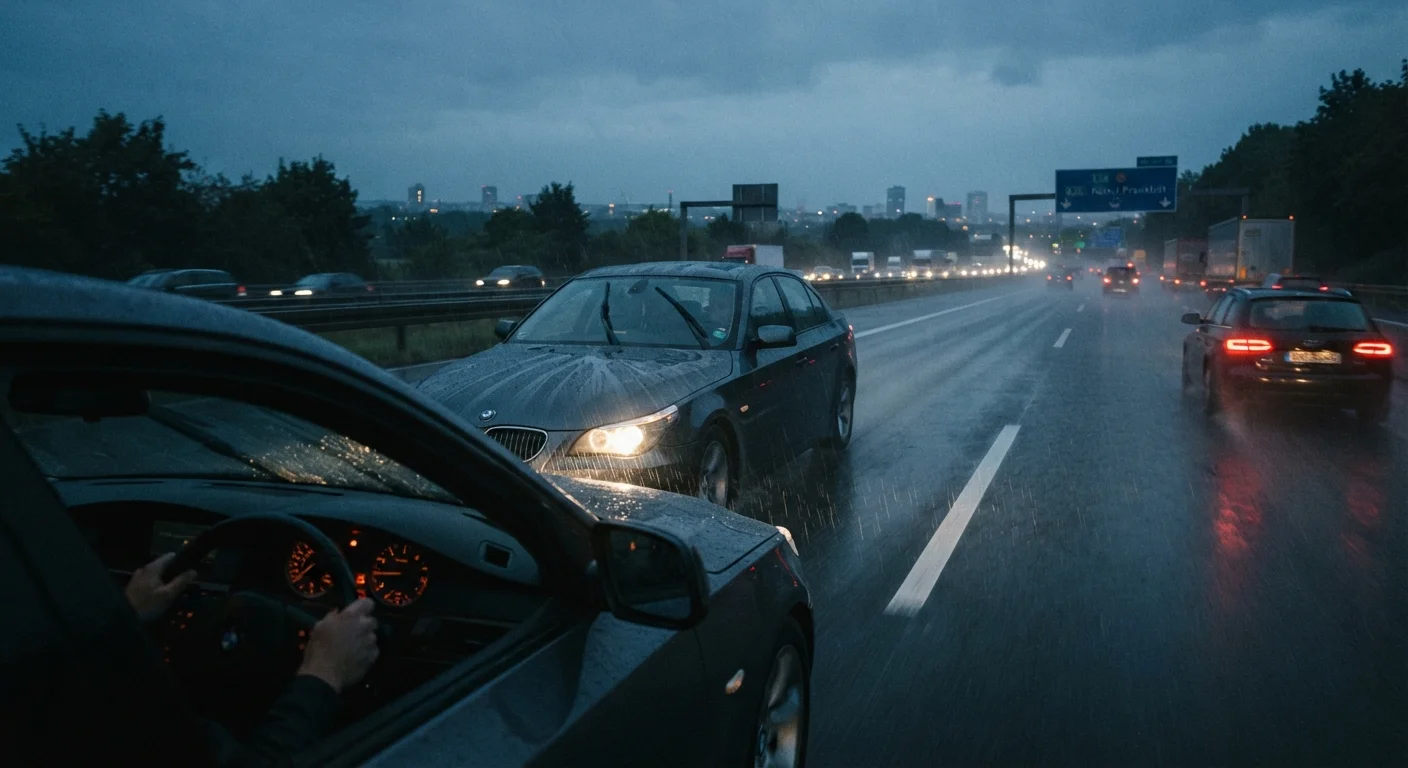
Rain, snow, and fog are fundamentally different hazards that reward different driving responses. Rain primarily attacks traction and visibility; snow and ice punish any abrupt vehicle input; fog strips away the reaction time you rely on to drive safely. Understanding what each condition actually does to your car — and to your ability to see and stop — is what allows you to adapt intelligently rather than simply slow down and hope for the best.
| Best for | Recommended |
|---|---|
| Drivers navigating wet roads and rain showers | Rain strategies: wider following gap, gentle braking, headlights on |
| Drivers facing winter snow and ice | Snow/ice strategies: feather inputs, low gears, know your ABS |
| Drivers caught in dense fog or low-visibility conditions | Fog strategies: low beams, reduced speed, increased spacing |
Why Weather Conditions Aren't Interchangeable Hazards
Many drivers treat any form of bad weather the same way: slow down a little, turn on the wipers, and proceed. That instinct is understandable but incomplete. Rain, snow, and fog each degrade a different aspect of driving — traction, vehicle control, and sight distance, respectively — and the countermeasures that help in one condition can be ineffective or even counterproductive in another.
The stopping distance your car requires changes dramatically in wet and frozen conditions. On dry pavement at 60 mph, a typical passenger vehicle needs roughly 300 feet to stop. Add rain, and that number grows. Add ice, and you may be looking at distances four to ten times longer than dry pavement. Understanding why each condition is dangerous helps you apply the right response instead of a generic one.
Before any drive in uncertain weather, a quick pre-trip check of your wipers, tires, and lights is one of the highest-leverage habits a driver can build.
| Rain | Snow / Ice | Fog | |
|---|---|---|---|
| Primary hazard | Reduced traction / hydroplaning | Near-total loss of friction | Severely limited sight distance |
| Recommended following distance | 4–5 seconds minimum | 10+ seconds on ice | Increase beyond normal; avoid tailgating taillights |
| Headlight setting | Low beams on | Low beams on | Low beams; fog lights if equipped |
| Braking approach | Smooth, early application | Slow, gradual; use ABS correctly | Early and progressive; avoid panic stops |
| Speed guidance | Below posted limit, especially in curves | Well below posted limit | Match speed to visible stopping distance |
| Cruise control | Avoid — complicates hydroplane recovery | Never use | Not recommended |
| Skid risk | Moderate, especially at highway speeds | High — any sharp input can trigger a skid | Low unless conditions are also wet or icy |
Driving in Rain: Traction Is the Core Problem
Water sitting on a road surface acts as a lubricant between your tires and the pavement. At highway speeds, tires can begin to ride on that film rather than grip the road — a phenomenon called hydroplaning. It can happen suddenly and without warning, and once your tires lose contact with the pavement, steering and braking inputs have almost no effect.
The primary rain adjustments are straightforward but must be applied consistently:
- Increase following distance to at least four to five seconds (double the typical dry-road standard), since wet braking distances are significantly longer.
- Reduce speed smoothly before turns and curves — not during them, when the weight transfer is already working against you.
- Turn headlights on any time wipers are running. Many states legally require it, and it dramatically improves your visibility to other drivers.
- Avoid cruise control in rain. If a tire begins to hydroplane, cruise control will try to maintain speed, making recovery harder.
If you feel the steering go light — a telltale sign of hydroplaning — ease off the accelerator gently, hold the wheel straight, and don't brake hard until you feel traction return.
Check Your Tire Tread Before Rainy Season
Tire tread depth is one of the most important factors in wet-weather grip. Worn tires dramatically increase hydroplaning risk because there are fewer channels to evacuate water from under the contact patch. The penny test — inserting a penny into the tread groove with Lincoln's head facing down — can tell you if tread depth has dropped to a point worth addressing. For serious wet-weather driving, dedicated all-season or rain tires with adequate tread depth make a measurable difference.
Driving in Snow and Ice: Gentle Inputs, Every Time
Snow and ice turn every vehicle input into a negotiation. Brake too hard and you lock the wheels. Accelerate too quickly and tires spin without grip. Turn the wheel too sharply and the front tires push wide in an understeer skid. The physics are unforgiving because friction between tire and road drops to a fraction of what it is on dry pavement.
The core principle for winter driving is deliberateness — every action should be slow and gradual:
- Brake early and gently. If your vehicle has ABS (anti-lock braking system), apply firm steady pressure and let the system pulse the brakes — do not pump the pedal manually. If it doesn't have ABS, brake with light, progressive pressure.
- Accelerate slowly from stops to prevent wheel spin. In deeper snow, starting in second gear (in a manual) or using a snow mode (in automatics so equipped) can help.
- Add far more following distance — ten seconds or more in icy conditions is not an exaggeration.
- Know your skid response. In a rear-wheel skid (oversteer), steer gently toward the skid. In a front-wheel skid (understeer), ease off the accelerator and let the front wheels regain grip before steering.
Four-wheel drive helps you move in snow — it does not help you stop. This is one of the most widely misunderstood aspects of winter driving. Treat stopping distance the same regardless of drivetrain.
Driving in Fog: Speed Must Match Sight Distance
Fog is uniquely deceptive. It creates an illusion of slow motion — objects appear farther away than they are, and your sense of speed becomes unreliable. The central danger is that you may be traveling faster than your ability to stop within the distance you can actually see.
The key fog-driving adjustments:
- Use low-beam headlights, not high beams. High beams reflect off the water droplets in fog and create glare that reduces visibility further. In thick fog, use fog lights if your vehicle has them.
- Reduce speed to match your sight distance. If you can see 200 feet ahead, you need to be able to stop within 200 feet — which at many highway speeds simply isn't possible.
- Use the road's edge or lane markings as a guide rather than the taillights of the car ahead, which can pull you dangerously close.
- Turn off distractions and open a window slightly — you may hear traffic you cannot see.
If fog becomes too dense to proceed safely, exit the road and pull well off the pavement. Staying on the shoulder of an active roadway in near-zero visibility is significantly more dangerous than stopping to wait out conditions.
Fog hazards share important characteristics with nighttime driving challenges. The habits that make night driving safer — managing speed relative to what you can see, reducing following distance complacency — apply directly to fog as well.
21%
Weather-related crash share
According to the U.S. Department of Transportation Federal Highway Administration, approximately 21% of all vehicle crashes are weather-related annually.
70%
Weather crashes on wet pavement
The FHWA reports that roughly 70% of weather-related crashes occur on wet pavement, making rain the most statistically common weather driving hazard.
4–10x
Stopping distance increase on ice
Transportation safety research consistently shows stopping distances can be four to ten times longer on ice compared to dry pavement, depending on speed and tire condition.
Building Weather-Adaptive Driving Habits
The gap between knowing these principles and consistently applying them under pressure is where most weather-related crashes occur. Familiarity with a road, time pressure, and underestimating conditions all erode the caution that adverse weather demands.
A few durable habits help close that gap:
- Check conditions before you leave, not just the forecast. Road temperature, recent precipitation, and local reports matter more than general weather predictions.
- Give yourself more time. Much of the risk-taking in bad weather is driven by schedule pressure. A built-in buffer eliminates the incentive to speed or follow too closely.
- Keep your vehicle prepared. Worn wiper blades, underinflated tires, and burned-out lights all amplify weather risks. Regular attention to basic vehicle maintenance is a direct investment in adverse-weather safety.
For a broader framework that ties these habits together, the complete guide to road safety habits and hazards covers how weather awareness fits into the full picture of risk reduction behind the wheel.
The content on this site is for informational purposes only and is not a substitute for professional advice. Always consult a qualified professional for guidance specific to your situation.