

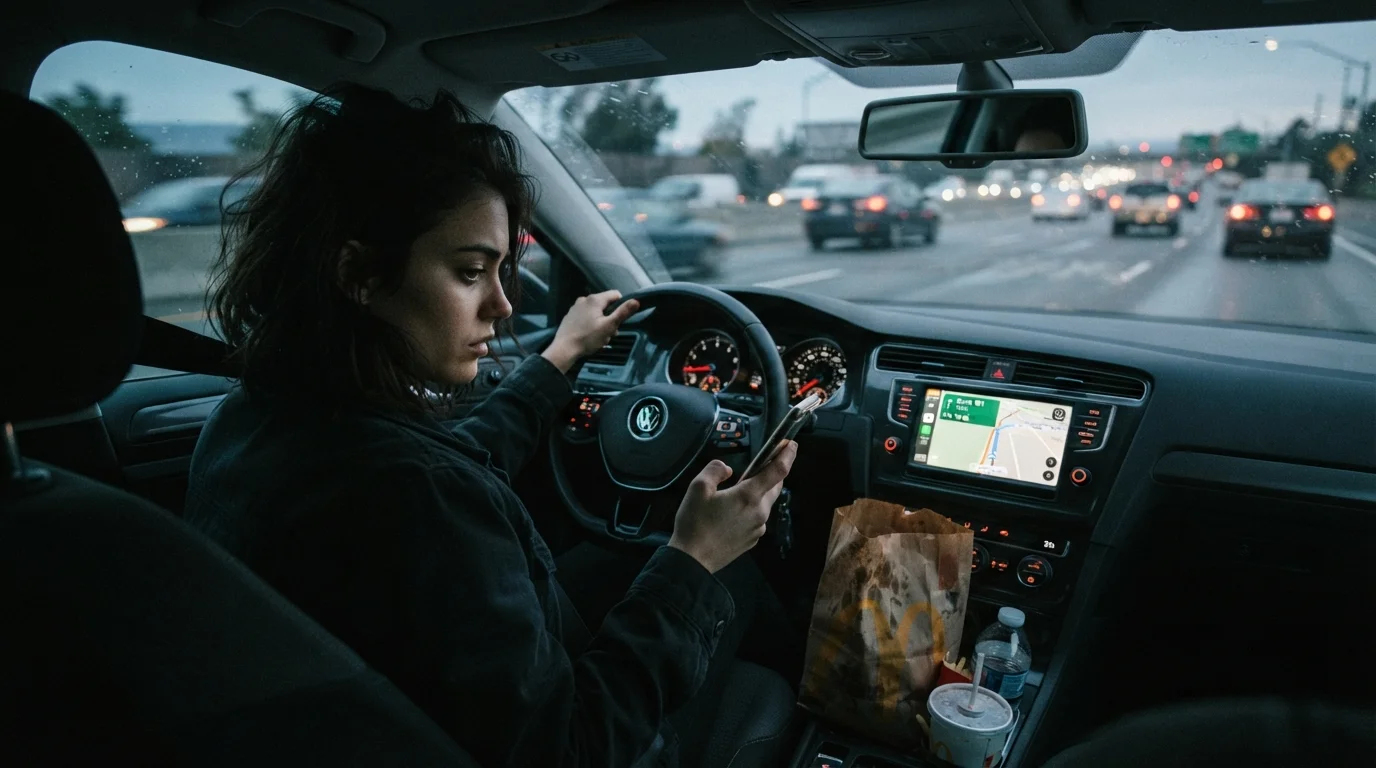
The Distraction Problem Is Bigger Than Your Smartphone
Public attention on distracted driving has rightly focused on smartphone use — texting and calling while driving remain serious hazards. But the scope of what genuinely pulls a driver's attention away from the road is much broader. Everyday habits and in-car conditions that feel ordinary can degrade driving performance in ways that aren't immediately obvious.
According to the National Highway Traffic Safety Administration (NHTSA), distracted driving claimed more than 3,000 lives in a recent reporting year. Phone use accounts for a significant portion of that — but a meaningful share involves the kinds of distractions most drivers never think to audit in their own behavior.
All Three Types of Distraction Matter
Distracted driving research generally identifies three categories: visual (eyes off road), manual (hands off wheel), and cognitive (mind off task). Many non-phone distractions — like eating, emotional stress, or infotainment interaction — involve more than one category simultaneously, which compounds their impact. Understanding this framework helps drivers recognize risks that aren't obviously "distracted driving" by conventional standards.
Part of what makes these distractions so persistent is that they don't feel dangerous. Eating a sandwich, adjusting a GPS route, or processing a stressful conversation can all happen while keeping two hands technically on the wheel — which gives a false sense of control. For a broader look at how hidden impairments compound behind the wheel, see our complete guide to road safety.
Six Overlooked Distractions That Deserve More Attention
In-Vehicle Navigation and Infotainment Systems
Modern touchscreen dashboards and GPS navigation are designed for convenience — but interacting with them while moving diverts eyes from the road for seconds at a time. Research from the AAA Foundation for Traffic Safety has found that some in-vehicle systems demand significant visual and cognitive attention, with certain tasks taking drivers' eyes off the road for more than 40 seconds cumulatively during a single interaction.
Even voice-controlled systems require cognitive load. A driver talking to their car's navigation is still mentally occupied — a form of distraction that doesn't disappear just because hands stay on the wheel. The safer approach is to enter destinations and adjust settings before driving, or pull over when a route change is genuinely necessary.
Entering a destination while moving can pull eyes from the road for 40 seconds or more.
Eating and Drinking While Driving
Grabbing a coffee or finishing lunch on the commute feels routine, but eating while driving is a well-documented manual and visual distraction. It removes at least one hand from the wheel, often demands a glance down, and can cause sudden reactions — like a spill — that create dangerous split-second distractions at the worst moments.
Spills and unwrapping food also tend to pull attention completely away from traffic for brief but critical windows. Even a two-second distraction at 55 mph covers the length of a football field. A consistent habit of finishing meals before or after a drive meaningfully reduces this exposure.
A two-second distraction at 55 mph means traveling nearly the length of a football field without full attention.
Passenger Conversations and Cabin Dynamics
Not all conversation is equal behind the wheel. Research has shown that talking with passengers can itself be distracting — though passengers have one advantage over phone callers: they can naturally pause and adjust the conversation when traffic demands it. The real risk rises with emotionally charged exchanges, backseat noise from children, or heated arguments.
Studies have found that driving performance degrades during intense conversations, even without any physical distraction. Younger drivers appear especially susceptible to peer-passenger influence — both in terms of distraction and risk-taking behavior. Keeping cabin dynamics calm, and not hesitating to ask for quiet during complex maneuvers, is a practical countermeasure. See our breakdown of driving safety myths for more on why hands-free and in-person conversation aren't as equivalent as many assume.
Emotionally charged conversations degrade driving performance even without any physical distraction.
Emotional and Cognitive Preoccupation
Driving angry, anxious, grieving, or deeply preoccupied with a personal problem is a form of cognitive distraction — sometimes called "driving while thinking." The mind's attention is a finite resource. When it's partially consumed by stress, rumination, or strong emotion, less is available for anticipating hazards, reading traffic patterns, or responding quickly.
This is related to the same cognitive load challenges documented in drowsy driving. As our article on how fatigue changes your driving notes, impairment doesn't always feel obvious from the inside — and emotional distraction follows the same pattern. If you're in a genuinely distressed mental state, delaying a trip or arranging alternate transportation is a legitimate safety decision.
Emotional preoccupation diverts cognitive resources from driving in ways the driver rarely notices in real time.
External Distractions: Crashes, Billboards, and Rubbernecking
The road environment itself generates distractions. Digital billboards, roadside accidents, and unusual events draw visual attention away from the path of travel. Rubbernecking — slowing to look at a crash — is a leading secondary cause of traffic backups and follow-on collisions. The visual pull is involuntary for most people, but drivers can counter it by consciously returning focus to the lane ahead and maintaining appropriate following distance.
High-stimulation environments — dense urban corridors, festival routes, construction zones — multiply these external demands. Reducing speed, increasing following distance, and limiting in-vehicle distractions in these settings provides a meaningful safety buffer. See also why tailgating is more dangerous than most drivers admit for context on how reduced reaction time compounds in close-following situations.
Rubbernecking is a leading cause of secondary collisions near crash scenes — and the pull is largely involuntary.
Overreliance on Driver Assistance Technology
Adaptive cruise control, lane-keep assist, and automated emergency braking are genuine safety tools — but they carry a less-discussed risk: automation complacency. When drivers believe a system is managing the vehicle, attention drifts faster and more deeply than it would otherwise. This is particularly dangerous because these systems have defined operational limits that drivers may not fully understand.
As explored in our guide to driver assistance technologies, these features are designed to assist, not replace, a fully attentive driver. Relying on them as a license to mentally disengage is itself a form of distraction with real crash risk attached.
Automation complacency — trusting a system too completely — is an emerging and underappreciated distraction risk.
Build a Pre-Drive Routine to Clear Distractions
Before moving, set your navigation, adjust mirrors, secure loose items, and finish any food or drink. A 90-second pre-drive reset significantly reduces the temptation to multitask once underway. Treat it the same way pilots treat pre-flight checklists — small effort, meaningful payoff.
Staying Aware Is the First Step Toward Staying Safe
The common thread across all six distractions above is that they feel normal — even responsible in some cases. Using navigation seems helpful. Eating on a long drive seems practical. These judgments aren't wrong in isolation, but they underestimate how much cognitive and visual bandwidth driving actually demands, especially at highway speeds, in heavy traffic, or in reduced-visibility conditions. Our article on night driving safety illustrates how quickly multiple small factors combine into serious risk.
Recognizing which habits qualify as distraction — not just the ones that show up in public safety campaigns — is where meaningful behavior change starts. No technology, law, or vehicle safety feature eliminates the need for an attentive driver.
This article is for general informational and educational purposes only. It does not constitute legal, medical, or professional safety advice. Drivers should consult applicable local traffic laws and qualified professionals for guidance specific to their circumstances.
The content on this site is for informational purposes only and is not a substitute for professional advice. Always consult a qualified professional for guidance specific to your situation.