

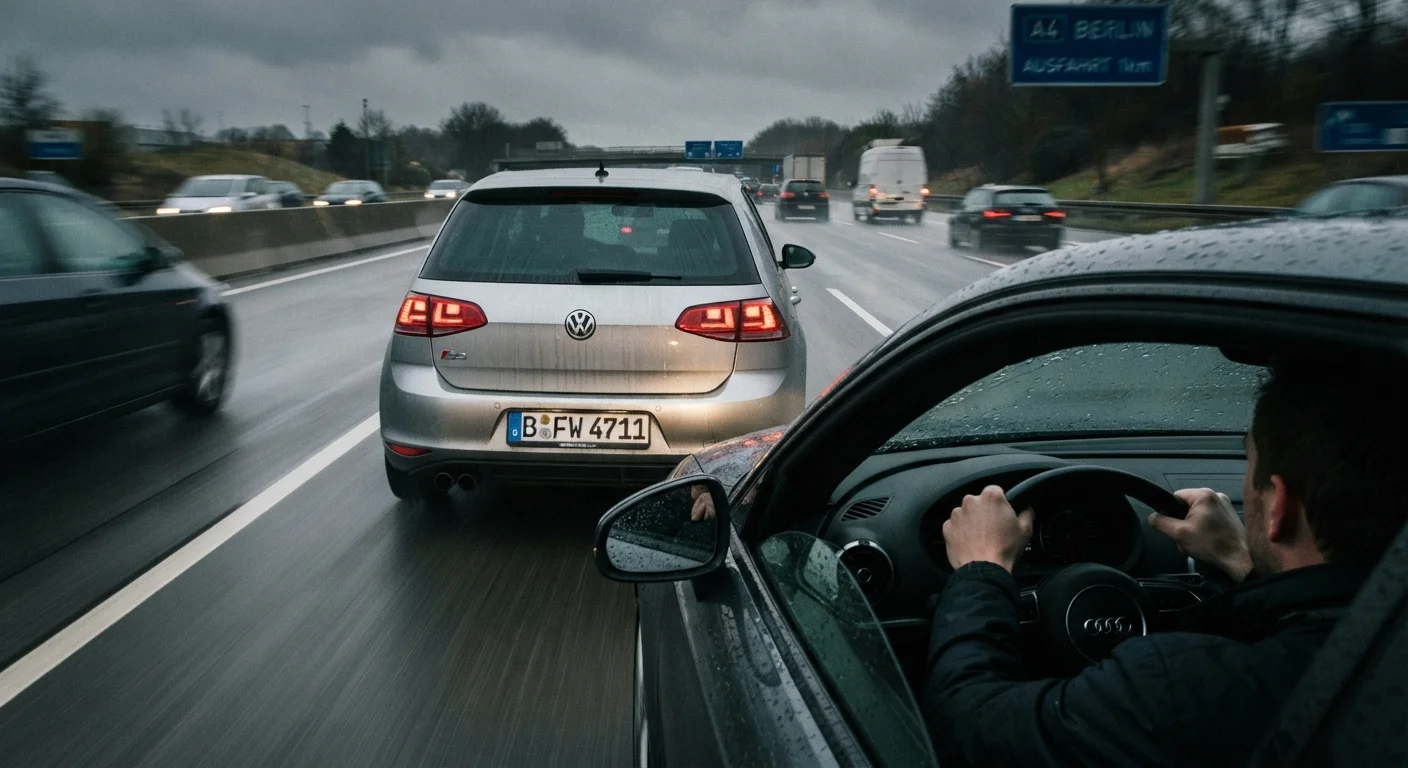
The Physics That Make Tailgating So Risky
Tailgating feels low-stakes until it suddenly isn't. The physics explain why the margin for error collapses so quickly. At 60 mph, your vehicle is covering 88 feet every second. A following distance of one car length — roughly 15 feet — gives you less than 0.2 seconds before contact if the driver ahead brakes hard. By the time your brain registers the brake lights, transmits a signal to your foot, and your foot reaches the pedal, you have already consumed time you did not have.
Understanding stopping distance is foundational here. It is not just braking distance — it includes perception time, reaction time, and then the mechanical process of slowing the vehicle. Our article on stopping distance and what affects it breaks this down in detail and is worth reviewing alongside this piece.
29%
of all U.S. traffic crashes that are rear-end collisions
According to NHTSA data, rear-end crashes consistently represent roughly one in three collisions on American roads each year.
3–4 sec
Minimum recommended following distance at highway speeds
Traffic safety experts generally recommend at least a three-second gap in ideal conditions, with four or more seconds advised in poor weather or heavy traffic.
Road conditions compound every one of these factors. Wet pavement, worn tires, and loaded vehicles all extend the distance your car needs to stop — yet most drivers do not expand their following gap to match. This is one of the most consequential and underappreciated mismatches in everyday driving behavior.
Wet and Icy Roads Make Tailgating Far Worse
Stopping distances can double or triple on wet pavement and increase even more dramatically on ice or packed snow. A following distance that feels adequate on a dry summer day may be dangerously insufficient in rain or freezing temperatures. Always expand your gap well beyond the standard three-second rule when conditions deteriorate.
Common Tailgating Mistakes and How to Correct Them
Most tailgating is not malicious — it is the product of poor habits, distorted self-assessment, and a general failure to internalize stopping physics. The mistakes below represent the patterns that appear most consistently in crash data and driver behavior research.
Assuming your reaction time is fast enough to compensate for a short following distance.
Why it happens: Drivers tend to overestimate their own reflexes, especially on familiar routes where the road feels predictable.
Maintaining highway following distances in urban stop-and-go traffic without adjustment.
Why it happens: Drivers often apply a one-size-fits-all gap regardless of traffic flow, speed changes, or density of surrounding vehicles.
Following just as closely in rain, fog, or darkness as in clear daytime conditions.
Why it happens: Habit and routine lead many drivers to operate on autopilot, keeping a fixed gap without adjusting for changed stopping physics.
Using tailgating as a pressure tactic to make a slower driver move over.
Why it happens: Frustration with perceived slow traffic can cause drivers to unconsciously or deliberately close the gap to signal impatience.
Not accounting for the vehicle's load, size, or tire condition when choosing a following distance.
Why it happens: Drivers often calibrate distance based on their general experience, without considering how a heavy load or worn tires extend stopping distances.
Tailgating Is a Leading Crash Cause
Rear-end collisions are among the most common crash types on U.S. roads, and following too closely is a primary contributing factor. The National Highway Traffic Safety Administration (NHTSA) consistently identifies rear-end crashes as responsible for a significant share of traffic fatalities and injuries each year. Closing the gap between vehicles is one of the highest-impact steps any driver can take to reduce crash risk.
It is also worth noting that distracted driving and tailgating frequently occur together — a driver whose attention is split has even less chance of reacting in the limited window a short following distance provides. Eliminating one risk makes addressing the other more effective.
Building Better Following-Distance Habits
Correcting tailgating is primarily a habit change, and habits respond to deliberate, consistent practice. The three-second rule is the most practical baseline: choose a stationary object ahead, watch the car in front pass it, then count. If you reach that marker before reaching three seconds, you are too close. In adverse conditions, extend to four, five, or six seconds without negotiation.
Beyond the counting method, positioning awareness helps. Keep your eyes scanning well ahead — not just at the bumper immediately in front of you. When you see brake lights two or three cars ahead, you have a head start. This forward scanning habit is part of the broader situational awareness covered in our complete road safety guide.
Finally, managing your own stress behind the wheel matters. Running late, frustration with traffic, and emotional tension all erode the patience that safe following distance requires. Leaving earlier, accepting that other drivers will move at their own pace, and recognizing that no amount of pressure applied through a gas pedal will meaningfully change your arrival time — these are the mindset shifts that translate into safer spacing on the road.
For a broader look at pre-trip habits that set you up for safer driving, see our pre-trip safety checklist.
The content on this site is for informational purposes only and is not a substitute for professional advice. Always consult a qualified professional for guidance specific to your situation.