

Our Verdict
The glycemic index offers genuine insight into how different carbohydrates affect blood sugar, and using it as one lens among many can support smarter food choices. However, its limitations — including ignoring portion size, food combinations, and individual variation — mean it works best as a rough guide rather than a rigid rulebook. Pairing GI awareness with attention to overall diet quality, fiber intake, and meal composition gives a far more complete picture.
Best for people who want a foundational framework for understanding carbohydrates and blood sugar, particularly those managing or working to prevent blood sugar imbalances under a healthcare provider's guidance.
What the Glycemic Index Actually Measures
The glycemic index (GI) is a numerical scale from 0 to 100 that ranks carbohydrate-containing foods by how rapidly they raise blood glucose levels after eating. Pure glucose is the reference point at 100. Foods scoring 55 or below are considered low-GI; 56–69 is medium; 70 and above is high.
To generate a GI value, researchers feed a group of fasted volunteers a portion of a test food containing 50 grams of digestible carbohydrate, then measure blood glucose at regular intervals over two hours. The result is compared to the same volunteers' response to 50 grams of pure glucose. The average across participants becomes that food's GI score.
This makes GI a standardized, repeatable measure of carbohydrate quality — specifically, how quickly the carbohydrates in a food are digested and absorbed into the bloodstream. For anyone trying to understand the relationship between diet and blood sugar, that's genuinely useful foundational knowledge. To go deeper on how to read the broader nutrient picture on packaged foods, see our guide to nutrition labels.
Provides a standardized way to compare carbohydrate quality
GI gives consumers and clinicians a consistent, research-tested framework for distinguishing rapidly digested carbohydrates from slower-digesting ones, which is more informative than simply counting carbs.
Supports blood sugar management strategies
For people managing blood glucose levels, favoring lower-GI foods has been associated with more stable post-meal blood sugar responses, according to research reviewed by diabetes organizations.
Encourages attention to food processing levels
Because heavily refined foods tend to have higher GI values, using GI as a guide naturally nudges people toward whole, minimally processed foods — a pattern consistently associated with better health outcomes.
Backed by decades of peer-reviewed research
The glycemic index concept has been studied extensively since the 1980s, giving it a substantial scientific evidence base compared to many popular nutrition frameworks.
Where the Glycemic Index Falls Short
Despite its usefulness as a teaching tool, GI has real-world limitations that are easy to overlook.
It ignores portion size. GI is calculated from a fixed 50-gram carbohydrate serving, which may not reflect how much of a food you actually eat. Watermelon, for example, has a high GI but a typical serving contains relatively few carbohydrates overall — so its real-world blood sugar impact is modest. This is why researchers developed glycemic load (GL), which multiplies GI by the grams of carbohydrate in an actual serving and divides by 100, giving a more realistic estimate of impact.
It was measured in isolation. Most people don't eat plain boiled rice or white bread alone. Adding fat, protein, fiber, or acid (like vinegar or lemon juice) to a meal meaningfully slows carbohydrate absorption and lowers the combined glycemic response — something a single-food GI value cannot capture.
Individual responses vary widely. A landmark 2015 study published in Cell found that people's blood glucose responses to identical foods differed substantially based on factors including gut microbiome composition, body composition, and physical activity levels. Two people eating the same meal can have very different glycemic outcomes.
Cooking and ripeness matter. A ripe banana has a higher GI than an unripe one. Al dente pasta has a lower GI than fully cooked pasta. These real-world variables aren't reflected in standardized GI tables.
Ignores real-world portion sizes entirely
GI is always calculated from a fixed 50g carbohydrate serving regardless of typical portions, meaning a food's score can be misleading when the amount normally eaten differs significantly from the test portion.
Doesn't account for meal combinations
Adding fat, protein, or acid to a meal substantially lowers glycemic response, but GI values are measured for individual foods in isolation — making single-food scores a poor predictor of mixed-meal effects.
Individual blood sugar responses vary considerably
Research shows that people's glycemic responses to identical foods differ meaningfully based on gut microbiome, metabolic health, and activity level, limiting the universal applicability of any GI number.
Can mislead people away from nutritious foods
Nutritious, high-fiber foods like carrots and watermelon can appear problematic based on GI scores alone, potentially steering people away from foods that have a minimal real-world glycemic impact.
GI values shift with cooking, ripeness, and storage
The same food can have meaningfully different GI values depending on how it was prepared or how ripe it is — variability that standardized tables cannot capture.
Glycemic Load: A More Practical Companion
Glycemic load addresses the portion-size gap in GI. A GL of 10 or below is considered low, 11–19 is medium, and 20 or above is high. For most everyday eating decisions, thinking in terms of GL rather than GI alone gives you a more accurate sense of how a food will affect your blood sugar.
GI vs. Glycemic Load: A Quick Distinction
Glycemic index tells you how fast a food raises blood sugar; glycemic load tells you how much it raises blood sugar based on a realistic serving. Glycemic load is calculated by multiplying the GI by the grams of carbohydrate in a serving, then dividing by 100. A GL under 10 is considered low. For most practical dietary decisions, considering both values together is more informative than GI alone.
For example, carrots have a high GI (around 71), which has historically led some people to avoid them. But a standard serving of carrots contains so few digestible carbohydrates that their GL is very low — around 4. Avoiding nutritious, fiber-rich vegetables based on GI alone is one of the most common misapplications of this tool.
Fiber plays a central role in moderating glycemic response by slowing digestion and blunting glucose spikes. For a detailed look at why fiber matters and how to eat more of it, see our overview of dietary fiber.
How to Use GI Sensibly in Your Daily Diet
The glycemic index works best as one tool among several — not a rigid dietary framework. Here's how to apply it practically:
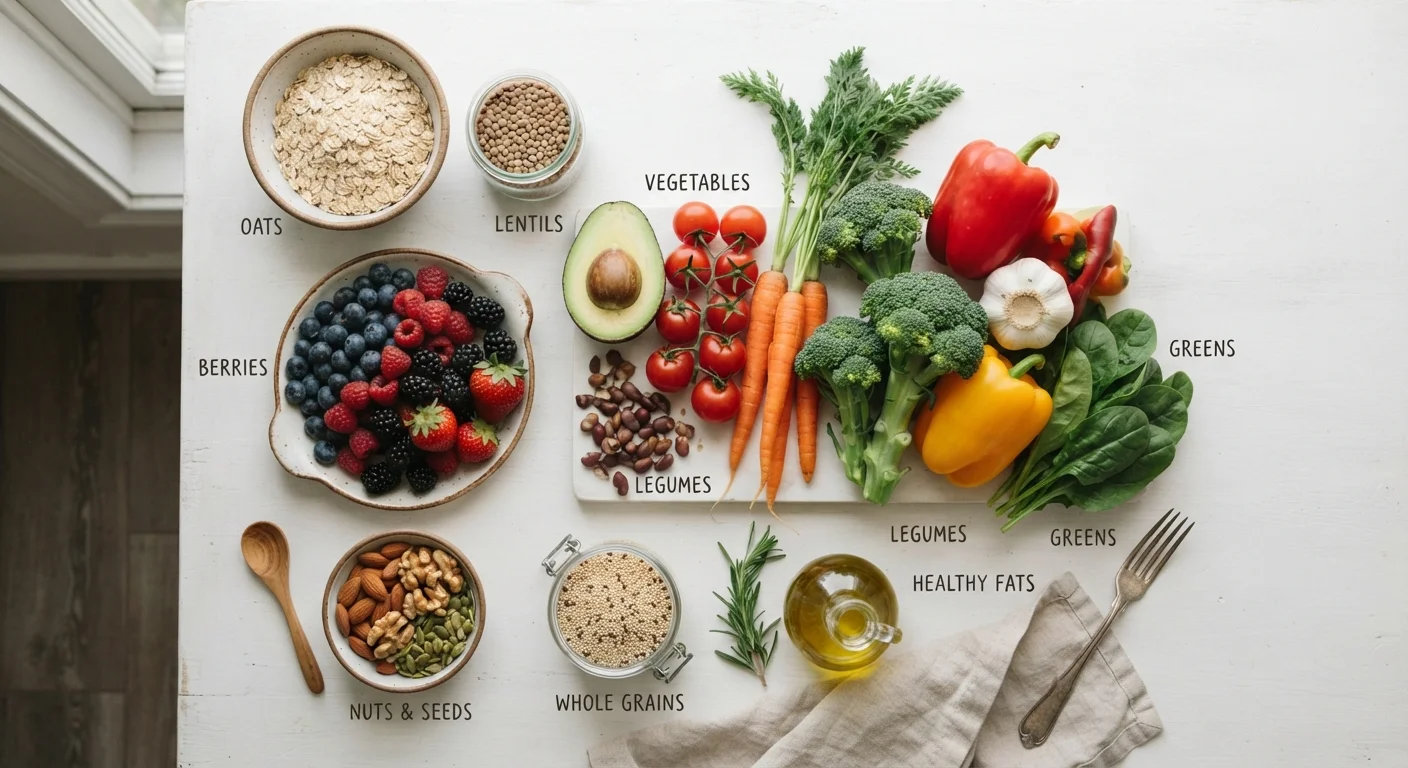
- Favor minimally processed carbohydrates. As a general pattern, whole grains, legumes, non-starchy vegetables, and most fruits tend to cluster in the low-to-moderate GI range and also deliver fiber, vitamins, and minerals.
- Consider the whole meal. Pairing a higher-GI food with protein, healthy fats, or fiber-rich vegetables will naturally reduce the combined glycemic response — no strict GI math required.
- Don't demonize high-GI foods categorically. Some nutritious foods (like certain root vegetables or ripe fruits) have moderate-to-high GI values but are also rich in micronutrients and fiber.
- Use GI to compare similar foods. Choosing whole-grain bread over white bread, or steel-cut oats over instant oats, are decisions where GI provides meaningful, practical guidance.
If you're working to separate evidence-based nutrition thinking from persistent food myths — including the idea that all high-GI foods are harmful — our nutrition myth-busting guide provides useful context.
~50%
Variation in glycemic response between individuals
A 2015 study in Cell demonstrated that blood glucose responses to identical foods varied by roughly 50% or more between individuals, driven largely by gut microbiome differences.
GI ≤ 55
Threshold for a low-GI food
Foods scoring 55 or below on the 0–100 glycemic index scale are classified as low-GI by the framework established by researchers at the University of Sydney.
This article is for general informational and educational purposes only and is not a substitute for personalized medical or dietary advice. If you have diabetes, prediabetes, or other conditions affecting blood sugar, consult a qualified healthcare professional before making significant changes to your diet.
The content on this site is for informational purposes only and is not a substitute for professional advice. Always consult a qualified professional for guidance specific to your situation.