

How Active Noise Cancellation Actually Works
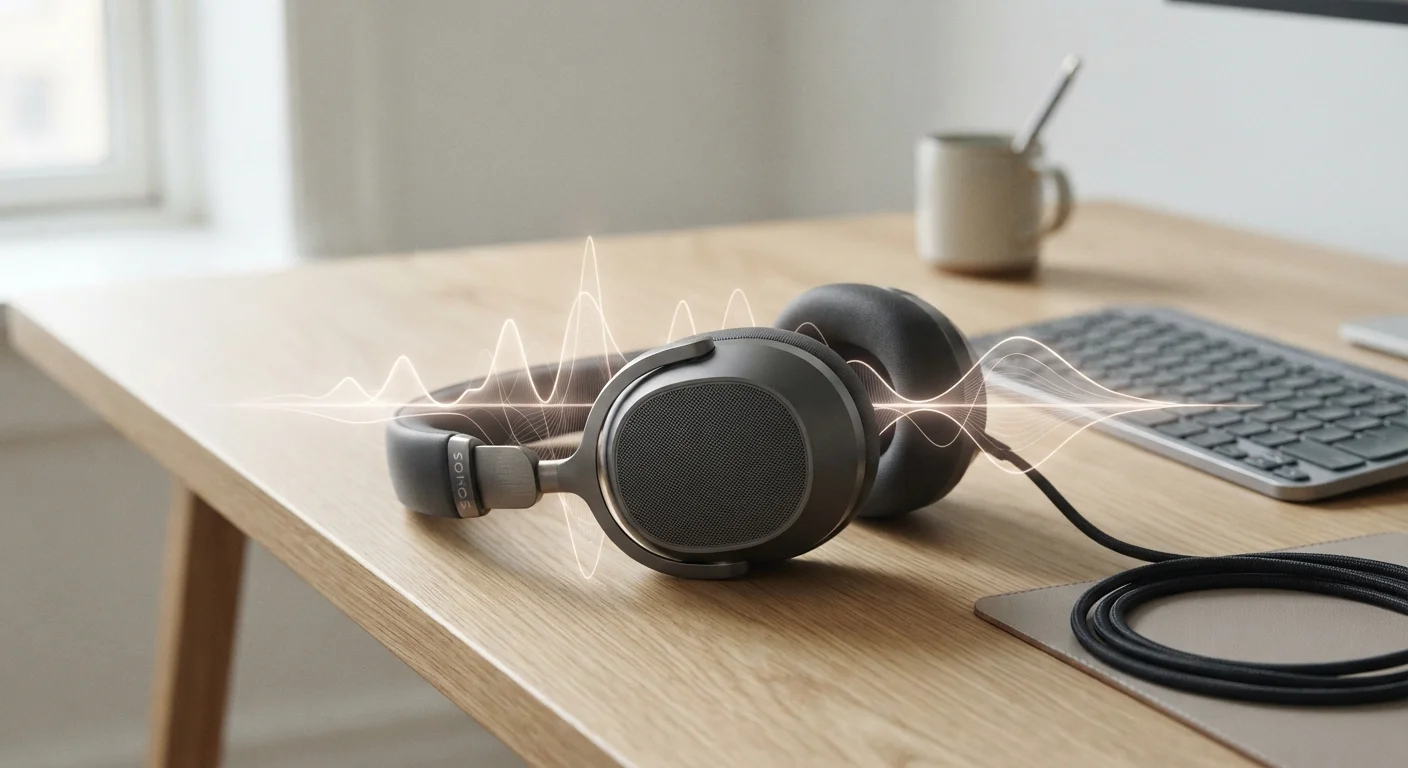
Active noise cancellation (ANC) relies on a physics principle called destructive interference. Tiny microphones on the headphone's exterior sample incoming sound, and an onboard processor generates an inverted — or "anti-phase" — copy of that waveform. When the two signals meet at your ear, they partially cancel each other out, reducing what you perceive as noise.
The operative word is partially. Because the processor must sample, invert, and replay sound in real time, the system works best on sounds that are predictable and repetitive — the drone of a plane cabin, the hum of an air conditioner, or the rumble of a train. These low-frequency, steady signals give the processor enough time to generate an accurate anti-phase response.
Understanding this mechanism helps set realistic expectations before you spend several hundred dollars. If you're hoping to disappear into silence during a loud open-plan office conversation, you'll be disappointed — that's a different problem, and one ANC is physically ill-suited to solve. For context on managing office noise more broadly, see practical acoustic control options for home workspaces.
Common Myths — and What the Physics Says
Marketing departments have had years to build impressive-sounding claims around ANC. Below, we examine the most persistent myths and correct them with what the underlying technology actually supports.
Myth
ANC headphones block out all background noise, creating total silence.
Fact
ANC reduces certain types of noise — it does not eliminate all sound, and significant background noise often remains audible.
Destructive interference is never perfectly complete. Real-world signals are irregular, and the processor's inversion is always an approximation. In practice, users typically experience a noticeable reduction in low-frequency drone, but voices, high-pitched sounds, and sudden noises pass through largely unaffected. "Total silence" is a marketing aspiration, not a physics outcome.
Myth
A higher decibel reduction number on the box means better ANC performance.
Fact
Published dB reduction figures are often measured under controlled lab conditions that don't reflect everyday environments.
Manufacturers typically test ANC attenuation using pure tones or standardized noise in an anechoic chamber. Real ambient noise — a coffee shop, a commuter train, a busy household — is far more complex and dynamic. A headphone rated at 30 dB attenuation in the lab may perform closer to 15–20 dB in realistic conditions, and the difference between competing products at similar price points is often smaller than the spec sheet implies.
Myth
ANC is just as effective on voices and high-frequency sounds as it is on engine noise.
Fact
ANC is fundamentally better suited to low-frequency, steady sounds; it offers minimal benefit against voices and transient high-pitched noise.
The processing chain requires time to sample, analyze, and invert incoming sound. High-frequency waves cycle too rapidly and voices are too unpredictable for the system to track accurately. This is why even premium ANC headphones don't eliminate a colleague speaking nearby. Passive isolation — the physical barrier of the ear cups — is what reduces those sounds, not the active electronics.
Myth
More expensive ANC headphones always perform better at cancelling noise.
Fact
Price correlates with build quality, audio tuning, and features — but not necessarily with ANC effectiveness alone.
Premium headphones often justify their cost through superior audio fidelity, comfort, codec support, and durability — not purely through ANC output. Independent acoustic measurements have repeatedly shown that mid-range headphones can match or outperform flagship models on raw noise attenuation, particularly in specific frequency bands. The right question is whether the ANC addresses the specific noise environment you face, not simply which product costs more.
Myth
Transparency mode and ANC are opposites — you use one or the other.
Fact
Transparency mode and ANC use the same microphone hardware; they are two different processing modes, not competing designs.
Many modern headphones use their external microphones to amplify and pass through ambient sound (transparency mode) as well as to cancel it (ANC mode). Both functions rely on the same physical components. Some devices also allow partial or adaptive ANC, blending attenuation and ambient awareness dynamically. Understanding this helps evaluate whether a device's microphone array is high quality — it affects both modes.
What Specs and Features Are Worth Scrutinizing
Beyond the myth-busting, there are a handful of measurable factors that do correlate with real-world performance.
20–500 Hz
Frequency range where ANC is most effective
Acoustics research consistently shows that active noise cancellation performs best in this low-frequency band, which covers engine drone and HVAC hum.
~10–20 dB
Realistic real-world noise reduction in many environments
Independent acoustic testing frequently finds real-world attenuation in this range, compared to higher figures cited in controlled manufacturer testing.
- Frequency range of attenuation: Look for documentation on which frequency bands a device targets. Broad low-frequency attenuation (roughly 20 Hz–500 Hz) is a reliable indicator of effective ANC for travel noise.
- Passive isolation rating: The physical seal of the ear cups matters enormously. A well-sealed over-ear design provides meaningful attenuation before ANC even activates.
- Processor latency and microphone count: More external microphones generally allow better environmental sampling, which helps the processor generate more accurate anti-phase signals.
- Battery life under ANC load: ANC draws additional power. A headphone with strong ANC but poor battery endurance may deliver the promised quiet only during a fraction of your workday.
If focus during remote work is your goal, it's also worth reading about common home office productivity myths — because silence alone does not automatically produce concentration.
Don't Rely on ANC for Hearing Safety
Some users listen at higher volumes assuming ANC has eliminated background noise, which can mask how loud their audio actually is. ANC reduces noise perception — it does not protect your hearing from the audio playing through the headphones themselves. Prolonged exposure to high playback volumes carries genuine hearing risk regardless of ANC engagement. Public health guidelines recommend keeping personal audio devices at moderate volume levels, especially during extended listening sessions.
The content on this site is for informational purposes only and is not a substitute for professional advice. Always consult a qualified professional for guidance specific to your situation.