

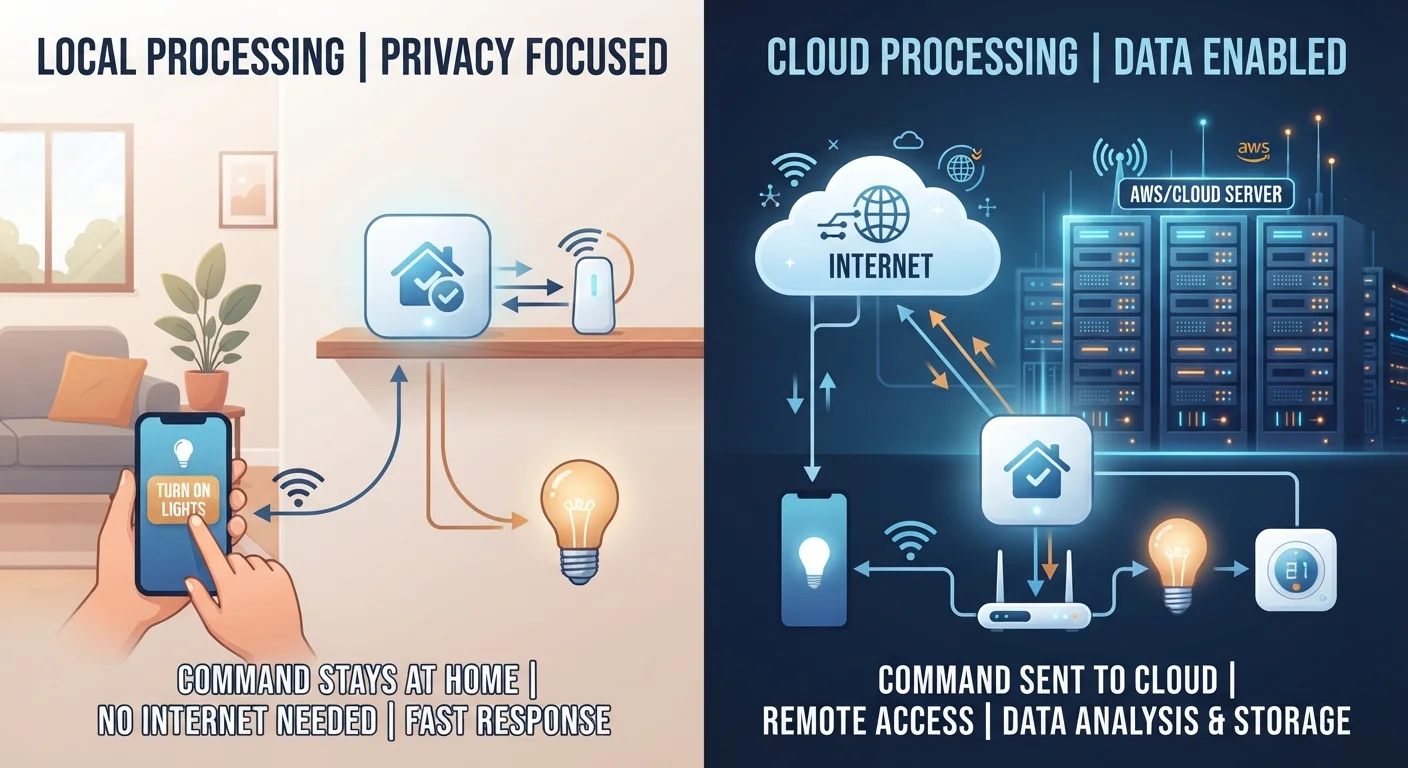
Option A
Local Processing
The self-contained, offline-capable approach.
Best for: Households that prioritize reliability, speed, and privacy over broad app integration.
Option B
Cloud-Dependent Processing
The connected, feature-rich, internet-reliant approach.
Best for: Users who want voice assistants, remote access, and frequent feature updates through cloud services.
What Does 'Processing' Actually Mean for a Smart Device?
When you tap a button in a smart home app or say a voice command, your device has to interpret that instruction and act on it. Where that interpretation happens is what separates local processing from cloud-dependent processing.
A locally processed device runs its logic on hardware inside your home — either on the device itself or on a local hub. The command never leaves your network. A cloud-dependent device sends your command to a remote server, processes it there, and relays the result back. This round trip typically takes only fractions of a second on a fast connection — but it requires a working internet connection at every step.
Understanding this distinction helps explain why some smart bulbs still turn on during an outage while others go completely dark. See our guide to why smart devices stop talking to each other for more on what causes these failures.
Head-to-Head: How They Compare
The practical differences between local and cloud-dependent smart devices span reliability, speed, privacy, and long-term usefulness. Here's how the two approaches stack up across the factors that matter most to everyday users.
| Criterion | Local Processing | Cloud-Dependent |
|---|---|---|
| Works without internet | Yes, by design | No, requires connectivity |
| Response speed | Milliseconds (on-device) | Varies with network quality |
| Data privacy | Stays on home network | Sent to third-party servers |
| Voice assistant support | Limited or none | Full integration typical |
| Remote access (away from home) | Requires extra setup | Built-in by default |
| Feature updates | Manual or infrequent | Automatic, over-the-air |
| Dependency on manufacturer | Lower — survives server shutdowns | High — service discontinuation affects use |
One often-overlooked factor is latency — the tiny delay between issuing a command and seeing a result. Locally processed devices typically respond in milliseconds. Cloud-dependent devices can feel equally snappy on a fast connection, but network congestion or server issues can introduce noticeable lag. For most lighting or music commands, this barely matters. For security triggers or time-sensitive automations, it may.
The Privacy Dimension
Cloud processing means your usage data — which lights you turned on, when you armed your system, how often you adjust your thermostat — travels to and is stored on a manufacturer's servers. That data is subject to the company's privacy policy, which can change over time.
Local processing keeps that behavioral data within your home network. It's not inherently immune to all risks (your router and connected devices can still have vulnerabilities), but the data doesn't leave your house by default. This is a meaningful difference for households that are privacy-conscious or cautious about data sharing.
What Happens If a Cloud Service Shuts Down?
Several smart home platforms have been discontinued, leaving cloud-dependent devices non-functional even though the hardware itself still works. Locally processed devices are generally immune to this risk — they don't rely on an external service to operate. When evaluating a cloud-dependent device, it's worth considering the maturity and stability of the platform behind it.
For a deeper look at connected home risks, our smart home security overview covers what your devices can and cannot protect against.
The Hybrid Reality: Most Devices Mix Both
The local vs. cloud distinction isn't always a clean binary. Many smart home platforms today use local fallback — the device handles basic commands locally but routes advanced features (like voice assistant integration or remote access) through the cloud. When the internet is available, you get the full experience. When it's not, core functions still work.
~30%
U.S. households with at least one smart home device
Estimates from industry research suggest roughly a third of American homes had adopted at least one smart home device as of recent years, with growth driven largely by voice assistant-connected products.
Seconds to minutes
Typical command delay during cloud congestion
During peak demand or server issues, cloud-routed commands can experience delays that feel significant compared to the near-instant response of locally processed alternatives.
Knowing how a device behaves in each mode before purchasing is worth the research. Check whether the manufacturer documents offline capabilities, and look for community reviews that specifically test behavior during outages.
If you're building out a larger system, the guide to building a smart home ecosystem explains how to avoid locking yourself into a single platform's cloud dependency. And before adding any new device, the honest checklist for smart home expansion is a practical place to start.
This article provides general educational information about smart home technology categories. Actual product behavior varies by manufacturer and model; always consult device documentation before purchasing.
The content on this site is for informational purposes only and is not a substitute for professional advice. Always consult a qualified professional for guidance specific to your situation.