

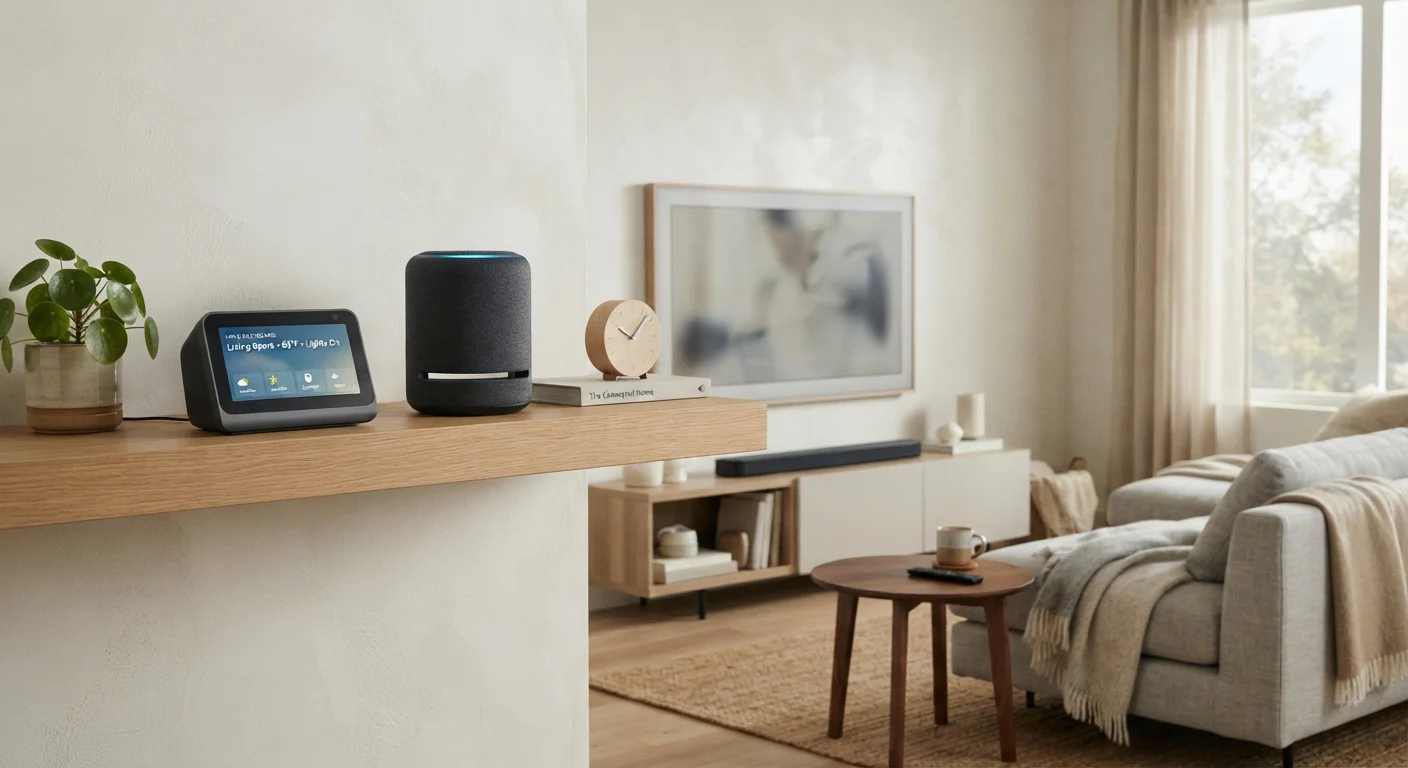
Option A
Smart Hub
The behind-the-scenes coordinator of your connected home.
Best for: Homeowners who want reliable, local device automation without depending on cloud services or voice commands.
Option B
Voice Assistant
The conversational, cloud-connected interface for quick commands.
Best for: Users who want hands-free convenience and easy control over individual devices using natural language.
The Core Distinction: Coordinator vs. Interface
When people new to smart home technology ask why their voice assistant can't run a complex automation, or why a hub doesn't respond when they speak to it, they've stumbled onto one of the most common points of confusion in connected home tech. These are two different tools solving two different problems.
A smart hub is the coordination layer. It connects disparate devices — lights, locks, thermostats, sensors — that might otherwise use incompatible wireless protocols such as Zigbee, Z-Wave, or Matter. The hub translates between these protocols and, critically, can execute automated rules: if the front door opens after 9 p.m., turn on the hallway light. Many hubs run this logic locally, meaning your home keeps responding even if your internet connection drops.
A voice assistant is an interface. It listens to natural language commands, sends them to cloud servers for interpretation, and routes instructions back to your devices. It's how you talk to your smart home — not how your smart home thinks. For a plain-language overview of how these concepts fit the broader picture, see what 'smart home' actually means.
| Criterion | Smart Hub | Voice Assistant |
|---|---|---|
| Primary function | Coordinates and automates devices | Interprets and relays voice commands |
| Processing location | Often local (on-device) | Cloud-dependent |
| Works without internet | Yes, for most automations | Generally no |
| Device protocol support | Zigbee, Z-Wave, Matter, and more | Relies on linked accounts or hubs |
| Automation complexity | High — multi-condition logic supported | Low — primarily single commands |
| User interaction | Runs silently in background | Responds to spoken commands |
| Setup complexity | Moderate to high | Low — plug in and speak |
Why the Confusion Happens — and Why It Matters
Voice assistant speakers are visible and vocal — they respond when spoken to, and their manufacturers market them heavily as the center of a smart home. Smart hubs, by contrast, tend to sit quietly in a closet or on a shelf, doing invisible work. That visibility gap leads many people to assume the assistant is the hub.
The practical consequences of this confusion can be real. If you rely entirely on a voice assistant for automation, every routine you've set up depends on that company's cloud servers staying online and available. Outages, policy changes, or a discontinued product can disrupt your entire setup. Hubs with local processing are more insulated from these risks.
~40%
Smart home users relying solely on voice assistants
Industry research has consistently found a significant share of smart home adopters use only voice assistants, with no dedicated hub for automation logic.
Local
Processing mode favored for reliability
Smart home professionals and enthusiast communities broadly recommend local processing hubs for setups where uptime and automation reliability are priorities.
Understanding each tool's actual role also helps you avoid buying redundant gear or blaming the wrong device when something doesn't work. If an automation fails when your internet is out, the issue likely isn't your hub — it's that your voice assistant was the one actually running the logic through the cloud. For a deeper look at assumptions that trip up new smart home owners, common smart home myths is worth reading alongside this article.
How They Work Together — and When You Need Both
In practice, the most capable smart home setups use a hub and a voice assistant as complementary layers. The hub manages device compatibility and runs automations based on conditions — time of day, sensor state, occupancy — without needing a spoken trigger. The voice assistant provides a natural, accessible way to fire commands on demand or adjust what the hub has already set up.
Think of the hub as the part of your home that acts without being asked, and the voice assistant as the part that listens when you do want to ask. Neither replaces the other. If you're building a setup from scratch and want to understand how these components fit together, The Connected Home from the Ground Up walks through all the foundational concepts before you commit to any hardware.
Once you understand the hub-vs-assistant distinction, the logical next step is exploring how automations, scenes, and routines differ from one another. Each term describes a different way of triggering smart home behavior — and mixing them up leads to setups that don't work the way you expect. Automations vs. Scenes vs. Routines explains each clearly. If any terms in this article are unfamiliar, the Smart Home Glossary covers the full vocabulary in plain language.
The content on this site is for informational purposes only and is not a substitute for professional advice. Always consult a qualified professional for guidance specific to your situation.