

Option A
HMO (Health Maintenance Organization)
The coordinated, cost-conscious structure.
Best for: People who want predictable costs and don't mind working through a primary care doctor to access specialists.
Option B
PPO (Preferred Provider Organization)
The flexible, wide-access alternative.
Best for: People who want the freedom to see specialists directly and occasionally use out-of-network providers.
What Each Plan Type Actually Does
When you enroll in a health plan, you're not just buying coverage — you're choosing a structure for how your care is organized and paid for. HMOs and PPOs are the two most common structures in the U.S. market, and they differ in three fundamental ways: how you access care, who pays for it, and how much flexibility you have. For a broader look at all plan types, see what HMO, PPO, EPO, and HDHP actually mean.
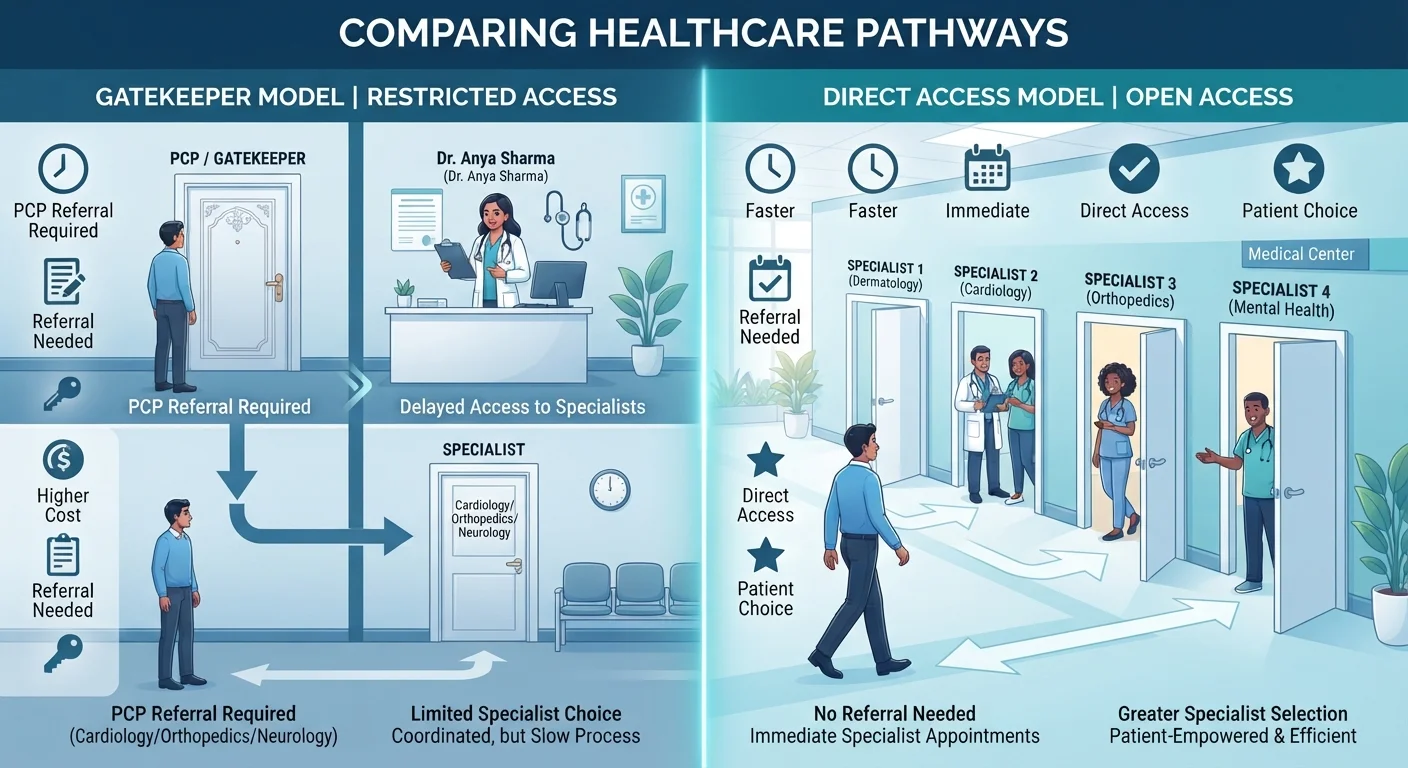
An HMO builds care around a designated primary care physician (PCP). That doctor manages your health overall and, when you need a specialist, provides a referral. Without that referral, most HMOs will not cover specialist visits. The network of providers is fixed, and care outside it is generally not covered except in emergencies.
A PPO removes the gatekeeper requirement. You can book a specialist appointment directly without a referral from anyone. You also have a broader network — and even outside that network, your plan will typically cover a portion of costs, though at a lower reimbursement rate. That added freedom comes with higher premiums and often higher deductibles. Understanding exactly how those numbers interact is essential; deductibles, premiums, and out-of-pocket maximums are the figures that define what any plan actually costs you.
Side-by-Side: Key Structural Differences
The table below compares HMOs and PPOs across the criteria that matter most to everyday consumers. Keep in mind that specific figures vary by insurer and plan tier — use these as directional guidance, not guarantees.
| Criterion | HMO | PPO |
|---|---|---|
| Primary care physician required | Yes — must designate a PCP | No — optional |
| Referrals needed for specialists | Yes — typically required | No — see specialists directly |
| Out-of-network coverage | Generally none (emergency excepted) | Partial — at higher cost-sharing |
| Monthly premiums | Lower | Higher |
| Deductibles | Often lower or none for in-network | Typically higher |
| Geographic flexibility | Limited to local service area | Broader — useful for travelers |
| Care coordination | Centralized through PCP | Self-directed by patient |
| Administrative complexity | Lower — referrals are structured | Higher — patient manages access |
For clarity on how copays and coinsurance work within either plan type, see copay vs. coinsurance. Those two cost-sharing mechanisms appear in both HMOs and PPOs but are structured differently depending on your plan.
The Real-World Trade-Offs
The premium gap between HMOs and PPOs is often the first thing people notice — HMO plans tend to carry meaningfully lower monthly costs. But the more important question is what that difference buys or costs you in practice.
~$100–$200
Typical monthly premium difference (HMO vs. PPO)
Industry surveys consistently show PPO premiums running meaningfully higher than HMO premiums for comparable coverage tiers, though exact gaps vary by market and employer.
49%
Share of covered workers enrolled in PPOs
According to the Kaiser Family Foundation's 2023 Employer Health Benefits Survey, PPOs remain the most common plan type among employer-sponsored coverage.
13%
Share of covered workers enrolled in HMOs
The same KFF 2023 survey found HMO enrollment at roughly 13% of employer-covered workers, reflecting PPOs' continued dominance in workplace plans.
With an HMO, the referral requirement isn't merely an administrative hurdle — it's a coordination mechanism. Your PCP tracks your full health picture, which can prevent duplicate testing and conflicting treatments. For people managing chronic conditions or multiple medications, this structure can genuinely improve care continuity. The trade-off is that if your preferred specialist is outside the network, you'll typically pay the full cost out of pocket.
With a PPO, you gain autonomy. You can book a dermatologist, cardiologist, or physical therapist on your own, without waiting for a referral. If you live in a rural area with limited in-network options, or you travel regularly, this flexibility has real practical value. The cost, however, is built into every monthly premium and surfaces again in higher deductibles. Review what premiums, deductibles, and copays actually mean if any of those terms are unclear before comparing specific plans.
How to Match the Structure to Your Situation
No plan type is objectively superior. The right fit depends on your health history, provider relationships, financial priorities, and how you use care. Ask yourself these practical questions before choosing:
- Do you have a specialist you see regularly? Confirm whether they are in-network for any plan you're considering. If they're out-of-network for an HMO, you'll pay full price.
- How often do you use healthcare? If your visits are infrequent, the lower HMO premium may save more than the PPO's out-of-network access earns you. If you need frequent specialist care, PPO coverage could offset its higher cost.
- Where do you live and work? HMO networks can be geographically narrow. If your job involves travel or you spend significant time in multiple states, a PPO's broader reach becomes more valuable.
- What's your financial cushion for surprises? PPOs typically have higher deductibles and out-of-pocket maximums. If an unexpected bill would cause financial strain, a predictable HMO structure may offer peace of mind.
If you're weighing these plan types through your employer or the ACA marketplace, the enrollment context also matters. See employer-sponsored insurance vs. marketplace plans for guidance on how those settings shape your options.
Network Verification Before Enrollment
Provider networks change annually. A physician or hospital that was in-network last year may not be this year — and vice versa. Before finalizing any plan, use the insurer's online directory to confirm that your specific doctors and facilities are currently in-network. Do not rely on a provider's office to confirm this on your behalf, as their information may lag behind insurer updates.
This article provides general educational information about health insurance plan structures and is not personalized insurance or financial advice. Coverage terms, network composition, costs, and rules vary by insurer, plan, and state. Always read your plan documents carefully and consult a licensed insurance professional before making enrollment decisions.
The content on this site is for informational purposes only and is not a substitute for professional advice. Always consult a qualified professional for guidance specific to your situation.