

Our Verdict
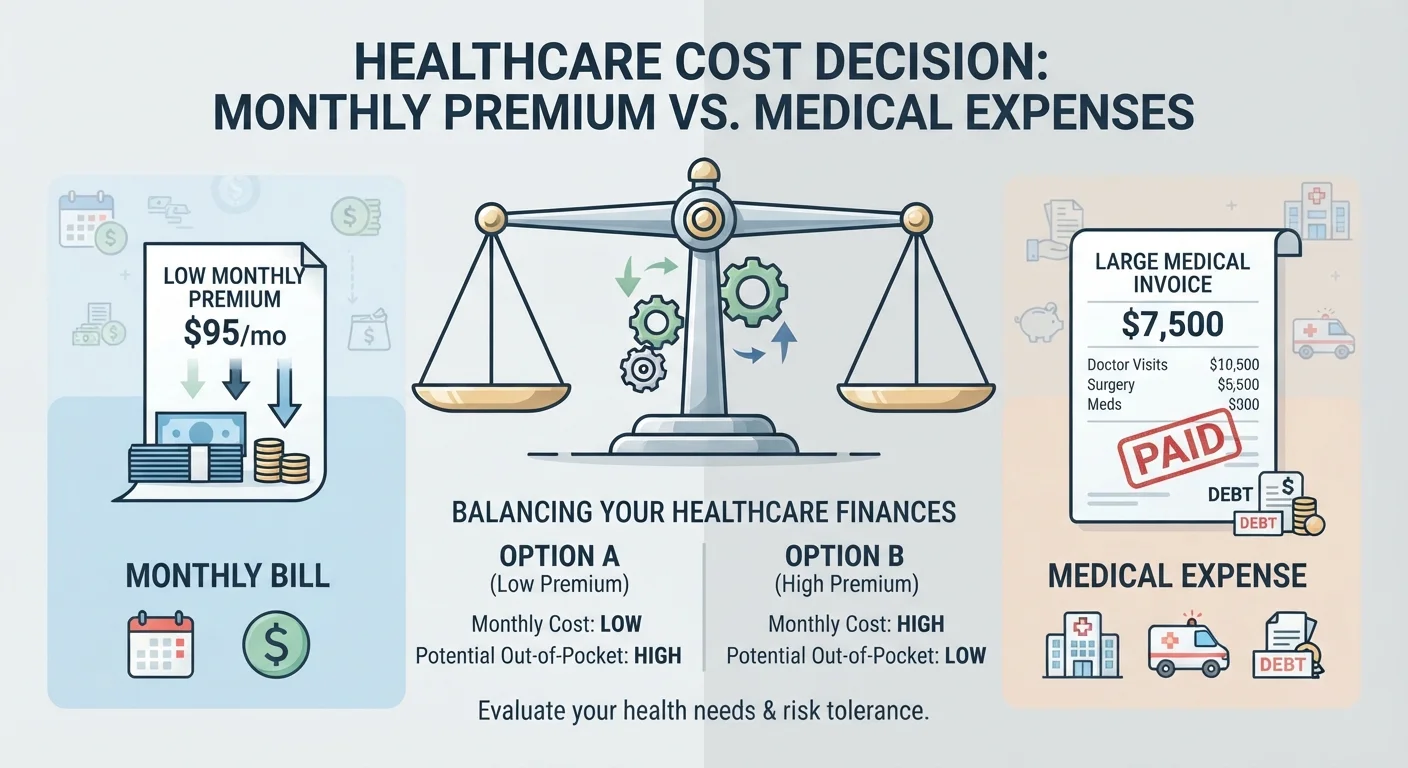
Higher deductibles are a legitimate strategy for reducing premium costs, but only when you have the savings to absorb a large out-of-pocket expense. For people who rarely file claims and maintain a financial cushion, the math often favors them. For those with frequent healthcare needs, chronic conditions, or limited emergency funds, the lower monthly cost can mask a much steeper real-world price.
Best for financially stable individuals in good health who have sufficient emergency savings and want to reduce monthly insurance costs.
What a Higher Deductible Actually Means
Your deductible is the amount you pay out of pocket before your insurance begins sharing costs. Choosing a plan with a higher deductible — say $3,000 instead of $500 — generally lowers your monthly premium in exchange. The insurer takes on less immediate risk, and that savings gets passed to you in the form of a smaller bill each month.
This trade-off is straightforward in theory, but it's worth understanding the mechanics clearly. As explained in our guide to premiums, deductibles, and copays, each of these figures plays a distinct role in your total cost of coverage. A deductible isn't a fee you pay regardless — it's a threshold you cross only when you file a claim.
High-deductible health plans (HDHPs) are formally defined by the IRS each year based on minimum deductible and maximum out-of-pocket limits. These plans often qualify holders to open a Health Savings Account (HSA), which adds a tax-advantaged layer to the equation. For auto and home insurance, the same logic applies: higher deductibles reduce premiums across the board.
IRS Thresholds Define 'High Deductible'
The IRS sets minimum deductible and maximum out-of-pocket limits each year to define what officially qualifies as a High-Deductible Health Plan (HDHP) for HSA purposes. These thresholds adjust annually. Check IRS.gov or your plan documentation to confirm whether your specific plan meets the current definition before assuming HSA eligibility.
The Case For: Where Higher Deductibles Make Sense
For the right person, choosing a higher deductible is a financially sound decision — not a corner-cutting one. Here's when the trade-off genuinely works in your favor.
Meaningfully lower monthly premium payments
Premium savings can be substantial — sometimes hundreds of dollars per month — freeing up cash for other financial priorities or savings contributions.
HSA eligibility adds tax advantages
Qualifying high-deductible health plans allow you to open a Health Savings Account, letting you contribute pre-tax dollars toward future medical expenses — a benefit unavailable with most low-deductible plans.
Efficient for low-utilization individuals
If you rarely file claims, you may go years without reaching your deductible, meaning you capture premium savings without ever bearing the higher out-of-pocket cost.
Encourages more cost-conscious healthcare decisions
When you're spending your own money up to the deductible threshold, you're more likely to compare costs, ask about generic medications, and avoid unnecessary services — behaviors that can reduce overall spending.
Can accelerate savings when combined with an HSA
HSA contributions roll over year to year and can be invested, building a tax-advantaged medical nest egg over time that offsets future high-deductible costs.
The central question is whether your annual premium savings exceed what you'd realistically pay out of pocket in a given year. Our article on how deductibles, premiums, and out-of-pocket maximums interact walks through exactly this break-even calculation.
The Case Against: When It Backfires
The risks of a high deductible are just as real as the benefits — and they hit harder when you're least prepared for them.
Large upfront cost when a claim actually occurs
A $4,000 deductible isn't hypothetical — it's real money you owe before insurance begins paying. Without savings set aside, a single unexpected illness or accident can become a significant financial burden.
Can deter necessary medical care
Research consistently shows that people with high deductibles delay or skip care to avoid costs, including preventive screenings and early-intervention appointments that could prevent more serious conditions.
Poorly suited to people with chronic conditions
If you regularly take prescription medications, see specialists, or manage an ongoing health issue, you're likely to hit your deductible every year — negating the premium savings and potentially costing more overall.
Premium savings may not offset deductible exposure
If the annual premium difference is $800 but your deductible is $3,000 higher, it takes nearly four claim-free years to break even — a gamble that doesn't always pay off.
Risk is amplified without an emergency fund
Choosing a high deductible without liquid savings to cover it is a common financial mistake. It creates a false sense of affordability based on the monthly premium alone.
It's also worth noting that the cheapest monthly premium often costs more over time once deductibles and coverage gaps are factored in. A low premium is only genuinely affordable if you can comfortably cover your full deductible without financial hardship.
~57%
Workers enrolled in high-deductible health plans
According to KFF's Employer Health Benefits Survey, more than half of covered workers in employer-sponsored plans were enrolled in a high-deductible or consumer-directed plan.
~40%
Americans who couldn't cover a $400 emergency
The Federal Reserve's Survey of Household Economics found that a significant share of U.S. adults would struggle to cover an unexpected $400 expense — a concerning overlap with high-deductible plan enrollment.
How to Decide: A Practical Framework
Before selecting a plan tier, work through these considerations honestly:
- Calculate your break-even point. Multiply the monthly premium difference between plans by 12. If the higher-deductible plan saves you $150/month, that's $1,800 annually. If the deductible difference is $2,500, you'd need to go nearly 17 months without a significant claim to come out ahead.
- Assess your actual health utilization. Look at your last two to three years of claims. If you rarely see a doctor beyond preventive care, a high-deductible plan likely suits you. If you manage a chronic condition or anticipate surgery, a lower deductible may cost less overall.
- Audit your emergency savings. A good rule of thumb: before choosing a high-deductible plan, have your full deductible amount sitting in a liquid savings account. If that's not realistic, you're taking on more risk than you may realize.
- Factor in HSA eligibility. If your plan qualifies, contributing to an HSA lets you set aside pre-tax dollars specifically for medical costs — effectively reducing the sting of that higher deductible. Review key policy concepts to understand how HSAs interact with HDHPs.
The same framework applies to auto and home insurance decisions. Explore coverage types to see how deductible choices vary across different insurance categories, and check hidden costs inside auto insurance policies for how deductibles play out in vehicle coverage specifically.
Also consider how your deductible and out-of-pocket maximum work together — because the deductible is only one part of your financial exposure.
This article is for general informational purposes only and does not constitute personalized financial, insurance, or legal advice. Coverage terms, costs, and eligibility vary by provider, plan, and state. Consult a licensed insurance agent or financial adviser before making coverage decisions.
The content on this site is for informational purposes only and is not a substitute for professional advice. Always consult a qualified professional for guidance specific to your situation.