

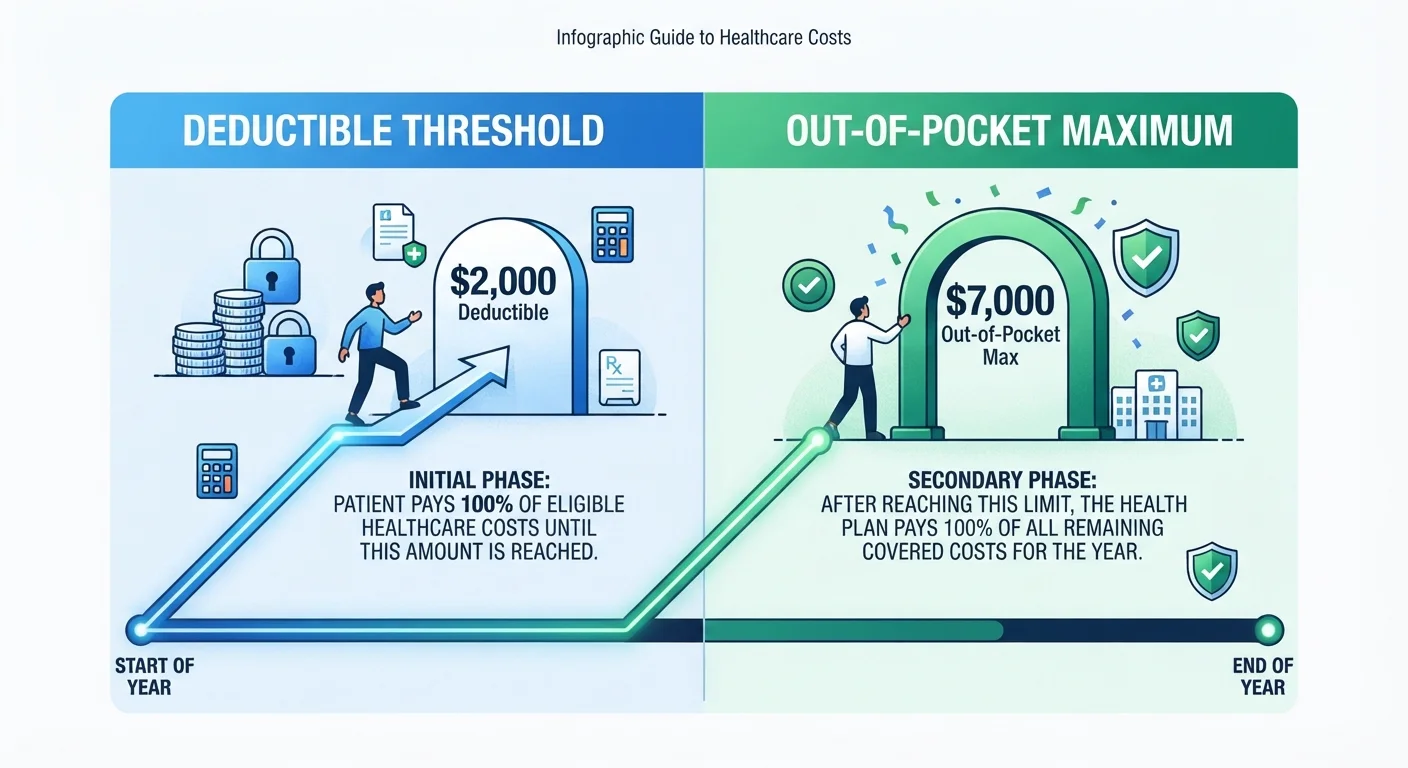
Option A
Deductible
The threshold you must clear before coverage truly kicks in.
Best for: Understanding what you pay first, out of your own pocket, before your insurer shares costs with you.
Option B
Out-of-Pocket Maximum
The annual ceiling that caps your total exposure.
Best for: Understanding the upper limit on what you'll ever owe in covered costs during a single plan year.
Two Limits, One Policy: Understanding the Difference
Health insurance policies contain several cost-sharing mechanisms, but two tend to cause the most confusion: the deductible and the out-of-pocket maximum. They both represent dollar thresholds you may cross during a plan year — but they serve completely different functions.
A deductible is the amount you pay for covered services before your insurance plan starts contributing. If your deductible is $1,500, you pay the first $1,500 of covered medical expenses yourself. After that point, your insurer begins sharing costs — typically through copays or coinsurance.
The out-of-pocket maximum (sometimes called the out-of-pocket limit) is a cap on the total amount you'll pay in covered costs within a single plan year. Once your spending reaches that ceiling — including what you paid toward your deductible, plus any copays and coinsurance after that — your insurer covers 100% of additional covered expenses for the remainder of the year.
For a broader foundation on these terms, see our guide to premiums, deductibles, and copays.
| Criterion | Deductible | Out-of-Pocket Maximum |
|---|---|---|
| What it represents | Amount you pay before insurer shares costs | Most you'll pay in covered costs per plan year |
| When it applies | At the start of covered spending | After deductible and ongoing cost-sharing are met |
| What happens after you reach it | Insurer begins sharing costs via copays/coinsurance | Insurer pays 100% of covered costs |
| Do premiums count toward it? | No | No |
| Does it include copays/coinsurance? | Usually no (varies by plan) | Yes — typically includes deductible + copays + coinsurance |
| Resets | Each plan year | Each plan year |
| Relative size | Always lower than out-of-pocket maximum | Always equal to or higher than the deductible |
How They Work Together: A Step-by-Step View
Think of these two thresholds as sequential stages in your annual cost exposure:
- Before the deductible: You pay 100% of covered medical costs out of pocket.
- After the deductible, before the out-of-pocket maximum: Your insurer begins paying its share. You continue paying copays and/or coinsurance on covered services.
- After the out-of-pocket maximum: Your insurer pays 100% of covered costs for the rest of the plan year.
One critical detail: your premium — the monthly amount you pay to maintain coverage — does not count toward either threshold. Neither do costs for services your plan doesn't cover, or amounts above what your insurer considers the allowed cost for a service. Only spending on covered services, counted by your insurer, moves you toward either limit.
$9,450
ACA out-of-pocket maximum for individual plans
For plan years 2024, the ACA sets the out-of-pocket maximum for individual marketplace plans at $9,450, per the U.S. Department of Health and Human Services.
$1,500–$3,000
Typical individual deductible range
Individual deductibles on employer-sponsored plans commonly fall in this range, according to the Kaiser Family Foundation's annual Employer Health Benefits Survey.
It's also worth knowing that the out-of-pocket maximum is always equal to or greater than the deductible. They cannot logically be reversed — you must cross the deductible threshold first before any spending counts toward the maximum in the same category.
To understand how these figures interact with your overall coverage structure, see how deductibles, premiums, and coverage limits connect.
Common Misconceptions — and Why They Matter
Several misunderstandings repeatedly trip up policyholders:
Family Plans Have Two Sets of Thresholds
On family health plans, there are typically both individual and family-level deductibles and out-of-pocket maximums. An individual family member may reach their personal deductible before the family deductible is met, triggering cost-sharing for that person while others are still in their deductible phase. Plan documents will specify exactly how these embedded thresholds work, and they can vary significantly between plans.
- "Once I hit my deductible, I'm done paying." Not true. You still pay copays or coinsurance on covered services until you reach the out-of-pocket maximum.
- "The out-of-pocket maximum covers everything." It only applies to covered services under your plan. Out-of-network care, non-covered services, and balance billing from providers may not count.
- "My deductible and out-of-pocket maximum reset when I change jobs." Generally, yes — plan years are fixed, and switching plans mid-year typically resets both clocks, though specifics vary by plan and circumstances.
Understanding these distinctions directly affects how you plan for medical expenses. Someone who incorrectly assumes their out-of-pocket exposure ends at the deductible may be unprepared for the coinsurance charges that follow. Conversely, knowing your out-of-pocket maximum gives you a reliable worst-case budget figure for any given plan year.
For related cost-sharing mechanics, see how copays and coinsurance work differently — both contribute to your out-of-pocket maximum but operate by different rules. It's also useful to understand that policy-level coverage caps work differently from personal cost limits; understanding policy limits completes that picture.
This article provides general educational information about insurance concepts and is not personalized financial, legal, or insurance advice. Coverage terms, thresholds, and rules vary by plan and provider. Always read your actual policy documents and consult a licensed insurance professional for guidance specific to your situation.
The content on this site is for informational purposes only and is not a substitute for professional advice. Always consult a qualified professional for guidance specific to your situation.