

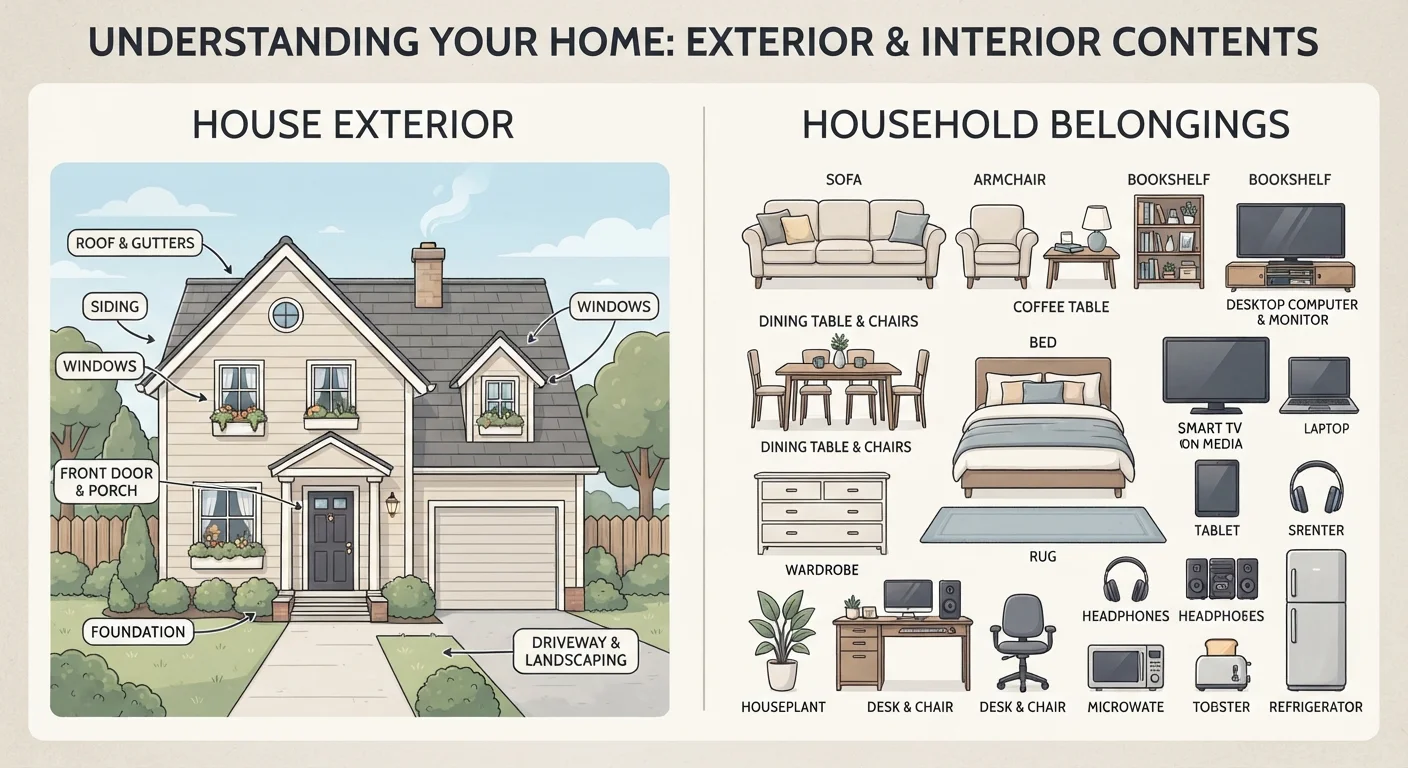
Option A
Dwelling Coverage
The protection built around your home's physical structure.
Best for: Homeowners who need to cover the cost of repairing or rebuilding the house itself after a covered loss.
Option B
Personal Property Coverage
The protection that follows your belongings inside and sometimes outside your home.
Best for: Anyone who wants financial protection for the contents of their home — furniture, clothing, electronics, and more.
What Each Coverage Actually Protects
When you buy a homeowners insurance policy, you're not purchasing one blanket protection — you're buying several distinct coverage components packaged together. Two of the most fundamental are dwelling coverage and personal property coverage, and they protect entirely different things.
Dwelling coverage (often called Coverage A in standard policy language) pays for physical damage to the structure of your home — the walls, roof, foundation, built-in appliances, and permanently attached fixtures. If a windstorm tears off your roof or a fire guts your kitchen, dwelling coverage is what funds the reconstruction. It also typically extends to attached structures like a garage or a covered porch.
Personal property coverage (Coverage C) protects the contents you own — your furniture, clothing, electronics, kitchenware, and similar movable items. If those same possessions are destroyed in that kitchen fire, or stolen during a burglary, personal property coverage responds.
Understanding what each covers is the foundation of reading your policy clearly. For a broader primer on how coverage works, see what coverage actually means in an insurance policy.
| Criterion | Dwelling Coverage | Personal Property Coverage |
|---|---|---|
| What it protects | The home's physical structure and attached features | Movable belongings and contents inside the home |
| Standard policy label | Coverage A | Coverage C |
| Who needs it | Homeowners only | Homeowners and renters alike |
| How limits are set | Based on rebuild cost of the structure | Often a percentage of dwelling limit; adjustable |
| Sublimits on certain items | Not typically applicable | Yes — jewelry, art, collectibles often capped |
| Common settlement basis | Often replacement cost value | Often actual cash value; RCV available |
| Applies off-premises | No | Sometimes — theft away from home often covered |
Key Differences That Matter at Claim Time
The distinction between these two coverages becomes critical the moment you file a claim. Several practical differences shape how each pays out.
Coverage Limits Are Set Separately
Your dwelling limit should reflect the estimated cost to rebuild your home from the ground up — not its market value, which includes land. Personal property limits are typically set as a percentage of your dwelling limit (often 50–70%), but you can adjust that figure. If your belongings exceed that default percentage, you may be underinsured without realizing it.
Settlement Method Differs by Component
Both coverages can be written on either an actual cash value (ACV) basis — which deducts for depreciation — or a replacement cost value (RCV) basis, which pays what it actually costs to repair or replace the item today. Policies often default to RCV for the dwelling and ACV for personal property, but that isn't universal. Actual cash value vs. replacement cost value explains how this choice significantly affects your payout.
High-Value Items May Need Separate Scheduling
Personal property coverage applies sublimits to certain categories — jewelry, firearms, fine art, and collectibles often have caps well below their actual worth. A separate endorsement (sometimes called a floater or rider) can schedule those items individually for fuller protection. Dwelling coverage doesn't involve this complication.
50–70%
Typical personal property limit as share of dwelling coverage
Most standard homeowners policies set the personal property limit at 50–70% of the dwelling limit by default, though policyholders can request adjustments.
$1,500
Common sublimit for jewelry theft in standard policies
Many standard homeowners policies apply a sublimit around $1,000–$1,500 for jewelry theft, regardless of the actual value of the items.
Where Renters Fit In — and Where They Don't
One practical way to understand the division is to consider renters. A renter has no insurable interest in the building — the structure belongs to the landlord, who carries their own policy covering it. A renters insurance policy therefore provides personal property coverage (along with liability protection) but no dwelling coverage.
This is why a fire that destroys both the apartment and a tenant's belongings results in two separate claims: the landlord's policy responds to structural damage, and the tenant's renters policy covers their possessions. Neither policy crosses into the other's territory.
For a fuller look at what falls inside and outside a renters policy, renters insurance coverage explained covers the details.
Named Perils vs. Open Perils: It Applies Here Too
Whether your policy covers only named perils or all perils except those excluded affects both dwelling and personal property coverage — but not always in the same way. Personal property is often written on a named-perils basis even when dwelling coverage is open perils. Named perils vs. open perils explains how to identify which type applies to each component of your policy.
This article provides general insurance education and is not personalized insurance, financial, or legal advice. Coverage terms, limits, and exclusions vary by provider and state. Always read your actual policy documents and consult a licensed insurance professional for guidance specific to your situation.
The content on this site is for informational purposes only and is not a substitute for professional advice. Always consult a qualified professional for guidance specific to your situation.