

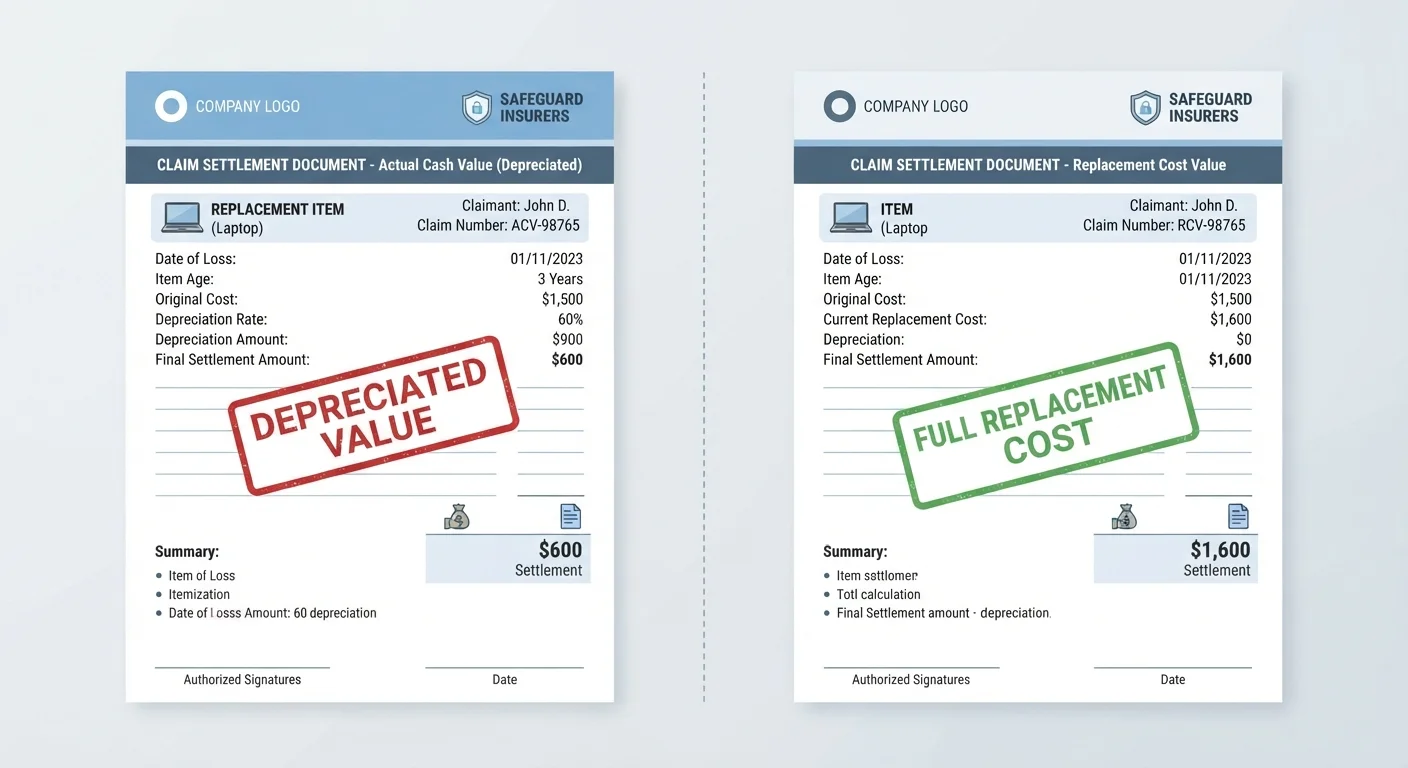
Option A
Actual Cash Value (ACV)
The depreciation-adjusted settlement method.
Best for: Policyholders seeking lower premiums who can absorb the gap between depreciated value and full replacement cost out of pocket.
Option B
Replacement Cost Value (RCV)
The full-replacement settlement method.
Best for: Policyholders who want to restore damaged or destroyed property to its pre-loss condition without contributing additional funds.
What Each Term Actually Means
When an insurer settles a claim, it needs a method for calculating how much to pay. The two most common methods are Actual Cash Value (ACV) and Replacement Cost Value (RCV). Both appear frequently across home, renters, and auto policies, and the distinction between them is one of the most consequential things a consumer can understand before a loss occurs. For a broader grounding in insurance terminology, the Coverage Type Glossary defines these and dozens of related terms in plain language.
Actual Cash Value is calculated as the cost to replace an item minus depreciation. Depreciation accounts for age, wear, and obsolescence. A five-year-old roof, for example, will receive a lower ACV payout than a brand-new one — even if the damage is identical — because the insurer deducts the value the roof already lost simply by aging.
Replacement Cost Value, by contrast, pays the amount needed to repair or replace the damaged property with a comparable new item at current market prices, without any deduction for depreciation. If that same five-year-old roof needs full replacement, an RCV policy pays the cost of a new equivalent roof.
| Criterion | Actual Cash Value (ACV) | Replacement Cost Value (RCV) |
|---|---|---|
| Payout basis | Depreciated market value at time of loss | Cost to replace with new comparable item |
| Depreciation deducted | Yes — reduces payout | No — paid at current replacement cost |
| Premium cost | Lower | Higher |
| Out-of-pocket gap at claim | Often significant on older property | Minimal or none after repairs completed |
| Holdback / two-step payment | Not applicable | Common — depreciation released after repair |
| Typical use | Auto policies; older structures | Home dwelling; personal property endorsements |
| Risk carried by policyholder | Higher — covers depreciation gap | Lower — insurer funds full replacement |
How Depreciation Widens the Gap
Depreciation is the engine behind the ACV shortfall. Insurers typically calculate depreciation using the item's expected useful life and its current age. A washing machine with a 12-year lifespan that is six years old might be considered 50% depreciated — meaning an ACV payout covers only half of what a replacement unit costs today.
This gap can be modest on newer property but substantial on older assets. Homeowners with aging HVAC systems, appliances, or roofing can face ACV payouts that cover a fraction of actual repair costs. For a deeper look at how asset age drives value loss, see our article on vehicle depreciation — the same economic forces apply to property broadly.
~50%
Typical ACV payout for mid-life property
A property halfway through its expected useful life may receive an ACV settlement equal to roughly half its replacement cost, depending on the depreciation schedule applied.
15–20%
Estimated premium difference for RCV vs. ACV
Industry guidance generally suggests RCV endorsements add a meaningful premium above a comparable ACV policy, though the exact difference varies by insurer, property type, and location.
The gap between ACV and RCV also varies by property type. Structures tend to depreciate more slowly than personal belongings like electronics or clothing, where depreciation is steep and swift. This is why many home insurance policies offer RCV on the dwelling itself but default to ACV on personal property — unless you specifically add a personal property RCV endorsement.
How Each Method Appears in a Policy
Settlement method is usually stated in the policy's conditions section or within specific coverage endorsements. It may not appear prominently on the declarations page. A policy that advertises a $300,000 dwelling limit does not automatically disclose, on that page alone, whether payment will be ACV or RCV. Consumers must read the full policy language or ask their agent directly. The hub on Choosing Coverage offers practical guidance on evaluating policy terms before you sign.
One nuance specific to RCV policies: many use a holdback structure. The insurer initially pays the ACV amount and releases the remaining depreciation (called the "recoverable depreciation") only after you complete repairs or replacement and submit proof. This means you may need to fund repairs upfront and be reimbursed later — an important cash-flow consideration.
RCV Holdbacks Require Action on Your Part
If your RCV policy uses a holdback structure, the insurer pays ACV first and releases the depreciation portion only after you document completed repairs or replacement. Failing to complete repairs — or not submitting proof — may mean you never receive that additional amount. Always confirm the claim requirements with your insurer in writing before beginning restoration work.
On the personal property side, the distinction also matters enormously at claim time. As explored in the companion piece on dwelling vs. personal property coverage, these two coverage sections within the same policy can follow different settlement rules, so it pays to check each one separately.
Making a Deliberate Choice
Choosing between ACV and RCV is ultimately a financial trade-off between premium cost and claim protection. RCV policies consistently carry higher premiums because the insurer assumes a larger potential payout. ACV policies cost less but shift more financial risk to the policyholder when a loss occurs.
Before deciding, consider the age and condition of what you are insuring, your ability to cover a depreciation gap out of pocket, and how long you plan to hold the policy. Insuring a newer home with mostly new contents is a different calculation than insuring a property with older systems and appliances. The article on choosing coverage types without overbuying walks through a practical framework for calibrating your choices.
Neither method is universally superior. What matters is that you know which one governs your policy before you file a claim — not after. Reading your policy documents and speaking with a licensed insurance agent or broker are the most reliable ways to confirm the settlement method that applies to each section of your coverage.
This article is for general informational and educational purposes only and does not constitute personalized insurance, financial, or legal advice. Coverage terms, settlement methods, and regulations vary by provider, policy, and state. Always read your actual policy documents and consult a licensed insurance professional for guidance specific to your situation.
The content on this site is for informational purposes only and is not a substitute for professional advice. Always consult a qualified professional for guidance specific to your situation.