

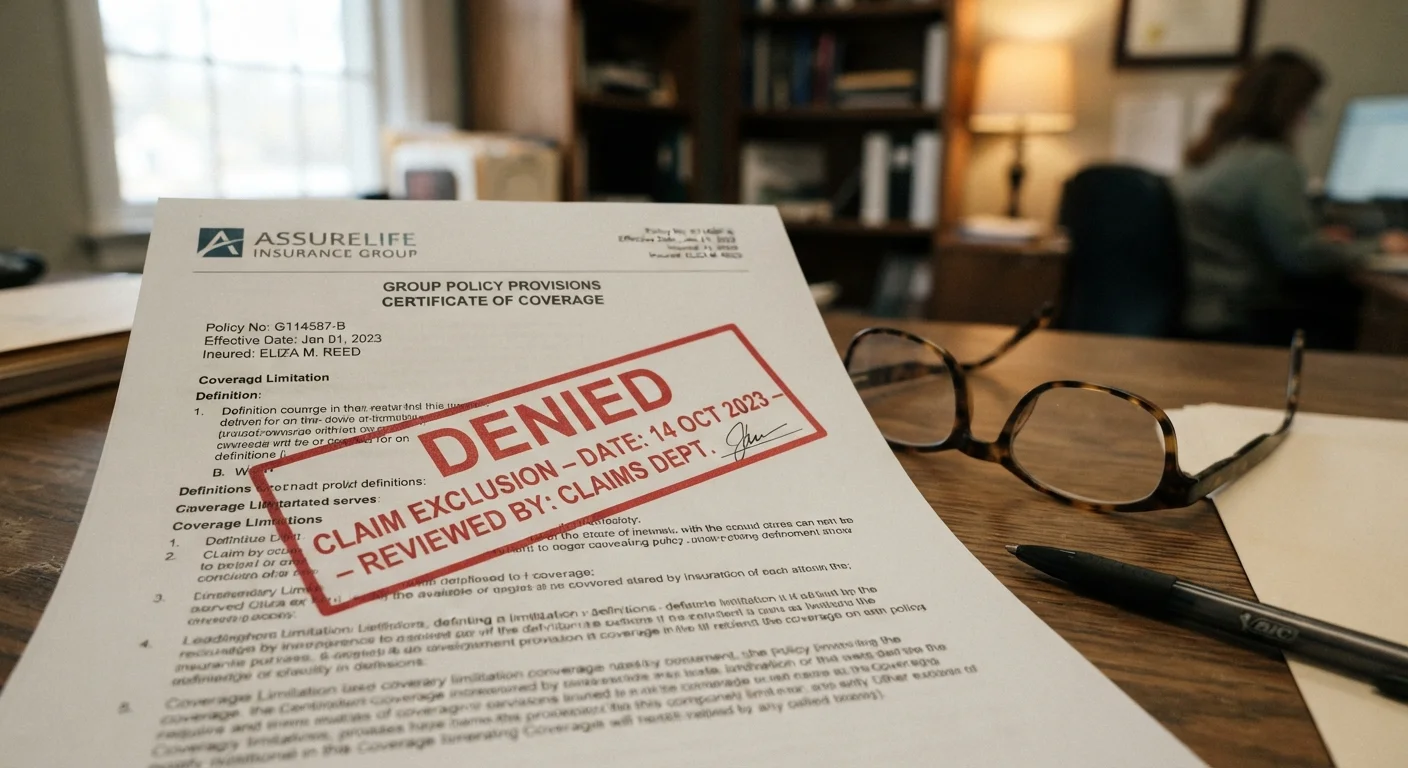
Why Policy Language Is the Starting Point
When an insurance claim is denied, the reason almost always lives inside the policy document itself — not in the insurer's discretion. Every denial should trace back to a specific clause, condition, or exclusion. The problem is that most policyholders never read those clauses before filing a claim.
Insurance policies are legal contracts. They use precise, defined language for a reason: to establish exactly what the insurer will and won't pay for. Terms that seem straightforward — like "damage," "accident," or "loss" — often carry narrow definitions that can determine whether a claim succeeds or fails. Before you can protect yourself from a denial, you need to understand how these documents are structured.
Most policies contain four core sections: the Declarations page (your coverage summary), Insuring Agreements (what is covered), Exclusions (what is not), and Conditions (what both parties must do). Skipping any of these sections leaves gaps in your understanding that can cost you when a loss happens. For a plain-language breakdown of essential policy terminology, see Insurance Terms Every Policyholder Should Know Before Signing Anything.
~30%
Of health insurance claims initially denied
Analyses of insurer data have found that roughly one in three health insurance claims is initially denied, though a large share of appealed denials are overturned.
0.1%
Of denied claims that are formally appealed
Research from the Kaiser Family Foundation found that fewer than two-tenths of one percent of denied marketplace plan claims were appealed by consumers, leaving many valid claims uncontested.
The Most Common Mistakes That Lead to Denials
Claim denials rarely come out of nowhere. In most cases, they stem from predictable, avoidable misunderstandings about what the policy says. The mistakes below reflect patterns that appear repeatedly across health, home, auto, and life insurance claims.
Assuming a loss is covered without reading the exclusions section.
Why it happens: Most policyholders focus on what a policy covers and skim past the exclusions, which are often buried in dense, small-print sections toward the back of the document.
Missing a reporting deadline specified in the policy conditions.
Why it happens: Policyholders often don't realize their policy contains strict timeframes — sometimes as short as 24 to 72 hours — for notifying the insurer after a loss occurs.
Misunderstanding the definition of a covered 'occurrence' or 'event.'
Why it happens: Words like 'accident,' 'occurrence,' and 'sudden and accidental' have narrow technical definitions in insurance contracts that differ from their everyday meanings.
Failing to meet a policy condition — such as maintaining required safety features.
Why it happens: Many policyholders are unaware that coverage can be voided if they don't uphold ongoing obligations, such as keeping a home security system active or maintaining a vehicle in roadworthy condition.
Submitting a claim for an amount below the deductible or for a non-covered party.
Why it happens: Policyholders sometimes forget what their deductible is, or assume that everyone involved in an incident is automatically covered under their policy.
Denials Must Be Explained in Writing
Under most state insurance regulations, insurers are required to provide a written explanation citing the policy provision used to deny a claim. If you receive a verbal denial or a vague letter, request a formal written denial referencing the exact policy language. This documentation is critical if you intend to appeal or escalate the matter.
Understanding exclusions is especially important because they define the boundaries of your coverage in ways that the main insuring agreement doesn't make obvious. For a deeper look at how exclusions are written and interpreted, What Insurance Exclusions Really Mean explains what to look for.
How to Read Your Policy Before You Need It
The most effective time to understand your policy is before a loss occurs — not while you're filing a claim. Set aside time at least once a year, ideally at renewal, to read through the full document rather than just the declarations page.
Start with the Definitions section so you understand the precise meaning of key terms. Then read the Exclusions section in full. Finally, review the Conditions section to confirm you know your obligations as a policyholder — including notification deadlines, cooperation requirements, and any maintenance standards you must uphold.
If you discover language you don't understand, contact your insurer or a licensed insurance agent for clarification. Don't assume. Many claim disputes arise because a policyholder assumed coverage applied when the written language said otherwise. Misconceptions like these are common — Insurance Myths That Lead People to Choose the Wrong Plan outlines how false assumptions shape poor coverage decisions.
If your claim is denied, request the written denial letter and locate the exact policy provision cited. You generally have the right to appeal internally through the insurer and, if unresolved, to file a complaint with your state's department of insurance. Coverage gaps often only become visible at this stage — which is why Coverage Gaps Most People Don't Discover Until They File a Claim matters so much.
This article provides general insurance information and education. It is not legal or personalized insurance advice. Policy terms, coverage, and regulations vary by provider and state. Always read your actual policy documents and consult a licensed insurance agent or adviser for guidance specific to your situation.
The content on this site is for informational purposes only and is not a substitute for professional advice. Always consult a qualified professional for guidance specific to your situation.