

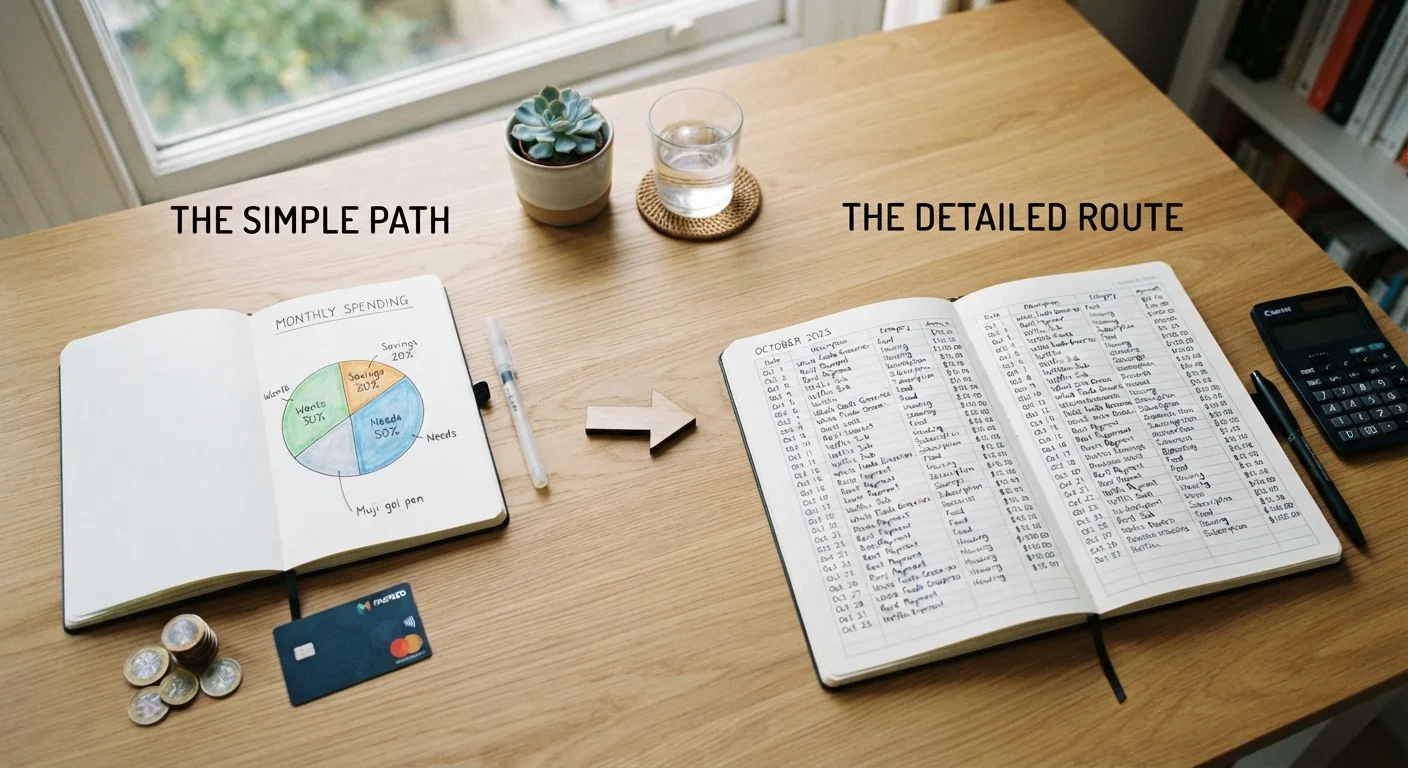
Option A
The 50/30/20 Rule
The flexible, low-maintenance framework for straightforward budgeting.
Best for: People who want a simple structure without tracking every individual expense.
Option B
Zero-Based Budgeting
The detail-oriented method that assigns every dollar a specific purpose.
Best for: People who want granular control and are willing to track spending closely each month.
How Each Framework Works
Before comparing the two methods, it helps to understand their core mechanics. If you're entirely new to personal budgeting, the foundational principles of budgeting provide essential grounding for either approach.
The 50/30/20 Rule
Popularized in part by consumer bankruptcy expert Elizabeth Warren, the 50/30/20 rule allocates your monthly after-tax income across three categories:
- 50% to needs: housing, utilities, groceries, transportation, insurance, and minimum debt payments.
- 30% to wants: dining out, entertainment, subscriptions, hobbies, and non-essential shopping.
- 20% to savings and debt repayment: emergency funds, retirement contributions, and paying down balances above the minimum.
The framework is intentionally broad. You don't track individual transactions — you simply monitor whether your spending stays within each bucket.
Zero-Based Budgeting
Zero-based budgeting (ZBB) starts from a different premise: every dollar of income must be allocated to a specific category before the month begins, leaving a balance of zero — meaning income minus all assigned expenses equals zero. Nothing is left unaccounted for. For a deeper look at how ZBB works in practice, see Zero-Based Budgeting Explained.
Categories are as detailed as you choose: separate line items for groceries, gas, pet care, streaming services, and so on. At month's end, any unspent money must be deliberately re-assigned — to savings, debt, or next month's plan.
| Criterion | 50/30/20 Rule | Zero-Based Budgeting |
|---|---|---|
| Core concept | Three percentage-based spending categories | Every dollar assigned a specific job |
| Time commitment | Low — monthly check-in | High — detailed monthly planning |
| Best income type | Stable, predictable salary | Variable or irregular income |
| Spending visibility | Broad category awareness | Line-by-line precision |
| Flexibility | High within each bucket | Low — changes require re-allocation |
| Debt payoff focus | Built into the 20% bucket | Dedicated line items for each debt |
| Learning curve | Minimal | Moderate to steep |
| Tools typically needed | Basic spreadsheet or app | Detailed budgeting app or spreadsheet |
Strengths, Limitations, and Who Each Method Suits
Each framework carries genuine trade-offs. Understanding them helps you choose — or combine — methods appropriately. For a broader view of how budgeting approaches vary by income type, the article on budgeting methods across different income levels is worth reviewing.
~74%
Americans living paycheck to paycheck
A 2023 LendingClub report found that roughly 74% of U.S. consumers reported living paycheck to paycheck, underscoring why a structured budgeting method matters.
20%
Savings target under 50/30/20 rule
The 50/30/20 framework designates 20% of after-tax income for savings and extra debt repayment, a threshold many financial educators cite as a useful general target.
$0
Unassigned dollars in a zero-based budget
By design, zero-based budgeting leaves no income unallocated — every dollar has an explicit purpose before the month begins, which is what makes the approach distinctively rigorous.
50/30/20: Strengths and Limitations
Strengths: Low time commitment, easy to remember, and forgiving enough to sustain long-term. It creates healthy overall structure without demanding daily attention.
Limitations: The percentages assume a salary that comfortably covers needs at 50% — which isn't realistic in high-cost-of-living areas. The broad categories also make it easier to rationalize overspending within a bucket. It may be too loose for someone carrying significant debt or saving for a near-term goal.
Zero-Based Budgeting: Strengths and Limitations
Strengths: Extreme clarity — you know exactly where every dollar goes. It's highly adaptable to variable income, and it tends to surface hidden spending habits quickly. For those focused on managing and reducing debt, ZBB's precision is a meaningful advantage.
Limitations: Time-intensive to set up and maintain. It requires revisiting your budget monthly, which can feel burdensome. A single unexpected expense can disrupt the entire plan, requiring mid-month re-allocation. The pros and cons of spending categories apply especially here — granularity sharpens awareness but can also introduce rigidity.
When the 50% Needs Threshold Doesn't Fit
In high-cost metropolitan areas, housing alone can consume well over 50% of after-tax income for many households. If your fixed necessities exceed 50%, the 50/30/20 rule's proportions may not apply without adjustment. In that situation, zero-based budgeting's category-by-category approach can be more honest about your actual spending constraints. Alternatively, you can scale the 50/30/20 percentages to reflect your local cost of living rather than abandoning the framework entirely.
Choosing a Method — or Blending Both
There's no universally correct budgeting method. The right choice depends on your income stability, financial goals, available time, and personal temperament. This is general financial education, not personalized advice — consider consulting a licensed financial adviser for guidance tailored to your situation.
A practical approach for many households is to start with the 50/30/20 rule to establish a baseline and build the budgeting habit. Once that feels routine, layer in zero-based detail for categories where overspending is a pattern. This hybrid lets you maintain simplicity where it works and apply precision where it's needed.
Whichever framework you choose, the foundational process of building a working budget is the same. The step-by-step guide to building your first savings-focused budget walks through that process in practical terms.
For a comprehensive reference covering multiple budgeting frameworks side by side, the Personal Budgeting Complete Reference consolidates strategies, savings planning, and adaptation guidance in one place.
This article is for general informational and educational purposes only and does not constitute personalized financial, tax, or legal advice. Consult a qualified financial professional before making decisions about your own financial situation.
The content on this site is for informational purposes only and is not a substitute for professional advice. Always consult a qualified professional for guidance specific to your situation.