

Option A
Debt Avalanche
The mathematically optimal, interest-minimizing approach.
Best for: People comfortable playing the long game who want to pay the least total interest over time.
Option B
Debt Snowball
The momentum-driven, motivation-first strategy.
Best for: People who need early wins to stay motivated and build consistent repayment habits.
How Each Method Works
Before choosing a strategy, you need a clear picture of every debt you carry — balance, minimum payment, and interest rate. If you haven't mapped this out yet, see our guide to understanding your debt before making a plan as a starting point.
Both methods share the same foundational rule: pay the minimum on every debt each month, then direct any extra money toward one target debt. What differs is which debt gets that extra payment.
The Debt Avalanche
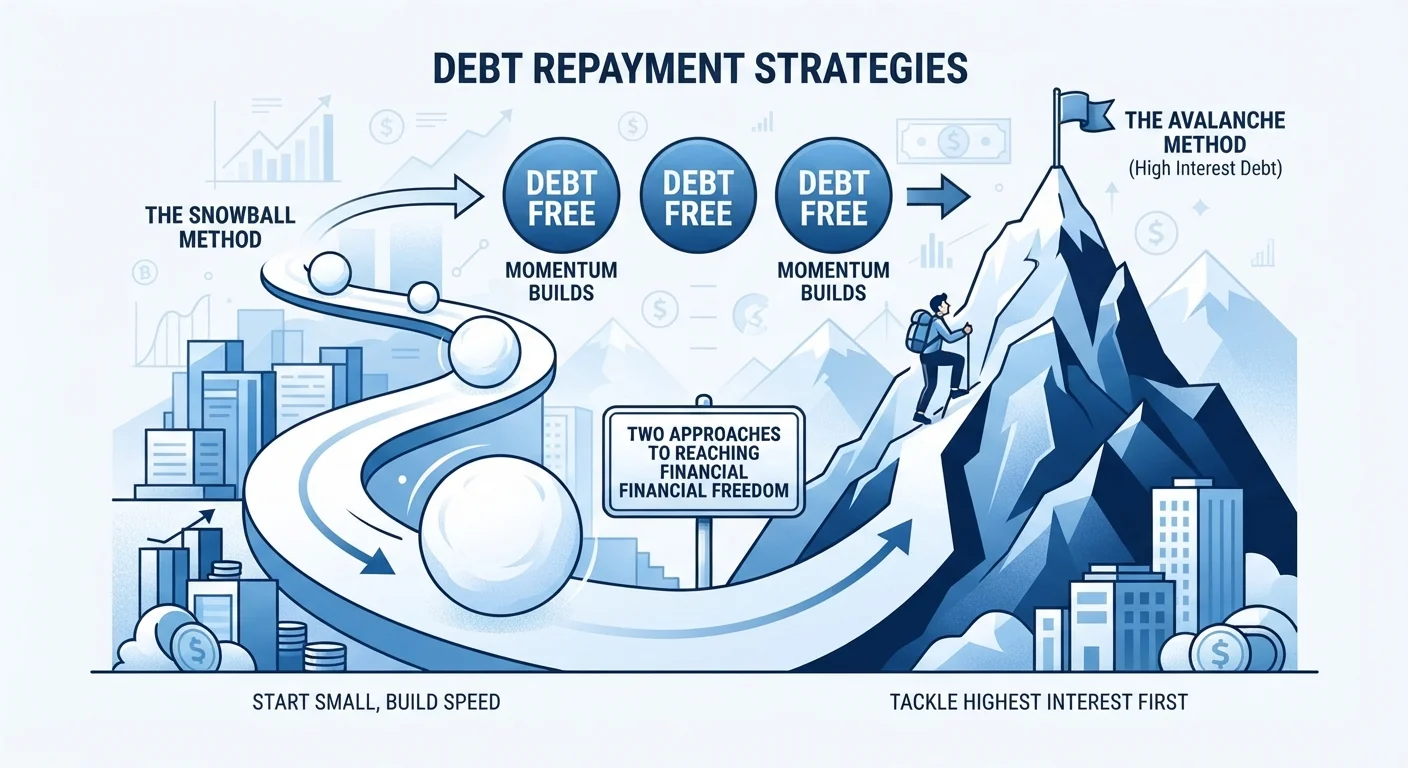
List your debts from highest to lowest annual percentage rate (APR). Put all extra funds toward the highest-rate balance. Once it's paid off, roll that freed-up payment into the next highest-rate debt, and so on. Because high-interest debt compounds the fastest, eliminating it first reduces the total amount of interest you'll pay across all your accounts.
The Debt Snowball
List your debts from smallest to largest balance, ignoring interest rates. Direct extra payments to the smallest balance. When it's gone, redirect that full payment amount to the next smallest. The early pay-offs happen faster, and each eliminated account provides a concrete sense of progress that can sustain effort over the longer haul.
| Criterion | Debt Avalanche | Debt Snowball |
|---|---|---|
| Payoff order | Highest interest rate first | Smallest balance first |
| Total interest paid | Lower (mathematically optimal) | Potentially higher |
| Time to first full payoff | Can take longer | Faster early wins |
| Motivational design | Logic-driven, delayed reward | Behavior-driven, quick wins |
| Best when rates vary widely | Strong advantage | Less relevant |
| Best when balances vary widely | Less relevant | Strong advantage |
| Complexity | Moderate (requires rate tracking) | Low (just sort by balance) |
The Math vs. The Psychology
On paper, the Avalanche wins. Because you're eliminating high-rate debt first, you stop the most expensive compounding early. The savings can be meaningful depending on your balances and rates — though the exact difference varies widely by individual situation.
The Snowball trades some of that savings for behavioral reinforcement. Academic research in consumer finance has noted that people are more likely to continue a debt payoff plan when they experience early, visible progress — a dynamic the Snowball is designed to exploit constructively. For many people, a plan they abandon produces worse outcomes than a slightly less optimal plan they finish.
~$1,000+
Potential interest saved with Avalanche vs. Snowball
The exact savings depend on individual balances and rates, but researchers have modeled scenarios where targeting high-rate debt first saves hundreds to thousands in interest.
~$6,000
Average American credit card balance carried month-to-month
According to Federal Reserve data, many U.S. households carry revolving credit card balances, making repayment strategy choice financially significant.
15–24%+
Typical APR range for revolving credit card debt in the U.S.
Federal Reserve consumer credit data regularly shows credit card interest rates in this range, underscoring why eliminating high-rate balances quickly can reduce overall costs.
Neither approach requires taking on new credit products. Both assume you're directing genuine surplus — money left after covering essentials and minimum payments — toward accelerated repayment. For help finding that surplus, our guide to building a household budget around debt repayment walks through how to structure your monthly cash flow.
When Each Strategy Has the Edge
Several variables shift which method makes more sense for a given situation:
- Interest rate spread: If you have one credit card charging 24% APR while others sit at 10–12%, the Avalanche's advantage is significant. If all your debts carry similar rates, the difference shrinks and the Snowball's motivational lift can dominate.
- Balance distribution: If your smallest-balance debt also happens to be your highest-rate debt, both methods point to the same account — your choice is moot on the first target.
- Debt type: These methods apply most cleanly to unsecured debts like credit cards and personal loans. Secured debts — mortgages, auto loans — carry different risk structures. For a fuller explanation, see our article on secured vs. unsecured debt and why the distinction matters.
- Your track record: If you've started and abandoned payoff plans before, the Snowball's early wins may be worth more to you than the Avalanche's interest savings.
It's also worth noting that avalanche and snowball aren't the only tools available. Options like balance transfers or debt consolidation carry their own trade-offs. Our coverage of balance transfer trade-offs and debt consolidation vs. debt settlement can help you evaluate those paths alongside your repayment strategy.
Hybrid Approach: A Middle Path
Some people find value in combining both methods. For instance, you might use the Snowball to eliminate one or two small balances quickly — freeing up cash flow and confidence — then switch to the Avalanche for the remaining, larger debts. This hybrid isn't a formal strategy, but it reflects the broader principle that personal finance is personal: the structure that fits your psychology and circumstances is the one most likely to succeed.
Putting a Strategy Into Practice
Whichever method you choose, a few habits determine whether you actually finish:
- Automate minimums: Set all minimum payments to auto-pay so you never accidentally miss one while focusing on your target debt.
- Designate a fixed extra payment: Decide on a specific dollar amount you'll add to your target account each month. Even modest consistent amounts compound into meaningful progress.
- Don't add new debt: Both strategies unravel quickly if new balances accumulate alongside the ones you're paying down.
- Reassess after each payoff: When a balance hits zero, explicitly redirect its payment to your next target — don't let that cash flow disappear into general spending.
Once your debt is eliminated, the same disciplined surplus that powered repayment can shift toward savings and investing. Our Saving & Investing hub covers practical next steps for that transition.
This article is for general informational and educational purposes only and does not constitute personalised financial, legal, or tax advice. Consult a qualified financial professional for guidance specific to your situation.
The content on this site is for informational purposes only and is not a substitute for professional advice. Always consult a qualified professional for guidance specific to your situation.