

Our Verdict
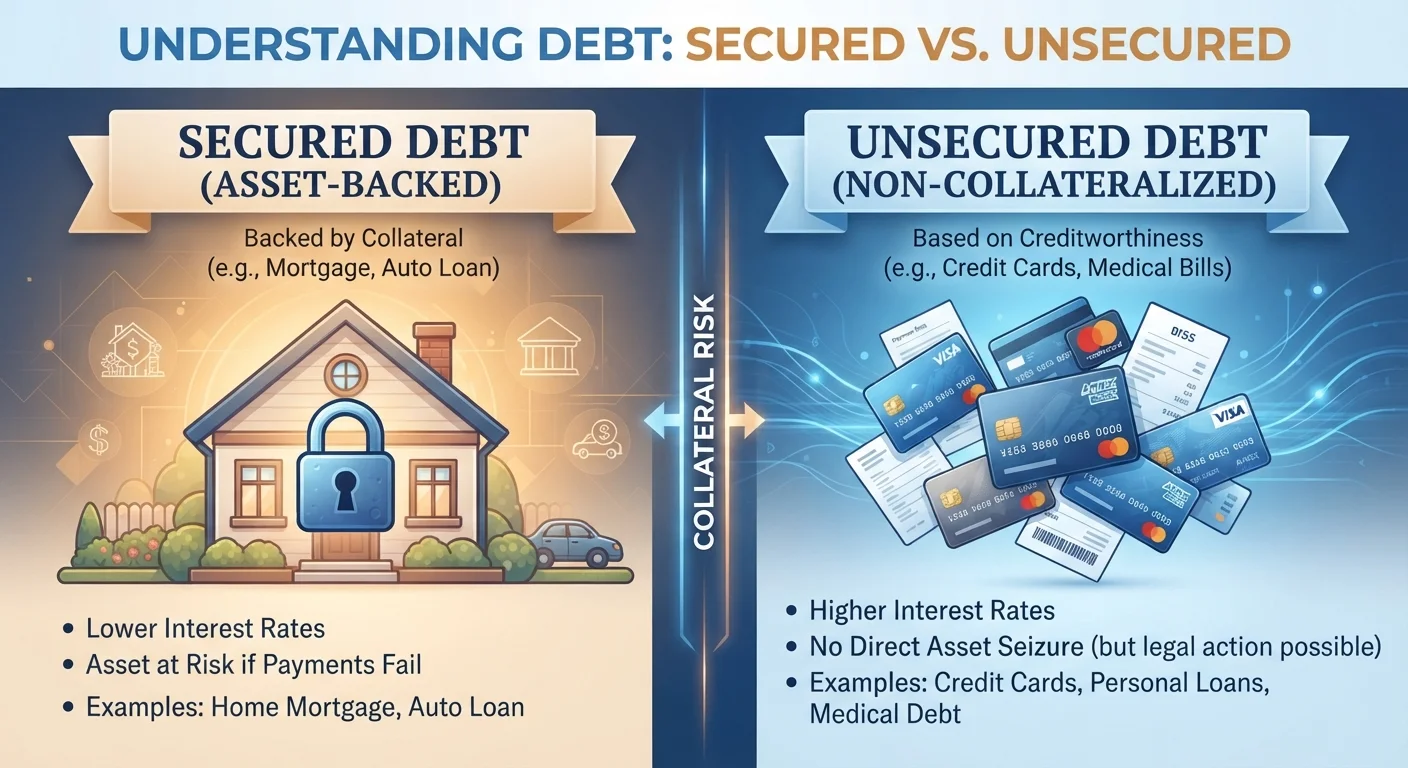
Secured and unsecured debt each serve a purpose in a borrower's financial life, but they come with meaningfully different risks. Secured debt typically offers lower interest rates in exchange for putting an asset on the line, while unsecured debt offers flexibility at the cost of higher rates. The distinction matters most when cash flow tightens — knowing which obligations could trigger asset loss helps you prioritize wisely.
| Best for | Recommended |
|---|---|
| Financing a large, long-term purchase with manageable monthly costs | Secured debt (e.g., mortgage or auto loan) |
| Short-term spending flexibility without pledging assets | Unsecured debt (e.g., credit cards or personal loans) |
| Borrowers focused on preserving a specific asset during financial hardship | Prioritizing secured debt payments first |
| Readers rebuilding credit after past difficulties | Secured credit products used responsibly over time |
What Makes Debt "Secured" or "Unsecured"?
At its core, the difference comes down to one word: collateral. Secured debt is tied to a specific asset — called collateral — that the lender can claim if you stop making payments. A mortgage is the most common example: the home itself secures the loan. Auto loans work the same way — the vehicle is the collateral.
Unsecured debt, by contrast, is not backed by any asset. Credit cards, medical bills, and most personal loans fall into this category. If you default, the lender cannot immediately seize property. Instead, they may pursue collection efforts, report the delinquency to credit bureaus, or ultimately sue for a court judgment.
For a plain-language breakdown of terms like default, delinquency, and charge-off, see Debt Terms Every Borrower Should Recognize.
| Secured Debt | Unsecured Debt | |
|---|---|---|
| Collateral required | Yes — specific asset pledged | No asset required |
| Typical interest rate | Generally lower APR | Generally higher APR |
| Common examples | Mortgage, auto loan | Credit card, personal loan, medical bill |
| Default consequence | Repossession or foreclosure | Collections, lawsuits, wage garnishment |
| Treatment in bankruptcy | Must pay or surrender collateral | May be partially or fully discharged |
| Lender risk level | Lower — collateral reduces exposure | Higher — relies on borrower creditworthiness |
How Risk and Interest Rates Differ
Because secured lenders have a fallback — they can repossess or foreclose — they take on less risk. That reduced risk typically translates into lower interest rates for borrowers. Mortgages and auto loans generally carry significantly lower annual percentage rates (APRs) than credit cards or personal loans.
Unsecured lenders, having no collateral to claim, price that additional risk into the interest rate. This is why credit card APRs tend to be substantially higher than those on secured loans, and why your credit score matters so much when applying for unsecured products — it is the lender's primary signal of repayment reliability.
Use Secured Debt Strategically, Not Casually
Because secured debt puts an asset on the line, it is worth pausing before using a home equity loan or similar product for discretionary spending. The lower interest rate can seem attractive, but converting unsecured spending into a secured obligation raises the stakes considerably. Reserve secured borrowing for purposes where the financial benefit clearly outweighs the risk to the underlying asset.
This dynamic also explains why secured debt is often used for large, long-lived purchases: spreading a lower-rate loan over many years can keep monthly costs manageable compared to carrying the same balance on a high-rate unsecured product.
What Happens When You Fall Behind
The consequences of missed payments diverge sharply between the two types.
With secured debt, lenders can initiate repossession or foreclosure if you default — often after a relatively short delinquency period. Losing a home or vehicle has immediate, severe life consequences beyond the financial damage. Auto repossession can happen in some states within days of a missed payment, while mortgage foreclosure typically involves a longer legal process but results in the same outcome: losing the asset.
With unsecured debt, default does not immediately cost you property, but it is not consequence-free. Lenders may charge off the account, sell it to a collection agency, and report the delinquency to the three major credit bureaus. Unresolved unsecured debts can eventually lead to a lawsuit and, if a judgment is entered, wage garnishment or bank account levies — depending on your state's laws.
Both debt types damage your credit when payments are missed. For a detailed look at how payment history and balances interact with your score, see How Debt Affects Your Credit Score.
Don't Ignore Secured Debt in Hardship
It can be tempting to stop paying a mortgage or auto loan while focusing on credit card minimums, but the repossession and foreclosure risks attached to secured debt make this a dangerous strategy. If you are struggling, contact your secured lender early — many offer hardship programs or deferment options before legal action begins. Waiting until default significantly narrows your options.
Secured vs. Unsecured Debt in Bankruptcy
Bankruptcy law treats the two debt types differently. In a Chapter 7 bankruptcy, many unsecured debts — such as credit card balances and medical bills — may be discharged, meaning you are no longer legally obligated to repay them. Secured debts are handled differently: if you want to keep the collateral, you generally must either continue paying or reaffirm the debt. If you surrender the collateral, the secured claim may be satisfied, but any remaining deficiency balance could be treated as unsecured debt.
In Chapter 13 bankruptcy, secured debts are typically paid in full through a court-approved repayment plan, while unsecured creditors often receive only a portion of what is owed. These are complex legal areas — anyone considering bankruptcy should consult a licensed bankruptcy attorney for guidance specific to their situation.
If you own a vehicle and are weighing the full cost picture of auto-related debt, the Car Ownership Costs offers useful context on where loan payments fit alongside insurance, maintenance, and depreciation.
How to Use This Knowledge Practically
Understanding the secured/unsecured divide gives you a clearer framework for financial decisions:
- Payment prioritization: When money is tight, secured debts often deserve first priority because the consequences of default — losing a home or car — can be severe and immediate.
- Debt payoff strategy: Because unsecured debt typically carries higher interest rates, many financial planners suggest targeting high-rate unsecured balances aggressively once secured obligations are current.
- Borrowing decisions: Before taking on any new debt, identify whether it is secured or unsecured, understand the asset at risk (if any), and compare APRs carefully.
- Negotiation leverage: Unsecured creditors have less leverage than secured ones, which sometimes makes them more willing to negotiate payment plans or settlements — though outcomes vary and are never guaranteed.
~$1.14T
Total U.S. credit card debt
According to the Federal Reserve Bank of New York's Q4 2023 Household Debt and Credit Report, Americans held approximately $1.13–1.14 trillion in credit card balances — a major category of unsecured debt.
~$12.25T
Total U.S. mortgage debt outstanding
The Federal Reserve Bank of New York's same Q4 2023 report found mortgage balances at approximately $12.25 trillion, reflecting secured debt's dominant share of household borrowing.
This article provides general financial education and is not personalized financial, legal, or credit advice. For guidance tailored to your circumstances, consult a qualified financial adviser or licensed attorney.
The content on this site is for informational purposes only and is not a substitute for professional advice. Always consult a qualified professional for guidance specific to your situation.