

The Five Factors—and Where Debt Fits In
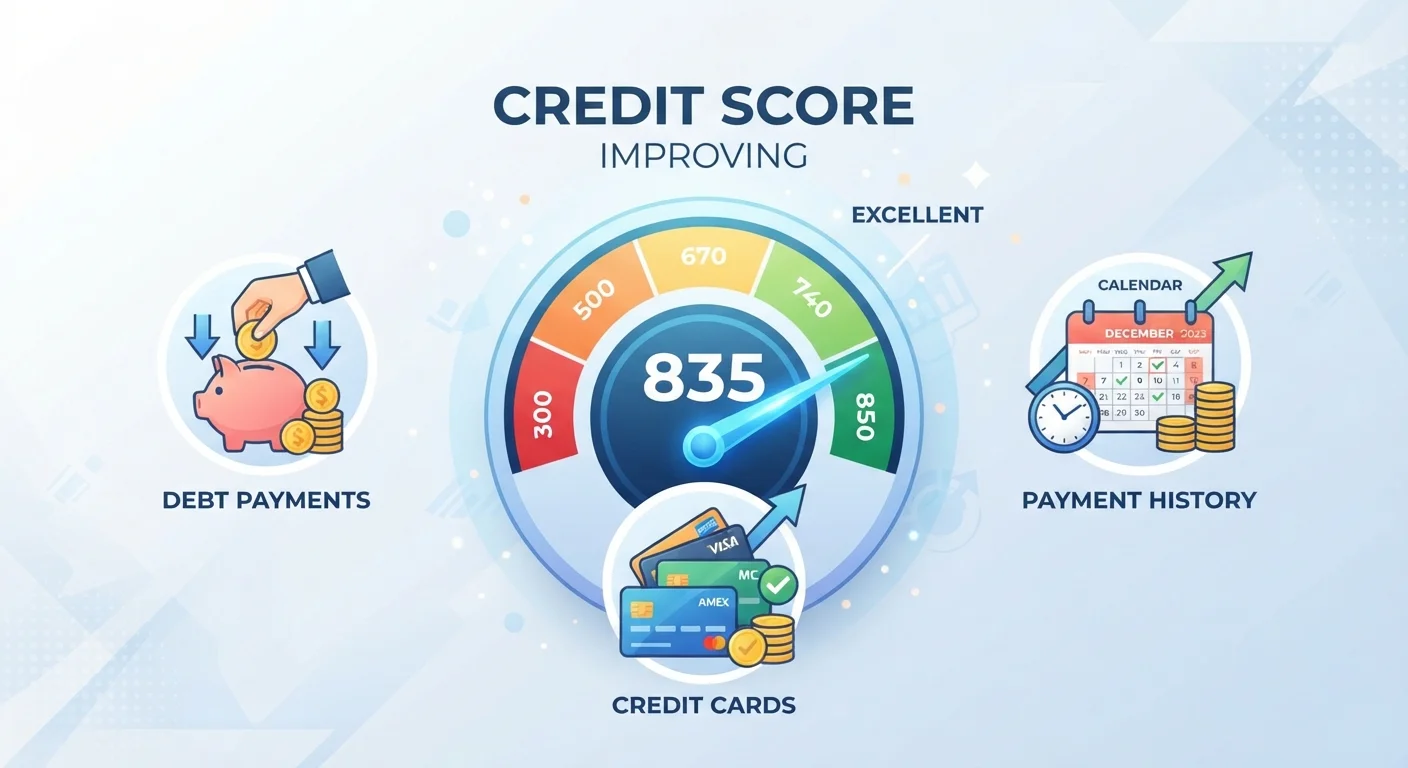
Credit scores don't measure how wealthy you are—they measure how predictably you handle borrowed money. FICO, the dominant scoring model, breaks that assessment into five weighted categories. Two of them—payment history and amounts owed—together account for 65% of your score and are both directly tied to your debt behavior.
The remaining three factors (length of credit history, credit mix, and new credit inquiries) matter, but they move more slowly and offer less immediate leverage. If you want to move the needle on your score, debt management is where to start.
For a plain-language explanation of the terminology you'll encounter along the way, see our glossary of debt terms every borrower should know.
35%
Weight of payment history in FICO score
According to FICO's published scoring model breakdown, payment history is the single largest factor in your credit score.
30%
Weight of amounts owed (utilization) in FICO score
FICO's model weights credit utilization as the second most influential factor, making it the fastest actionable lever for most borrowers.
7 years
How long late payments stay on your credit report
Under the Fair Credit Reporting Act, most negative items including missed payments can remain on a consumer's credit report for up to seven years.
Payment History: The Factor That Matters Most
At 35% of your score, payment history is the dominant variable. Every on-time payment quietly reinforces your creditworthiness. Every missed payment does the opposite—and does it loudly. A single payment that is 30 or more days late is reported to the credit bureaus and can drop a good score by 60 to 110 points, depending on where you started.
The practical implication is straightforward: before you optimize anything else, protect your payment history. Set up autopay for at least the minimum due on every account, even while you work toward paying more. Missing a payment to free up cash for an aggressive payoff strategy is counterproductive—the score damage far outweighs the interest saved.
Automate the Minimum, Then Pay More Manually
Set autopay for at least the minimum payment on every account so you never accidentally miss a due date. Then, when your budget allows, make additional manual payments to bring balances down faster. This two-step approach protects your payment history while still accelerating your debt payoff.
Late payments stay on your report for seven years, but their weight in the scoring model decreases over time. Consistent on-time payments after a delinquency will gradually rebuild your score.
Credit Utilization: The Lever You Can Pull Quickly
The second-largest factor—amounts owed, at 30%—is most sensitive to your credit utilization rate: the percentage of your revolving credit limit you're currently using. If you have $10,000 in combined credit card limits and carry a $4,000 balance, your utilization is 40%.
Scoring models generally reward utilization below 30%, and single-digit utilization is associated with the highest scores. Because card balances are reported monthly, reducing a high balance can improve your score within one to two billing cycles—making this one of the fastest actionable levers available to most borrowers.
Installment debt (mortgages, auto loans, student loans) contributes to amounts owed but has far less impact than revolving balances. Paying down a credit card will typically produce a more immediate score improvement than making an extra mortgage payment of the same dollar amount.
If you're weighing strategies like balance transfers to reduce revolving debt costs, our article on the tradeoffs of balance transfers walks through the benefits and risks in detail.
Common Mistakes That Quietly Damage Your Score
Several well-intentioned moves can backfire:
- Closing paid-off cards. Closing an account reduces your total available credit, which can raise your utilization rate instantly. It also shortens your average credit history if the card is an older account.
- Opening multiple accounts at once. Each application triggers a hard inquiry. Multiple inquiries in a short window signal elevated credit-seeking behavior to lenders.
- Ignoring small balances. A forgotten $40 medical bill sent to collections can damage your score as severely as a much larger delinquency.
Understanding how different types of debt behave is also useful. Our explainer on secured vs. unsecured debt explains why credit cards and mortgages are scored differently—and what's at stake when you fall behind on either.
Utilization Is Calculated at Statement Close
Most credit card issuers report your balance to the bureaus at the end of your billing cycle—not your due date. If you want to show a lower utilization, pay down your balance before the statement closing date, not just by the payment due date. Your statement balance is typically what appears on your credit report.
Once you have a clear picture of how debt affects your score, the next step is choosing a payoff method. Our guide to debt avalanche vs. debt snowball strategies compares the two most proven approaches side by side.
This article is for general informational and educational purposes only and does not constitute personalized financial or legal advice. Consult a licensed financial professional for guidance specific to your situation.
Frequently Asked Questions
No—this is a common myth. You do not need to carry a balance to build credit. Paying your statement balance in full each month avoids interest while still demonstrating responsible use to the credit bureaus.
Credit card payoffs can reflect in your score within one to two billing cycles once the creditor reports the new balance. Installment loan payoffs take effect similarly, though the score impact is usually smaller.
Applying for a consolidation loan triggers a hard inquiry, which may temporarily lower your score by a few points. However, if consolidation reduces your overall utilization and you make on-time payments, the long-term effect is typically positive.
A missed payment can remain on your credit report for up to seven years. Its negative impact is greatest in the first two years and gradually diminishes—especially if your payment behavior improves afterward.
No. Reviewing your own credit report or score is a soft inquiry and has no effect on your score. Only hard inquiries—triggered when lenders check your credit for a loan or card application—can cause a small, temporary dip.
Bring all accounts current, then focus on reducing revolving balances to lower your utilization rate. These two steps address the two heaviest-weighted factors and tend to produce the most noticeable score improvements.
The content on this site is for informational purposes only and is not a substitute for professional advice. Always consult a qualified professional for guidance specific to your situation.