

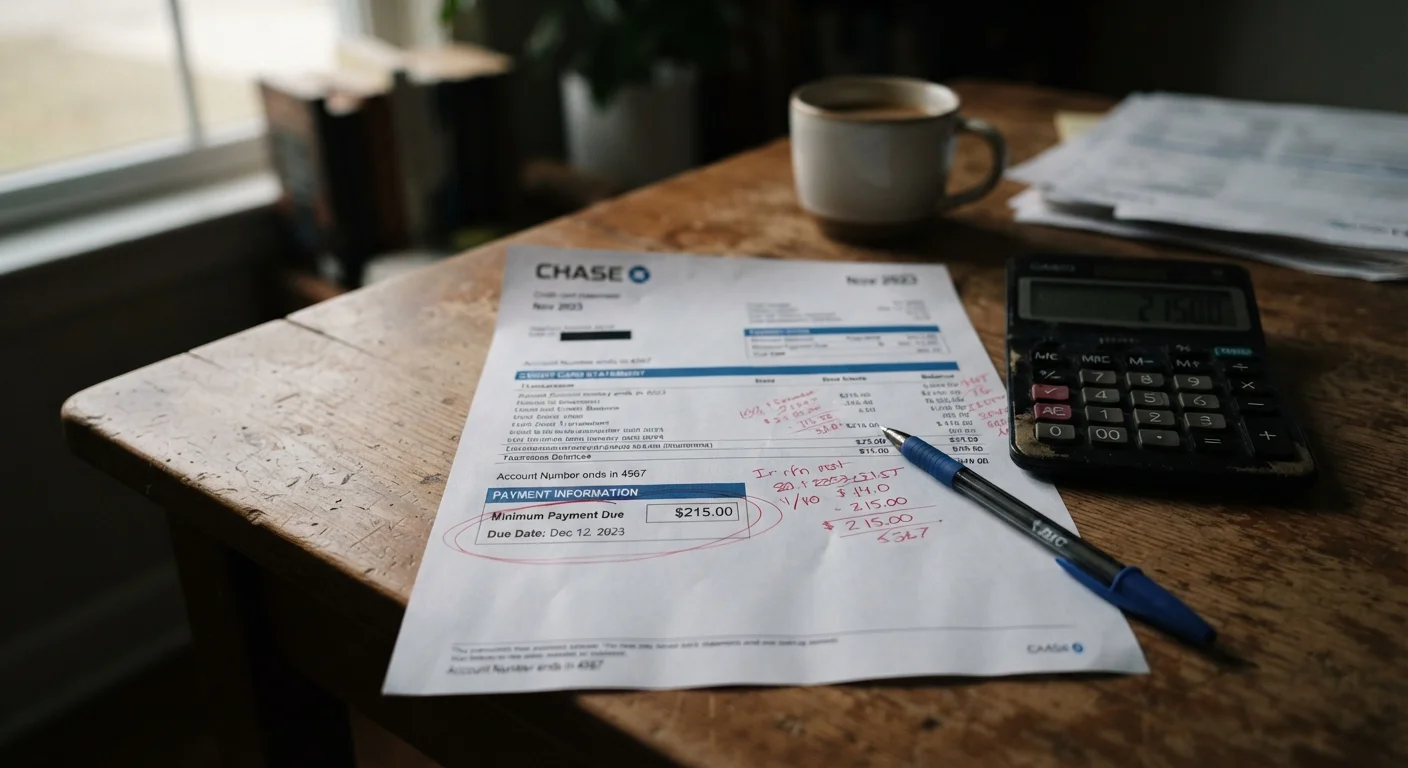
How Minimum Payments Are Designed to Work
Credit card issuers set minimum payments low on purpose. A low floor makes the card feel manageable month to month, encouraging continued use. But that convenience comes at a real cost to cardholders.
The typical formula works like this: your issuer calculates a small percentage of your current balance — often between 1% and 3% — or a flat dollar amount, and requires whichever is larger. On a $5,000 balance at a 2% minimum, that's $100. It sounds reasonable until you consider that at a 22% annual percentage rate (APR), roughly $90 of that $100 goes directly to interest. Only $10 reduces what you actually owe.
This is not a design flaw — it is the model. The longer the balance persists, the more interest the issuer collects. Understanding that dynamic is the first step toward breaking out of it. For a broader look at how debt-related decisions quietly extend repayment timelines, see choices that extend debt longer than necessary.
~1%–3%
Typical minimum payment as a share of balance
Most major U.S. credit card issuers set minimum payments at 1%–3% of the outstanding balance or a flat dollar floor, whichever is greater.
10+ years
Potential repayment timeline on minimum payments
On a mid-size balance at a high APR, paying only the minimum can extend repayment well beyond a decade, as disclosed on federally mandated statement warnings.
22%+
Average credit card APR in recent years
Federal Reserve data has shown average credit card interest rates climbing above 20% in recent periods, making high-balance, slow-repayment combinations especially costly.
The True Cost Over Time
The Credit CARD Act of 2009 requires issuers to print a minimum payment warning on every statement. It shows two numbers: how many years it takes to pay off the balance making only minimum payments, and how much total interest you would pay. Many cardholders are surprised by what they see.
On a $4,000 balance at 22% APR, paying only the minimum could stretch repayment beyond a decade and cost more in interest than the original balance itself. That is not a hypothetical scare tactic — it reflects standard amortization math when principal reduction is minimal each month.
Interest compounds on the remaining balance each billing cycle. When minimum payments barely dent principal, that compounding works against you continuously. Even a modest increase in your monthly payment — say, $50 or $75 above the minimum — can cut repayment time by years and save hundreds or thousands of dollars in interest. To understand how carrying this balance also affects your credit profile, learn how debt affects your credit score.
A More Effective Repayment Approach
Escaping the minimum payment trap does not require a dramatic income jump. It requires a deliberate reallocation of what you already have.
Two widely used frameworks can help. The avalanche method directs extra payments toward the highest-APR balance first, minimizing total interest paid. The snowball method targets the smallest balance first, building psychological momentum through early wins. Neither is universally superior — the one you can sustain consistently is the right one.
Start With a Fixed Extra Amount
Rather than vowing to pay 'as much as possible,' choose a specific dollar amount above your minimum and treat it as a non-negotiable monthly expense. Even a consistent $50 or $75 extra each month creates meaningful acceleration. Automating that payment removes the temptation to skip it in tight months.
Whichever method you choose, the foundation is a budget that treats debt repayment as a fixed monthly obligation rather than an afterthought. Embedding a specific payment amount into your spending plan — before discretionary expenses — is what makes progress predictable. The budgeting basics hub offers practical frameworks for doing exactly that, and building a household budget around debt repayment walks through how to structure those allocations month by month.
Some cardholders also explore balance transfers to a lower-APR card to reduce interest costs during repayment. This can be useful, but it carries its own trade-offs worth weighing carefully. See the tradeoffs of using a balance transfer for a grounded look at when this strategy helps and when it does not.
This article is for general informational and educational purposes only and does not constitute personalized financial or legal advice. Consult a qualified financial professional regarding your specific situation.
Frequently Asked Questions
Your account stays current and avoids late fees, but interest continues to compound on nearly your entire balance. On a high-APR card, much of each minimum payment goes toward interest rather than reducing principal, which can stretch repayment out by years or even decades.
Most issuers use either a percentage of the outstanding balance (commonly 1%–3%) or a flat minimum — often $25 or $35 — whichever is higher. Some methods add accrued interest and fees to that percentage before setting the floor.
Paying on time — even the minimum — protects your payment history, which is a significant factor in your credit score. However, carrying a large balance relative to your credit limit raises your utilization rate, which can negatively affect your score over time.
There is no universal answer, but even adding a fixed amount above the minimum each month can sharply reduce total interest paid. The key is consistency. Building that extra payment into a monthly budget makes it sustainable rather than sporadic.
A balance transfer to a lower-APR card can reduce interest costs, but it comes with fees, promotional period deadlines, and approval requirements. It works best as part of a disciplined repayment plan, not as a standalone fix.
Starting with a structured household budget is the most practical approach. Allocating specific dollars each month to debt repayment — rather than paying whatever is left over — creates momentum and predictability in reducing what you owe.
The content on this site is for informational purposes only and is not a substitute for professional advice. Always consult a qualified professional for guidance specific to your situation.