

Our Verdict
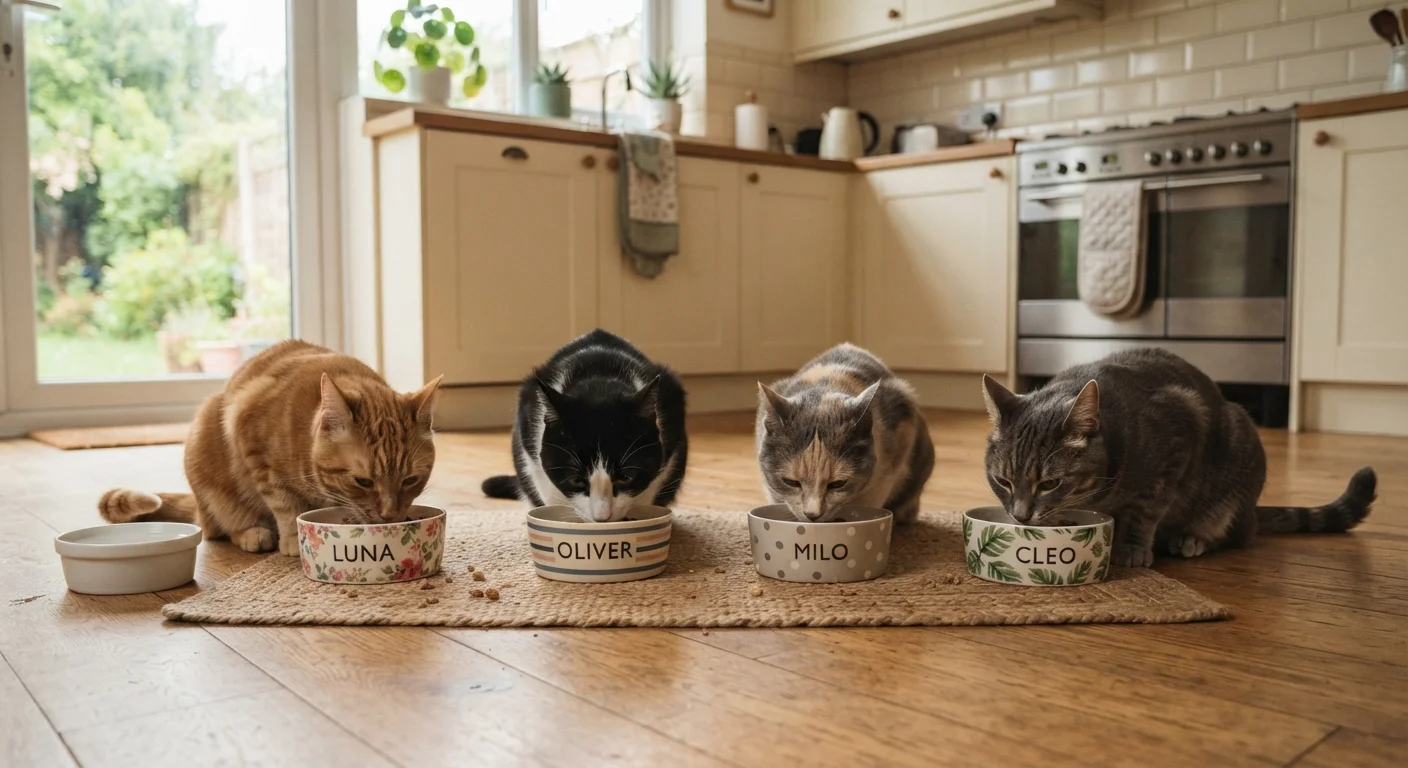
No single feeding method suits every multi-cat household. Scheduled meals offer the greatest control and are often the safest starting point, especially when cats have different health or dietary needs. Puzzle feeders complement almost any routine, while free-feeding is best reserved for households where all cats maintain a healthy weight and eat similar diets.
| Best for | Recommended |
|---|---|
| Households with cats on different therapeutic or age-appropriate diets | Scheduled Meals |
| Owners concerned about food guarding or inter-cat competition | Scheduled Meals with Separate Stations |
| Cats that eat too quickly or need behavioral enrichment | Puzzle Feeders |
| Households with all healthy, lean cats sharing the same diet | Free-Feeding (with monitoring) |
Why Mealtime Gets Complicated with Multiple Cats
Cats are solitary hunters by nature. Unlike dogs, they did not evolve to share food sources cooperatively, which means placing several cats around the same bowl can trigger stress, competition, and even subtle bullying — often invisible to the owner. In multi-cat homes, these tensions frequently surface as one cat overeating while another is quietly pushed away from the food station.
Beyond social dynamics, cats in the same household often have vastly different nutritional requirements. A senior cat managing kidney disease cannot safely share food with a young, active cat eating a high-protein growth formula. Similarly, a cat prone to weight gain needs strict portion control that free access to food undermines entirely. For a broader look at foundational cat care, see our guide to bringing a cat home for the first time.
Understanding the three primary feeding approaches — free-feeding, scheduled meals, and puzzle feeders — gives owners the tools to match a strategy to their household's specific dynamics.
Comparing the Three Main Feeding Approaches
Each method carries distinct trade-offs in terms of owner effort, suitability for different cat personalities, and impact on health outcomes. The table below summarizes the key differences.
| Free-Feeding | Scheduled Meals | Puzzle Feeders | |
|---|---|---|---|
| Owner effort required | Low — refill as needed | Moderate — twice-daily routine | Moderate — setup and cleaning |
| Portion control | Poor — hard to track intake | Excellent — measured portions | Good — limits speed, not volume |
| Suitability for different diets | Poor — cats may share food | Excellent — separated stations | Moderate — works per-cat |
| Early illness detection | Difficult — changes go unnoticed | Easy — appetite changes visible | Moderate — some observation needed |
| Reduces inter-cat competition | Poor without multiple stations | Excellent with separate rooms | Good — redirects focus to task |
| Mental stimulation provided | None | Minimal | High |
| Best suited for | Lean cats, same diet | Mixed-need households | Fast eaters, bored cats |
It is worth noting that these approaches are not always mutually exclusive. Many owners use scheduled meals as the foundation and incorporate puzzle feeders as an enrichment layer within that structure.
Free-Feeding: Convenience with Caveats
Free-feeding — leaving dry food out at all times — is the lowest-effort option and suits households where every cat maintains a healthy weight and eats the same diet. However, veterinary nutritionists generally note that free-feeding makes it very difficult to monitor how much each cat consumes. If one cat begins eating less due to illness or dental pain, that change can go undetected for weeks.
Resource guarding is another concern. Even cats that appear to coexist peacefully can engage in subtle intimidation around a shared food station, causing a more timid cat to under-eat chronically. If you pursue free-feeding, providing multiple feeding stations in different rooms — at minimum one per cat, plus one extra — reduces the likelihood of one cat monopolizing food access.
Free-Feeding and Weight Gain Risk
Research consistently links ad libitum (free-choice) feeding to higher rates of feline obesity, particularly in indoor cats with low activity levels. Overweight cats face elevated risks for diabetes, joint disease, and urinary problems. If any cat in your household is already at or above a healthy weight, free-feeding is generally not advisable without close veterinary supervision.
Scheduled Meals: Control and Visibility
Feeding cats at fixed times — typically twice daily — gives owners a clear window into each cat's appetite, which is one of the most reliable early indicators of illness. When a cat that normally eats enthusiastically begins leaving food, an owner on a scheduled routine is far more likely to notice quickly.
Scheduled feeding also enables portion precision, which is essential when cats have different caloric or therapeutic needs. Feeding in separate rooms or enclosed spaces during mealtimes removes competitive pressure entirely. While this requires more effort and coordination, it is the most medically sound approach for households with cats on prescription diets, seniors, or kittens. For context on how enrichment fits into a broader care routine, our pet wellness hub covers preventive care across species.
Puzzle Feeders: Slowing Down and Enriching Mealtimes
Puzzle feeders — devices that require a cat to work for each portion of food — address two common multi-cat problems simultaneously: fast eating and under-stimulation. Cats that eat rapidly often vomit shortly after meals, a complaint many multi-cat owners recognize. Puzzle feeders extend the eating process naturally, reducing this risk without medication or owner intervention.
From a behavioral standpoint, puzzle feeders distribute a cat's focus to the task rather than to other cats in the space, which can reduce tension at mealtimes. They also provide the kind of independent mental engagement that cats need, particularly in indoor environments. For owners curious about enrichment strategies for single cats — which translate well to multi-cat settings too — our article on keeping a solo cat mentally stimulated offers practical ideas.
Introduce Puzzle Feeders Gradually
If your cats have never used a puzzle feeder, start with the simplest design — a flat tray with shallow dividers — before moving to more complex versions. Cats unfamiliar with the concept may initially refuse to engage, especially anxious individuals. Patience and gradual complexity increases improve adoption rates significantly.
This article is for general informational purposes only and is not a substitute for personalized veterinary advice. Consult your veterinarian before making significant changes to your cats' diet or feeding routine, especially if any cat has a known health condition.
The content on this site is for informational purposes only and is not a substitute for professional advice. Always consult a qualified professional for guidance specific to your situation.