

Why Only Cats Need Extra Enrichment
Cats are often described as solitary animals, and while that's partly true, it's an oversimplification that can lead owners to underestimate how much mental engagement their pets actually need. In the wild, cats spend the majority of their waking hours hunting, exploring territory, and responding to environmental stimuli. A single cat living indoors without a feline companion loses access to a major source of that stimulation — social play and competition — and the owner becomes their primary outlet.
Without adequate enrichment, only cats commonly develop what behaviorists describe as boredom-related behaviors: redirected aggression, excessive vocalization, over-grooming, or furniture destruction. These aren't signs of a bad cat — they're signs of an understimulated one. Understanding this distinction is the first step toward addressing it confidently.
For cat owners thinking about lifestyle factors beyond just play, our overview of indoor versus outdoor living explores how environment shapes feline wellbeing across the board.
Rotate Toys Weekly to Preserve Novelty
Cats habituate quickly to familiar objects — what excited them on Monday may be completely ignored by Friday. Rather than buying constantly, divide your cat's existing toys into two or three rotating sets and swap them out on a weekly schedule. Reintroducing a toy after a short absence often triggers renewed interest, mimicking the unpredictability of prey. Feather wands, crinkle balls, and soft mice are particularly effective when rotated this way.
Cats habituate fast — rotating toys restores novelty without requiring new purchases.
Use Puzzle Feeders and Foraging Activities
Feeding from a bowl is efficient, but it bypasses one of a cat's most deeply wired drives: the hunt. Puzzle feeders — devices that require a cat to paw, nudge, or manipulate food out — extend mealtime and engage problem-solving instincts. Scatter feeding (spreading dry kibble across a mat or low-pile rug) is a low-cost alternative. Even hiding small portions of food in different locations around the home creates a foraging experience that occupies the mind for far longer than a standard bowl.
Puzzle feeders extend mealtime and engage the same instincts cats use when hunting prey.
Create Vertical Space and Exploration Zones
Cats are natural climbers who feel more secure when they can survey their environment from height. Cat trees, wall-mounted shelves, and cleared bookcase tops give a solo cat the ability to patrol territory vertically — a behavior that's cognitively engaging in itself. Pair elevated platforms with hiding spots at floor level (cardboard boxes work well) to give your cat options for both observation and retreat. Environmental variety reduces stress and encourages spontaneous exploration throughout the day.
Vertical space lets cats survey their territory — a cognitively active behavior all its own.
Offer Window Access and Safe Visual Stimulation
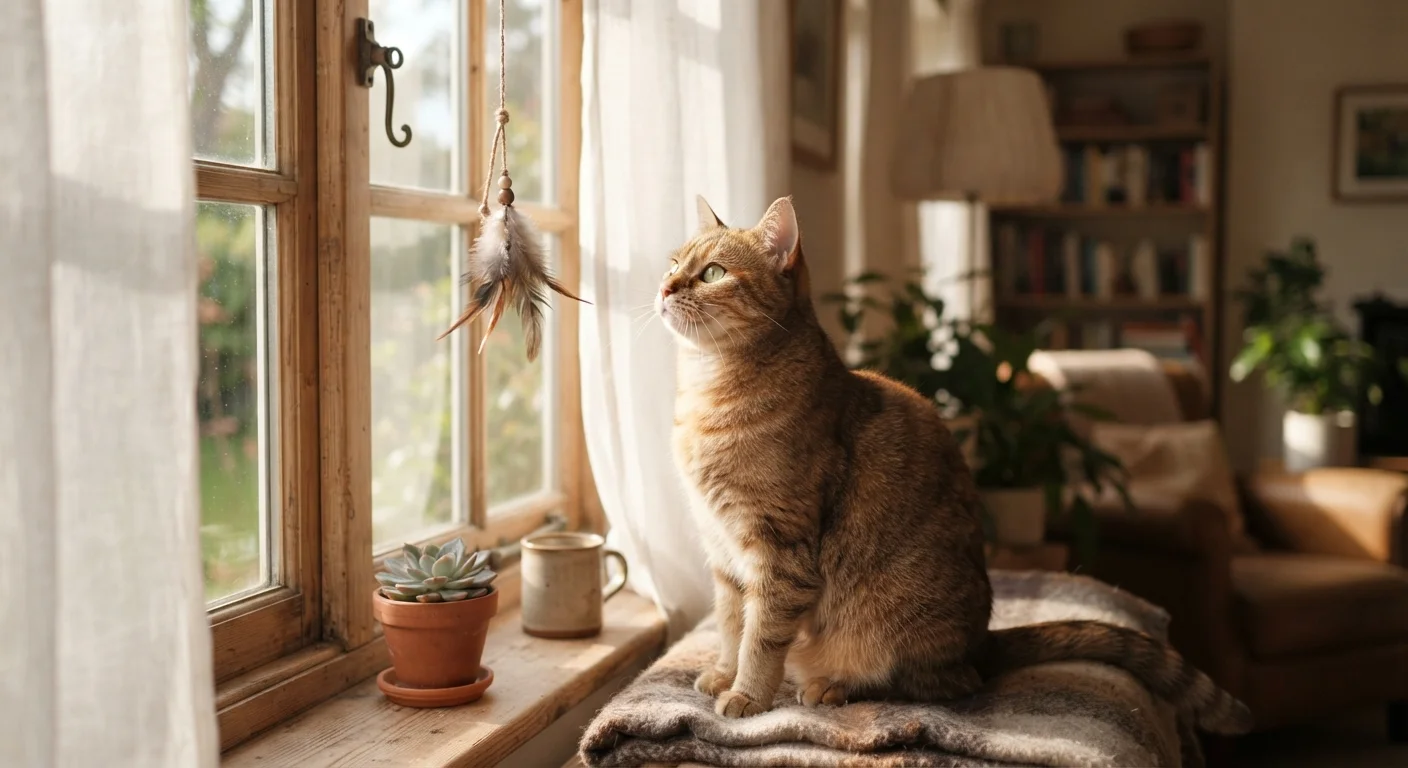
A window perch positioned near bird or squirrel activity is often called "cat TV" — and for good reason. Visual stimulation from outdoor movement engages attention and triggers mild predatory focus without any physical exertion required. If outdoor wildlife isn't reliably present, a bird feeder positioned just outside the window can reliably attract activity. Some owners supplement this with species-appropriate video content designed for cats, though individual responses vary significantly.
A strategically placed bird feeder outside a window can provide hours of reliable visual enrichment.
Schedule Short, Consistent Interactive Play Sessions
Research into feline behavior consistently supports the value of owner-led interactive play — sessions where you actively move a toy to simulate prey behavior. These don't need to be long; two focused 10-to-15-minute sessions per day are generally more beneficial than one extended session. The key is consistency and engagement: move the toy erratically, let the cat "catch" it periodically, and end on a satisfying capture to avoid frustration. Wand toys with feathers or fabric tails are particularly effective for this purpose.
Two focused 10-minute play sessions daily outperform a single long one for mental engagement.
Introduce Novel Scents and Sensory Experiences
A cat's sense of smell is estimated to be roughly 14 times stronger than a human's, making scent a powerful enrichment channel. Introducing novel smells — a sprig of dried valerian, a piece of bark from outdoors, or even a worn item of clothing from someone your cat knows — can occupy a cat's attention for extended periods. Catnip and silver vine are well-documented botanical stimulants that produce safe, temporary euphoric responses in cats that carry the relevant genetic sensitivity, which is estimated at roughly 50–70% of the domestic cat population.
Novel scents engage a cat's most powerful sense, providing enrichment that requires no equipment.
Train Simple Behaviors Using Positive Reinforcement
Many cat owners are surprised to learn that cats can be trained using clicker or marker-based methods. Teaching a solo cat to sit, touch a target, or navigate a simple obstacle course provides cognitive challenge and strengthens the human-animal bond simultaneously. Keep sessions brief — two to three minutes is typically the productive window — and use high-value treats as rewards. Training also gives you a reliable tool for redirecting attention-seeking behaviors toward structured, positive interaction.
Short training sessions give solo cats cognitive challenge while strengthening their bond with you.
Building a Stimulating Life for One
Mental enrichment works best when it's woven into your cat's daily routine rather than treated as an occasional activity. Consistency matters — cats are creatures of habit, and predictable windows of play, feeding engagement, and exploration help regulate mood and reduce anxiety.
Make Enrichment a Daily Habit, Not an Event
Cats benefit most from enrichment that's predictable and varied over time. Set a consistent time for interactive play — ideally in the evening when many cats are naturally more active — and treat it as a non-negotiable part of your routine. Even five minutes of intentional engagement is more valuable than an hour of passive coexistence. Over time, these habits build a calmer, more confident cat.
It's also worth noting that enrichment doesn't exist in isolation from other aspects of wellness. A cat whose nutritional needs are well met is more likely to have the energy and alertness for active play. See our guide to feline nutritional needs for a grounding overview of what supports a cat's overall vitality. And for cats sharing a household — where enrichment strategies necessarily shift — feeding approaches for multi-cat households offers useful context on managing resources fairly.
This article provides general educational information about cat enrichment and is not a substitute for advice from a qualified veterinarian or certified animal behaviorist. If your cat's behavior changes suddenly or significantly, consult a veterinary professional.
The content on this site is for informational purposes only and is not a substitute for professional advice. Always consult a qualified professional for guidance specific to your situation.