

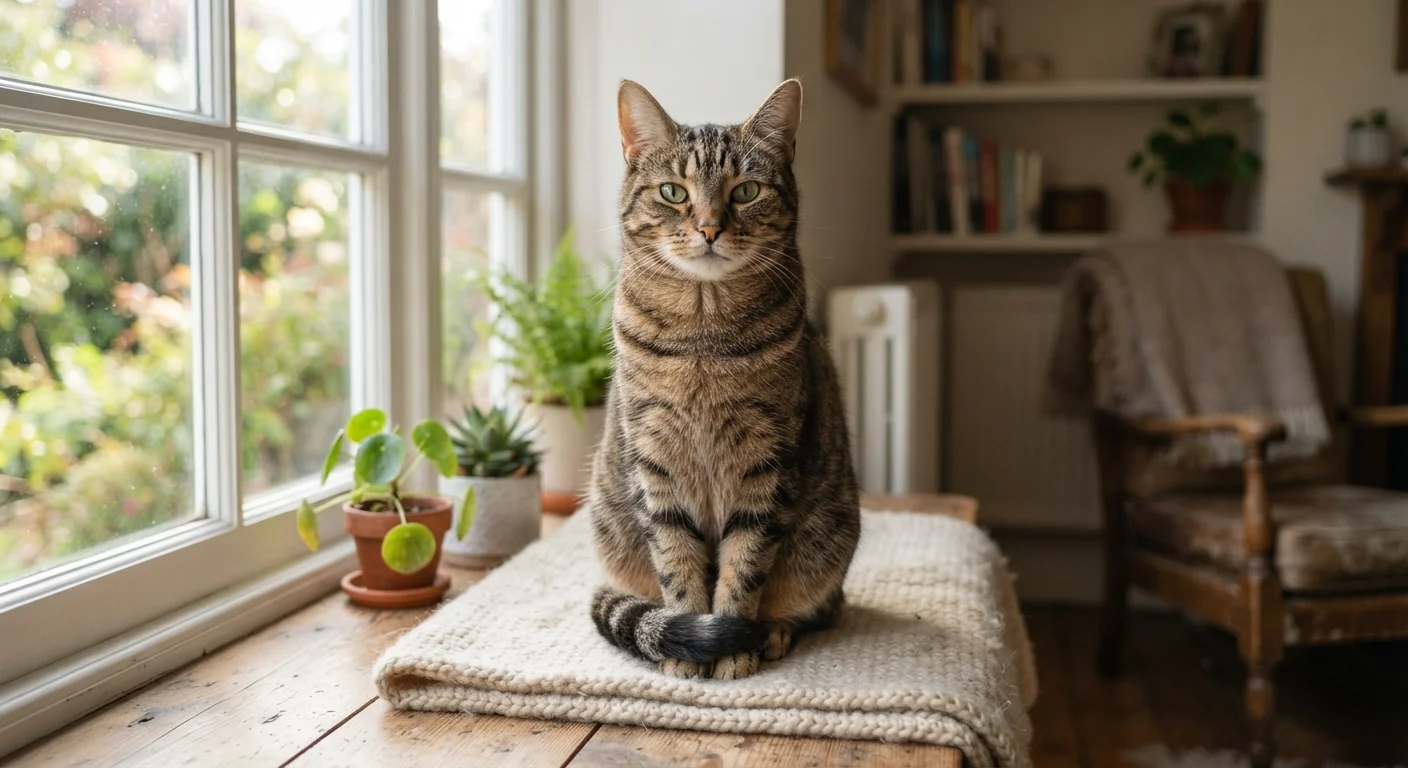
The Tail: A Real-Time Emotional Readout
The tail is one of the most expressive parts of a cat's anatomy. A tail held high and vertical, sometimes with a slight curl at the tip, is typically a greeting signal — cats that feel confident and friendly approach this way. A tail tucked low or wrapped tightly around the body signals anxiety or submission.
A slowly swishing tail can indicate focused attention, often seen during play or while watching prey. A rapid, lashing tail is a different story: it communicates irritation or overstimulation, and continuing to pet a cat showing this signal often results in a defensive swipe or bite. A puffed tail indicates fear or extreme agitation — step back and give your cat room to decompress.
Watch the Tail Before You Pet
Before reaching out to touch your cat, observe the tail for a few seconds. A calm, loosely held tail or an upright greeting tail suggests the cat is open to interaction. A rapidly flicking or lashing tail is a cue to pause — continuing to pet at that point often leads to overstimulation and a defensive response.
Ears and Eyes: Reading the Face
Cat ears are highly mobile and rotate up to 180 degrees, making them reliable emotional indicators. Ears pointing forward and slightly outward reflect relaxed curiosity or engaged interest. As tension rises, ears rotate sideways — often called "airplane ears" — and in high-alert or aggressive states they flatten completely against the skull.
Pupil size adds important context. Narrowed pupils in bright light are normal, but narrowed pupils in dim light can signal heightened arousal or mild aggression. Fully dilated pupils in normal lighting often reflect fear, excitement, or pain. The slow blink — where a cat half-closes its eyes and opens them gradually — is widely regarded by animal behaviorists as a low-threat, affiliative signal. Returning a slow blink to your cat is a recognized way to reinforce a calm social bond.
Cats and Dogs Signal Differently
A wagging dog tail usually signals excitement or friendliness; the same rapid movement in a cat typically means the opposite. Applying dog-reading instincts to cats is one of the most common sources of miscommunication between humans and their feline companions. If you share your home with both species, our guide to dog body language covers canine signals specifically.
Posture and Touch: What the Whole Body Reveals
A cat's full-body posture provides context that individual signals alone cannot. A relaxed cat holds its weight evenly, moves fluidly, and may roll onto its side or back — a posture that indicates comfort in its environment. An arched back combined with a puffed coat signals defensive aggression, while a crouched, low-to-the-ground posture with tucked limbs usually means the cat feels threatened and is preparing to flee or freeze.
Head bunting — when a cat presses its forehead or cheek against you — involves scent glands and is associated with affiliative behavior. Kneading, the rhythmic pressing of paws against a surface, is a behavior originating in kittenhood and often appears when a cat is relaxed or content. However, context matters: a cat kneading while appearing tense or vocalizing may be self-soothing under stress rather than expressing contentment.
Understanding the whole-body picture is especially important when monitoring health. Subtle postural changes — guarding a limb, hunching over the abdomen, reluctance to jump — can be early indicators of discomfort. See our guide to recognizing pain signals in pets for more detail on when behavior warrants a veterinary call.
276+
Distinct vocalizations documented in domestic cats
Research from animal communication studies suggests cats have developed an unusually wide vocal range compared to most other felids, much of it directed specifically at humans.
180°
Range of ear rotation in cats
The anatomical mobility of feline ears — controlled by roughly 30 muscles — makes them one of the most expressive and reliable emotional indicators in the species.
Putting It All Together: Context Is Everything
No single signal tells the full story. A twitching tail alone has multiple possible meanings; combined with dilated pupils and a crouched posture, it paints a clear picture of a cat on the defensive. Effective reading of feline body language requires watching several signals simultaneously and accounting for the environment — a new visitor, a loud noise, or a change in routine all influence how a cat carries itself.
It's also worth remembering that body language shifts across a cat's life stages. Kittens are typically more expressive and less inhibited, while senior cats may communicate more quietly or show more guarded postures. Our overview of how cats age covers how behavioral patterns evolve over a lifetime. And if you're ever unsure whether a signal reflects personality or a health concern, your veterinarian is the right resource — body language is general information and education, not a substitute for professional assessment.
This article is for general informational purposes only and is not a substitute for professional veterinary advice. Always consult a licensed veterinarian regarding your cat's health and behavior.
Frequently Asked Questions
A slow blink is generally associated with a calm, relaxed state and is considered a social signal of trust between cats and familiar humans. Many behaviorists describe it as a non-threatening gesture. You can try returning the slow blink, which may help reinforce a sense of safety for your cat.
A puffed or bristled tail is a response to perceived threat or extreme arousal — the fur stands on end to make the cat appear larger. This is an involuntary reaction driven by the nervous system. Give your cat space and remove whatever is triggering the response when possible.
Not necessarily. A belly-up posture signals that a cat feels safe enough to expose a vulnerable area, but it does not always mean the cat wants to be touched there. Many cats will respond defensively if their belly is rubbed, even when the initial roll seemed like an invitation.
Ears flattened sideways or pinned back against the head typically indicate fear, agitation, or aggression. This posture often appears alongside dilated pupils and a tense body. It is a clear signal to give the cat space rather than approach.
Yes. Cats often mask discomfort, but subtle body language changes — such as hunching, guarding a body part, reduced grooming, or unusual stillness — can indicate pain. Consult your veterinarian if your cat's posture or behavior changes without an obvious cause.
Cats and dogs use some of the same body parts to communicate — tails, ears, eyes — but the signals often mean opposite things. A dog wagging its tail is typically excited or friendly; a cat's lashing tail usually signals irritation. Applying dog-reading instincts to cats leads to frequent misinterpretation.
The content on this site is for informational purposes only and is not a substitute for professional advice. Always consult a qualified professional for guidance specific to your situation.