

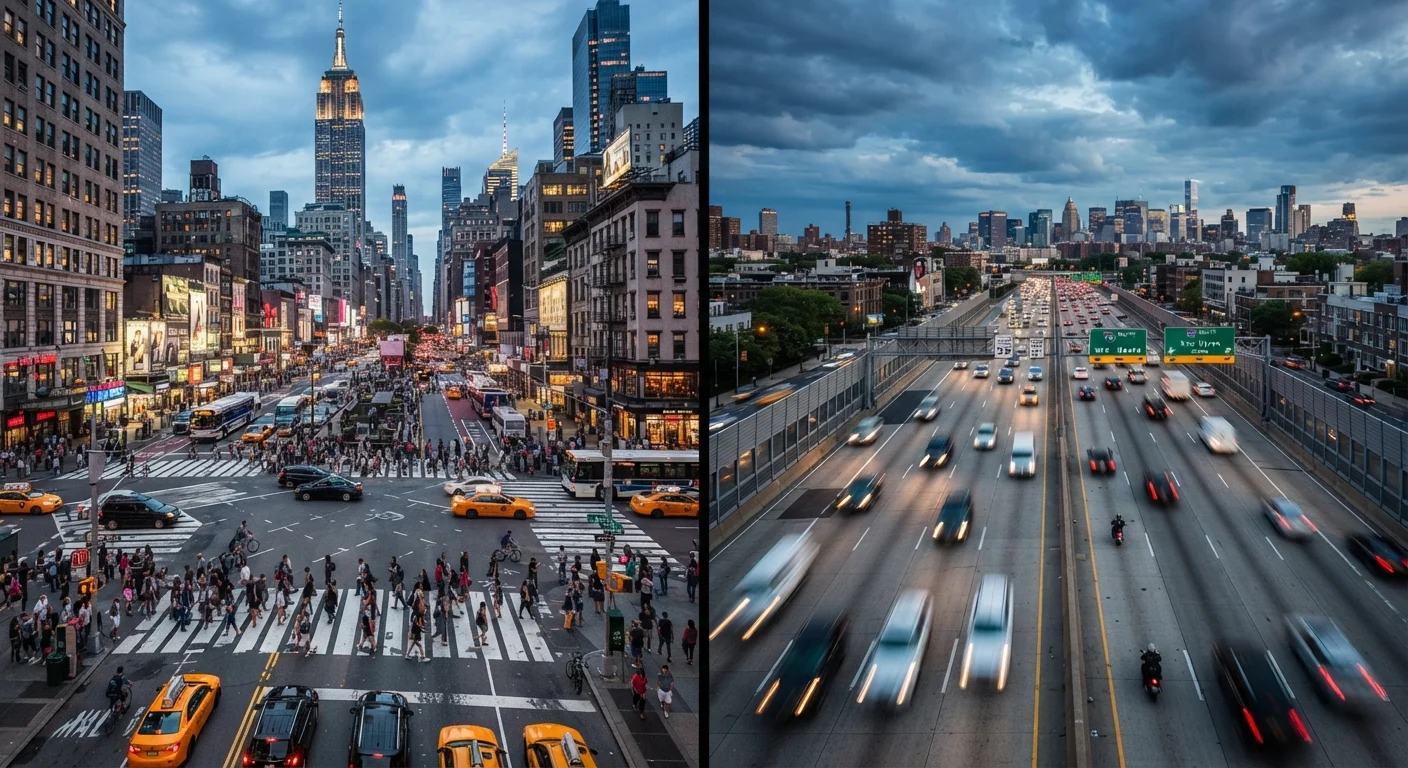
Option A
Highway Driving
High-speed, long-distance travel on controlled-access roads.
Best for: Drivers covering long distances who need to manage speed, following distance, and fatigue on limited-access freeways.
Option B
City Driving
Stop-and-go navigation through dense, unpredictable urban traffic.
Best for: Drivers navigating complex intersections, pedestrian zones, and frequent lane changes in high-density urban environments.
How Risk Is Distributed Across Each Environment
At first glance, highways seem more dangerous — speeds are higher, vehicles are heavier, and a single error can have catastrophic consequences. But crash data from the National Highway Traffic Safety Administration (NHTSA) consistently shows that urban roads account for the majority of total crash volume, while rural and highway roads account for a disproportionate share of fatalities relative to miles traveled.
This distinction matters. City driving generates more frequent collisions — fender-benders, sideswipes, pedestrian incidents — largely because of the sheer density of intersecting movements. Highway driving produces fewer crashes but a higher rate of serious injury or death when crashes do occur, primarily because of vehicle speed at the moment of impact.
Understanding where risk lives in each setting is the foundation for adapting your habits appropriately. See our complete driver's road safety guide for a broader overview of hazard categories.
~40%
Of U.S. crash fatalities occur at intersections
According to the National Highway Traffic Safety Administration, intersections are among the most dangerous points on any roadway network.
20% higher
Fatality rate per mile on rural/highway roads vs. urban
NHTSA data consistently shows rural roads — including highways — produce disproportionately fatal outcomes relative to total miles traveled.
20 hrs
Without sleep equates to 0.08% BAC impairment
Research from the AAA Foundation for Traffic Safety found that severe sleep deprivation impairs driving performance similarly to legal intoxication limits.
The Unique Hazards of Highway Driving
On a controlled-access freeway, the physical separation of opposing traffic and the absence of intersections removes many city hazards — but introduces new ones. The primary risks are speed-related: stopping distances increase dramatically above 60 mph, meaning the margin for error shrinks with every additional mile per hour.
Merging and lane changes are among the most dangerous maneuvers on a highway. Drivers must judge closing speeds of vehicles in adjacent lanes — a task complicated by the fact that humans notoriously misjudge the speed of approaching objects. Failing to match highway speed before merging from an on-ramp is a leading cause of rear-end collisions in freeway entry zones.
Driver fatigue is a uniquely severe highway hazard. Monotonous stretches of road, consistent speed, and reduced cognitive stimulation accelerate fatigue onset. Studies from the AAA Foundation for Traffic Safety indicate that going without sleep for 20 or more hours produces impairment comparable to a blood-alcohol level of 0.08%. Long highway trips demand structured rest stops, ideally every two hours.
Following distance must expand substantially at highway speeds. The commonly cited three-second rule is a minimum baseline — at 70 mph, a gap of four to five seconds is more appropriate to allow adequate reaction time. Conditions like rain or fog extend that further, as explored in our guide to driving in adverse weather.
| Criterion | Highway Driving | City Driving |
|---|---|---|
| Primary risk factor | High speed, reduced reaction time | High density, unpredictable hazards |
| Crash frequency | Lower overall collision rate | Higher overall collision rate |
| Crash severity | Higher fatality rate per crash | More property damage, fewer fatalities |
| Dominant hazard type | Fatigue, speed, merging errors | Intersections, pedestrians, distraction |
| Required following distance | 4–5 seconds minimum at speed | 2–3 seconds in stop-and-go traffic |
| Cognitive demand | Sustained alertness over time | Rapid, reactive multi-variable scanning |
| Key skill to develop | Speed management and fatigue awareness | Intersection discipline and hazard anticipation |
The Unique Hazards of City Driving
Urban environments compress risk into a different shape. The hazards aren't primarily about speed — they're about volume and unpredictability. Intersections alone account for roughly 40% of all crash fatalities in the United States, according to NHTSA data, and cities are dense with them.
Pedestrians and cyclists dramatically raise the stakes of a momentary lapse in attention. Unlike highway driving, where the roadway is predominantly shared by motor vehicles moving in the same direction, city streets introduce road users moving at widely varying speeds and from unexpected angles. A distracted driver checking a navigation screen for two seconds can travel the length of a crosswalk without realizing it.
Intersection decision-making is cognitively demanding. Drivers must simultaneously assess signal timing, oncoming traffic for left turns, pedestrian signals, cyclists in bike lanes, and vehicles running late yellows. This cognitive load is a major reason distraction is the dominant city hazard — there are simply more variables to track, and any reduction in attention narrows the window to respond.
Parking and low-speed maneuvers produce a significant proportion of urban collision reports. Door zone incidents (where an opening car door strikes a passing cyclist or vehicle), backing collisions, and visibility-obstructed turns through tight urban corridors all contribute. These crashes are rarely fatal but can cause injury and significant vehicle damage.
Drivers who want to challenge assumptions about their urban habits should also review common driving safety myths — several apply directly to city-specific behaviors like hands-free phone use.
Adapting Your Skills for Each Environment
The core competency gap between highway and city driving comes down to this: highway driving demands sustained awareness over time, while city driving demands rapid, reactive awareness across space. Neither is harder than the other — they're simply different cognitive modes.
For highway driving, the practical priorities are: maintaining appropriate following distance, performing mirror checks every five to eight seconds, planning lane changes well in advance, and scheduling mandatory rest breaks on trips longer than two hours. Night highway driving compounds fatigue and vision challenges — our article on nighttime driving safety covers the additional adjustments required after dark.
For city driving, the priorities shift: scan intersections before entering even on a green signal, use the two-second pause technique at stop signs to allow cross-traffic to clear, keep your eyes moving rather than fixed, and treat cyclist and pedestrian presence as a constant assumption rather than a situation-specific one.
Vehicle condition affects both environments — worn brakes perform worse at highway speeds, and degraded tires reduce responsiveness in emergency city stops. Routine car maintenance is a baseline safety investment regardless of where you spend most of your time driving.
This article is for general informational purposes only and does not constitute professional driving instruction or legal advice. Always follow your local traffic laws and consult a certified driving professional for personalized guidance.
The content on this site is for informational purposes only and is not a substitute for professional advice. Always consult a qualified professional for guidance specific to your situation.