

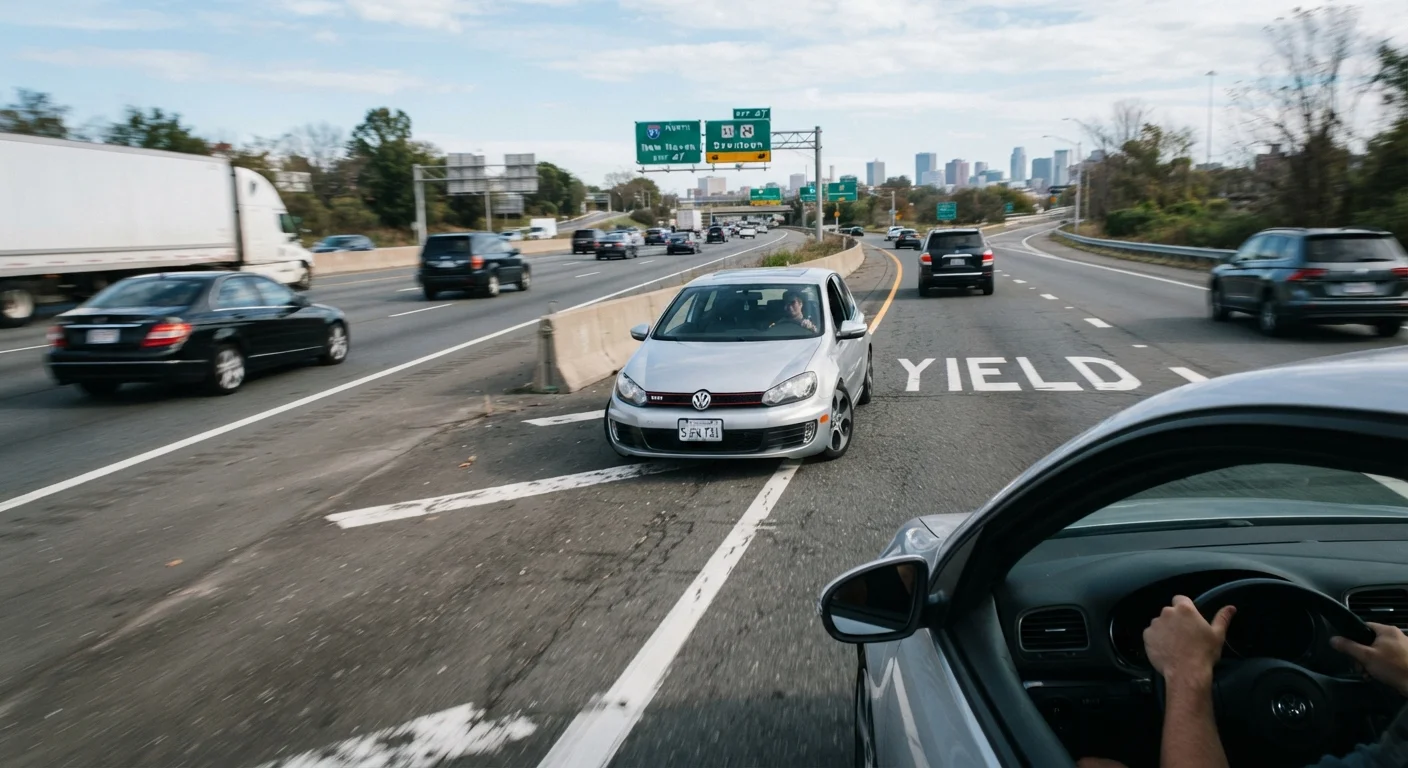
Why On-Ramp Merges Go Wrong
Freeway on-ramps are engineered to give drivers a controlled runway — time and distance to accelerate and find a gap. Despite that, merging is a consistent source of near-misses and fender-benders. The most common reasons: drivers merge too slowly, wait too long to check for gaps, or signal only after they've already started moving over.
The physics are straightforward. A freeway lane moving at 65 mph and a merging vehicle doing 40 mph creates a 25 mph closing speed differential with the car behind. That gap disappears quickly. Understanding this helps explain why matching speed — not just getting close to it — is the single most important habit in a safe merge.
For a broader look at how high-speed environments differ from city roads, see our breakdown of highway vs. city driving safety.
Never Stop at the End of an On-Ramp
Stopping at the merge point — unless forced by a yield sign and completely stationary traffic — creates a severe rear-end collision risk. Vehicles behind you on the ramp are accelerating and may not have time to stop. If traffic is too dense to merge, slow significantly but try to keep rolling while waiting for a gap.
Step-by-Step: Merging Onto the Freeway
Follow these steps every time you approach a freeway on-ramp. The sequence is designed to be repeatable, so it becomes automatic under pressure.
What you will need
Check your mirrors before you reach the ramp
As you approach the on-ramp, glance at your side and rearview mirrors to get a preliminary read on traffic density and speed in the right lane. This early scan gives you a baseline — you'll know roughly what gap size to look for before you're committed to the ramp.
Accelerate firmly throughout the ramp
Use the entire length of the on-ramp to build speed. Aim to reach or closely match the flow of freeway traffic before the merge point — not after it. Timid acceleration is one of the leading causes of dangerous speed differentials at the point of entry.
Signal your intent early
Activate your turn signal as soon as you enter the ramp — well before you need to merge. Signaling early communicates your intention to freeway drivers, giving them time to adjust their speed or position voluntarily rather than being surprised by your lane change.
Identify your target gap
While accelerating, look for a gap in right-lane traffic that is at least three to four seconds of following distance in length. A gap that looks adequate at 40 mph may shrink fast once you reach highway speed, so err toward larger openings.
Check your blind spot immediately before moving over
Mirror checks alone are not enough. Do a quick over-the-shoulder glance into your right blind spot in the last two to three seconds before you change lanes. A vehicle overtaking you in that zone may not be visible in your mirrors.
Merge smoothly into the gap
Once the gap is confirmed and speed is matched, steer into the right lane with a smooth, deliberate movement — not a sharp cut. Abrupt lane changes unsettle following traffic and can cause rear-end reactions. Settle into the lane, cancel your signal, and adjust your following distance to match the vehicle ahead.
This article provides general driver education and is not a substitute for formal driver training or your state's official vehicle code. Always follow posted signs, yield markings, and local traffic laws.
Habits That Reinforce Safe Merging
Merging safely is partly about the on-ramp moment and partly about what you do before you ever leave home. Mirrors adjusted correctly, tires properly inflated, and lights functional all reduce risk. A pre-trip safety checklist covers these basics in detail.
Once on the freeway, the habits that protect you during the merge — maintaining a safe following distance, staying aware of your surroundings — are the same ones that matter for the rest of the trip. Tailgating is especially hazardous in the right lane near on-ramps, where merging vehicles need room to enter. Giving extra space in that lane benefits everyone.
For a comprehensive look at the knowledge that underpins all of this, our complete road safety guide ties together habits, hazards, and high-risk situations in one place.
Freeway Drivers Can Help Too
If you're already on the freeway and see a vehicle merging, moving one lane left when it's safe to do so is both courteous and legal in most states. This simple adjustment removes conflict entirely and costs you almost nothing in terms of time or effort.
The content on this site is for informational purposes only and is not a substitute for professional advice. Always consult a qualified professional for guidance specific to your situation.