

Why Sitting All Day Is a Problem Worth Solving
Most American office workers — whether commuting to a building or logging in from home — spend six to nine hours a day seated. Research in occupational health has consistently linked prolonged, uninterrupted sitting to increased risk of cardiovascular concerns, metabolic issues, and musculoskeletal discomfort. The good news: you don't need to overhaul your life to push back against this pattern.
The goal isn't to turn your workday into a workout. It's to interrupt long stretches of stillness with small, deliberate movements that your body was designed to do. These habits are realistic, low-cost, and compatible with a full-time job — whether you're in a corporate office or a spare bedroom.
If you're also thinking about how your physical workspace contributes to posture and comfort, our ergonomics guide explains how small adjustments to positioning can reduce strain significantly. And if you want to extend these habits beyond the workday, building a weekly exercise schedule around a full-time job offers a practical framework for structuring movement across the full week.
Set a movement timer every 45–60 minutes
One of the most evidence-supported strategies for reducing sedentary time is simply breaking it up on a schedule. Set a recurring reminder — on your phone, computer, or smartwatch — to stand and move for two to five minutes every hour. Even short breaks interrupt the physiological effects of prolonged sitting.
Use these micro-breaks to refill your water, walk to another room, do a few shoulder rolls, or simply stand and shift your weight. The activity doesn't need to be strenuous — the interruption itself is what matters.
Breaking up sitting time on a schedule is one of the most evidence-supported strategies available.
Walk during phone calls and virtual meetings
If a meeting doesn't require you to be on camera or actively screen-sharing, treat it as an opportunity to move. Pacing around your home or stepping outside during a call adds meaningful steps without costing any extra time.
Many people find they think more clearly when walking — a phenomenon sometimes described in cognitive science literature as movement supporting creative and verbal processing. Even camera-on meetings allow for standing in place rather than sitting. Over a full workweek, these minutes compound significantly.
Walking during phone calls adds meaningful steps without costing any extra time in your day.
Habit-stack movement onto existing triggers
Habit stacking — attaching a new behavior to an existing routine — is one of the most reliable ways to build consistency. Link a brief movement practice to something you already do reliably: stand up every time you send an email, do a set of calf raises while your coffee brews, or walk around the block before and after your lunch break.
The key is specificity. Rather than planning to "move more," decide: when X happens, I will do Y. This removes the need for daily decision-making, which is often where new habits fail.
Linking movement to existing triggers removes the daily decision-making that causes habits to fail.
Incorporate desk-friendly stretching and mobility work
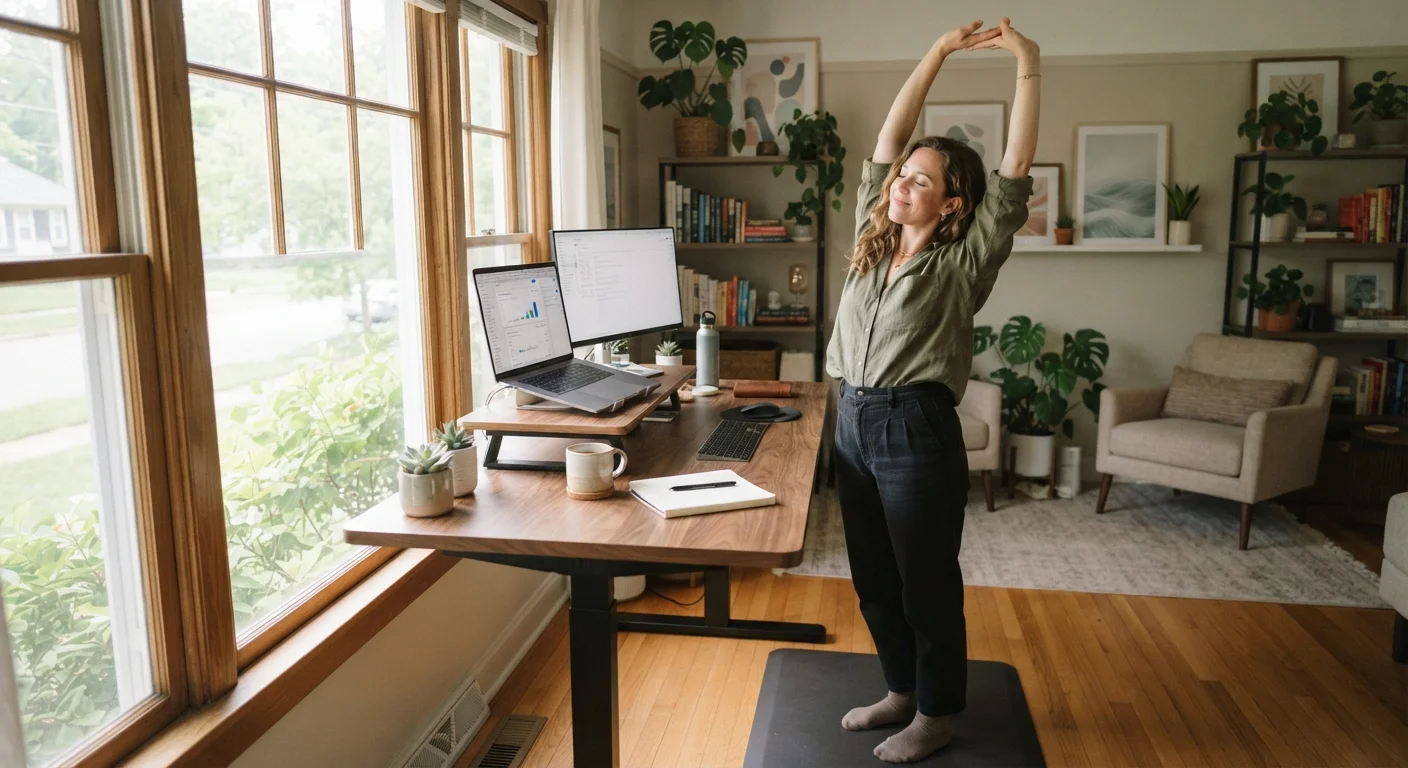
You don't need floor space or workout clothes to address stiffness that accumulates from sitting. Targeted stretches — hip flexor stretches using a chair, chest-opening movements, neck rolls, and seated spinal twists — can be done at or near your desk in under three minutes.
Tight hip flexors and rounded shoulders are among the most common postural consequences of desk work. A short daily mobility routine, especially mid-afternoon when tension tends to peak, can meaningfully reduce discomfort over time. If your workspace setup is contributing to strain, our guide to desk ergonomics is worth reviewing alongside these habits.
A three-minute midday mobility routine can meaningfully reduce the postural strain of desk work.
Rethink your commute and transition moments
Commutes, lunch hours, and the transitions between work and home life are underused movement opportunities. If you drive or take transit, parking farther away or getting off a stop early adds walking without requiring schedule changes. If you work from home, building a short walk into the start and end of your workday creates a physical boundary that also supports mental separation between work and rest.
These transition walks serve double duty: they accumulate steps and help regulate the shift in mental mode that desk workers — especially remote ones — often struggle with. For more on structuring a productive home workspace that supports wellbeing, see the anatomy of a productive home office.
Transition walks serve double duty — adding steps and helping regulate the mental shift between work and rest.
Explore a standing or sit-stand desk arrangement
Alternating between sitting and standing throughout the day — rather than standing for long uninterrupted periods — is generally considered more beneficial than either extreme alone. Sit-stand desks allow this flexibility, though they're one tool among many, not a complete solution on their own.
If you're considering this option, the evidence is worth understanding carefully. Our article standing desks vs. seated desks offers a clear-eyed look at what research actually supports. For those working in tighter spaces, small-space home office solutions covers flexible setup approaches that can still accommodate movement-friendly adjustments.
Alternating between sitting and standing is generally more beneficial than spending long stretches in either position.
Making It Stick Long-Term
Adding movement to a desk job isn't about willpower — it's about design. The habits that last are the ones anchored to something you already do, kept simple enough to sustain on hard days, and gradually built upon as they become routine.
Start With Just One New Habit
Behavior change research consistently shows that adding one habit at a time leads to better long-term success than attempting multiple changes simultaneously. Pick the strategy that fits most naturally into your current routine and practice it for two to three weeks before adding another. Small wins build momentum.
Start with one or two strategies from this list rather than attempting all of them at once. Once a habit feels automatic — usually after a few weeks of consistency — layer in another. For deeper guidance on making exercise a permanent part of your life, see our article on building a sustainable fitness habit.
This article is for general informational purposes only and does not constitute medical advice. If you have a health condition, injury, or concern about your activity level, consult a qualified healthcare professional before making changes to your routine.
The content on this site is for informational purposes only and is not a substitute for professional advice. Always consult a qualified professional for guidance specific to your situation.