

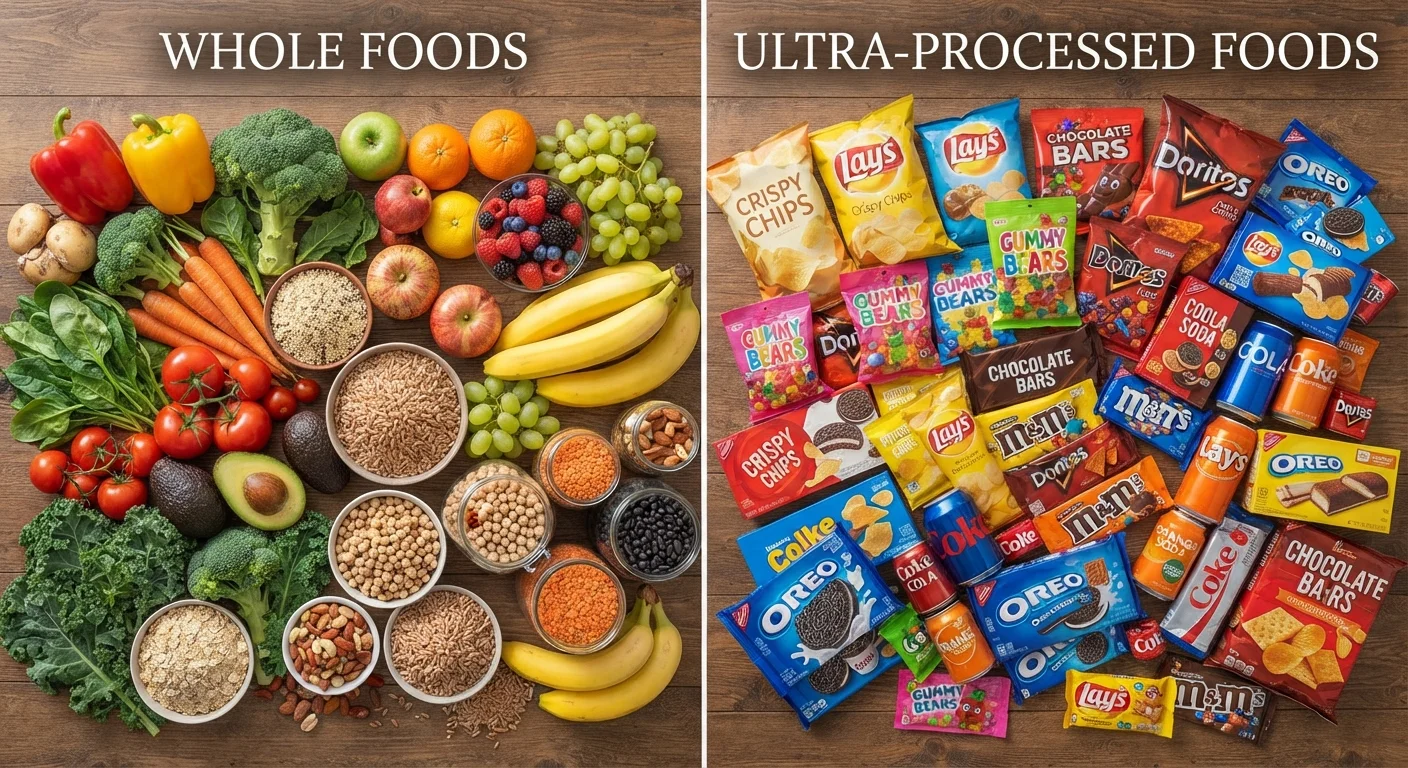
Option A
Whole Foods
Nutrient-dense, minimally altered foods as nature provides them.
Best for: People seeking maximum nutrient density, fiber, and minimal additives in their daily diet.
Option B
Processed Foods
Convenient, shelf-stable products altered by industrial preparation.
Best for: Situations where convenience and shelf life are priorities, though nutrient trade-offs vary widely by processing level.
What 'Processing' Actually Means
The word processed covers an enormous range — from washing and bagging spinach to engineering a shelf-stable snack cake with dozens of ingredients. Nutrition researchers commonly use the NOVA classification, which sorts foods into four groups based on how extensively they are industrially altered:
- Group 1 (Unprocessed/minimally processed): Fresh fruits, vegetables, plain meats, eggs, and plain legumes.
- Group 2 (Processed culinary ingredients): Oils, flour, salt, and sugar — used in cooking but not eaten alone.
- Group 3 (Processed foods): Canned fish, cheese, cured meats — whole foods altered mainly to extend shelf life.
- Group 4 (Ultra-processed foods): Packaged snacks, reconstituted meat products, sugary cereals — formulated with additives, flavors, and emulsifiers rarely used in home kitchens.
The nutritional concern centers almost entirely on Group 4. Understanding where a food falls on this spectrum is more useful than a blanket "processed is bad" rule. To decode the ingredient lists that reveal processing level, see our guide to reading nutrition labels.
Head-to-Head: Key Nutritional Differences
When comparing whole foods and ultra-processed foods across standard nutritional dimensions, consistent patterns emerge from peer-reviewed dietary research:
| Criterion | Whole Foods | Ultra-Processed Foods |
|---|---|---|
| Fiber content | High; intact from plant structure | Typically low; removed during refining |
| Micronutrients | Naturally rich in vitamins and minerals | Often depleted; some added back artificially |
| Added sugars | None (naturally occurring only) | Frequently high |
| Sodium | Naturally low | Often elevated for preservation and flavor |
| Additives and preservatives | Absent | Commonly present (emulsifiers, colorings, flavor enhancers) |
| Satiety per calorie | Generally higher due to fiber and protein | Lower; engineered palatability can promote overconsumption |
| Shelf life | Short to moderate | Extended |
Fiber loss is particularly significant. Most Americans already fall short of recommended daily fiber targets, and ultra-processed diets compound that gap. For a deeper look at why fiber matters so much, read our article on fiber — the nutrient most Americans under-eat.
What Research Shows About Dietary Patterns
Large-scale observational studies — including research published in journals such as The BMJ and JAMA Internal Medicine — have found associations between high ultra-processed food consumption and elevated risks of cardiovascular disease, type 2 diabetes, and all-cause mortality. These are population-level associations, not guarantees for any individual.
57%
Share of U.S. calories from ultra-processed foods
A study published in BMJ Open estimated that ultra-processed foods account for over half of daily caloric intake for the average American adult.
10%
Higher all-cause mortality risk per ultra-processed serving
A large cohort study published in JAMA Internal Medicine found each additional serving of ultra-processed food was associated with an approximately 18% higher risk of all-cause mortality, though individual risk varies.
95%
Americans falling short of fiber recommendations
Dietary survey data consistently shows that the vast majority of U.S. adults consume less than the recommended daily fiber intake, a gap worsened by heavy reliance on refined, processed foods.
Importantly, these studies identify patterns, not single foods as villains. A diet built predominantly around minimally processed whole foods — vegetables, fruits, legumes, whole grains, lean proteins — consistently performs well across health metrics. To understand how macronutrients within those foods actually function, see Macronutrients Decoded.
This article is for general informational and educational purposes only and is not a substitute for personalized medical or nutritional advice. Consult a qualified healthcare professional before making significant changes to your diet, especially if you have a health condition.
Practical Strategies for Shifting the Balance
An all-or-nothing approach rarely works in real life. Instead, consider incremental substitutions that shift your overall dietary pattern toward whole foods without requiring a complete overhaul:
- Anchor meals with a whole food base. Build plates around a vegetable, whole grain, or legume before adding other components.
- Swap refined for whole grains. Replacing white bread and white rice with whole-grain versions adds fiber and micronutrients with minimal effort.
- Use minimally processed convenience strategically. Frozen vegetables, canned beans (rinsed to reduce sodium), and plain Greek yogurt are time-saving without significant nutrient loss.
- Read ingredient lists, not just nutrition facts. A shorter ingredient list with recognizable items generally signals less processing.
- Crowd out rather than cut out. Adding more whole foods naturally leaves less room for ultra-processed options — a more sustainable approach than strict elimination.
Minimally Processed ≠ Nutritionally Poor
Pasteurized milk, plain frozen vegetables, canned tomatoes, and rolled oats are all technically "processed" — yet they retain strong nutritional profiles and fit well within a health-supportive diet. The processing level and what is added or removed matter far more than the processed/not-processed binary. When evaluating packaged foods, focus on the ingredient list and the degree of alteration rather than the label category alone.
For guidance on how what you drink interacts with nutrient absorption, see Hydration and Nutrition.
The content on this site is for informational purposes only and is not a substitute for professional advice. Always consult a qualified professional for guidance specific to your situation.