

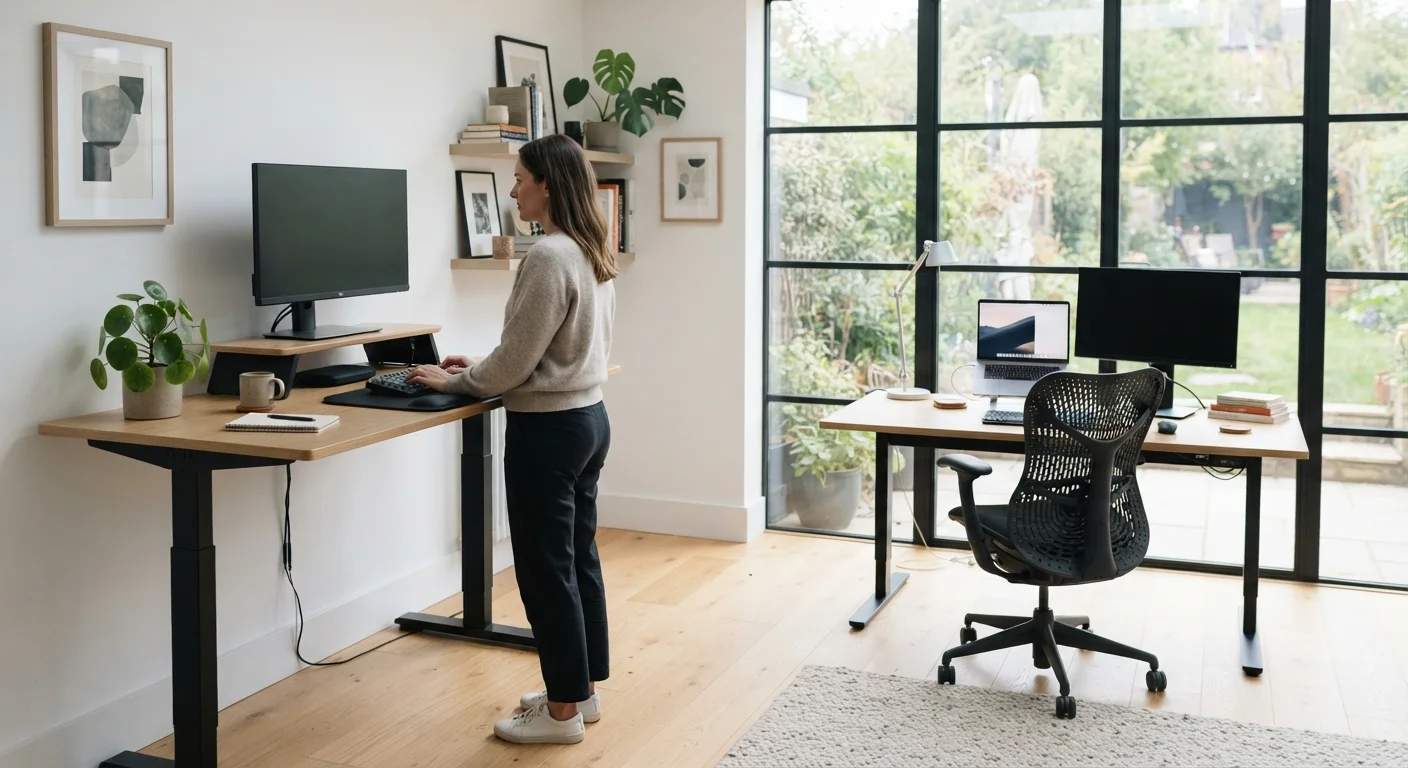
Option A
Standing Desk
The posture-forward, movement-oriented option.
Best for: Workers who want to break up long sedentary stretches and are willing to adapt their setup for variable-height use.
Option B
Seated Desk
The proven, ergonomically mature baseline.
Best for: Workers seeking stable, cost-effective setups optimized for focused, extended work sessions with proper ergonomic support.
What the Research Actually Shows
The standing desk market grew substantially over the past decade, fueled by headlines linking prolonged sitting to serious health risks. However, the actual research picture is more nuanced than those headlines suggest.
Studies published in occupational health journals have found that breaking up sitting time with standing does reduce continuous sedentary exposure. But standing in place for extended periods introduces its own set of problems — leg fatigue, lower-limb swelling, and varicose vein risk are documented concerns with prolonged standing at work. Researchers at institutions including the Institut de recherche Robert-Sauvé en santé et en sécurité du travail have noted these tradeoffs explicitly.
What evidence more consistently supports is postural variation — moving between sitting, standing, and light activity — rather than wholesale replacement of one posture with another. If you're evaluating your own work setup, check how common home office beliefs hold up under scrutiny.
This article is for general informational purposes only and does not constitute medical advice. If you have concerns about musculoskeletal health or chronic discomfort, consult a qualified healthcare professional.
Side-by-Side: Key Differences
Understanding the practical differences helps cut through marketing claims on both sides.
| Criterion | Standing Desk | Seated Desk |
|---|---|---|
| Typical cost range | Higher (especially motorized) | Lower to moderate |
| Ergonomic research base | Growing but mixed | Extensive, well-established |
| Posture variation support | High (sit-stand models) | Low on its own |
| Fatigue risk | Leg/lower-limb fatigue if overused | Back/hip stiffness if static |
| Setup complexity | Moderate to high | Low to moderate |
| Space requirements | Typically more | More flexible |
| Ideal posture duration | 30–60 min standing intervals | With regular breaks |
Height-adjustable (sit-stand) desks address the core limitation of a fixed standing desk by letting you shift throughout the day. But they come at a meaningful cost premium. For most remote workers, the ergonomic fundamentals — desk height, monitor distance, chair support — matter more than whether you're sitting or standing at any given moment. See how desk height and monitor distance affect your posture for detail on those adjustments.
The Ergonomics of Each Setup
A seated desk has decades of ergonomic research behind it. The principles are well-established: feet flat, knees at roughly 90 degrees, monitor at or just below eye level, forearms parallel to the floor. When these conditions are met, seated work is not inherently harmful.
Standing desks require their own ergonomic calibration. Elbows should still be at roughly 90 degrees, monitors need to rise accordingly, and anti-fatigue mats are widely recommended to reduce lower-limb strain. Getting this wrong — particularly standing at a surface that's the wrong height — can create neck and shoulder tension that rivals or exceeds seated discomfort.
~9.5 hrs
Average daily sitting time for desk workers
Research published in occupational health literature consistently finds that office-based workers sit for the majority of their working and leisure hours combined.
~30 min
Recommended standing interval before switching
Workplace ergonomics guidance generally suggests alternating between sitting and standing in roughly 30-minute blocks rather than standing for extended continuous periods.
Neither desk type eliminates the need for movement breaks. Practical movement habits that fit a sedentary work day can make a real difference regardless of which desk you use.
Making the Decision for Your Workspace
The desk choice should follow the worker, not the other way around. A few honest questions help clarify the decision:
- How long do you sit continuously? If you rarely get up for hours at a time, a sit-stand option may give you a useful prompt to change position.
- What's your budget? Quality seated setups — desk plus ergonomic chair — can be achieved for significantly less than a motorized height-adjustable desk.
- Do you have space constraints? Some standing desk frames require more floor area and cable management planning.
- What kind of work do you do? Fine motor tasks, extended writing, or dual-monitor workflows often feel more stable and controlled when seated.
For a broader look at every foundational decision in a home office, this complete starting point for remote workers covers desk, chair, tech, and environment in plain terms.
A Note on Individual Health Conditions
If you have a diagnosed musculoskeletal condition, circulatory issue, or chronic pain, neither a standing desk nor a seated desk is a substitute for professional guidance. An occupational therapist or physical therapist can assess your specific posture and workspace needs far more precisely than any general comparison. Always consult a qualified healthcare professional before making significant workspace changes based on a health concern.
The content on this site is for informational purposes only and is not a substitute for professional advice. Always consult a qualified professional for guidance specific to your situation.