

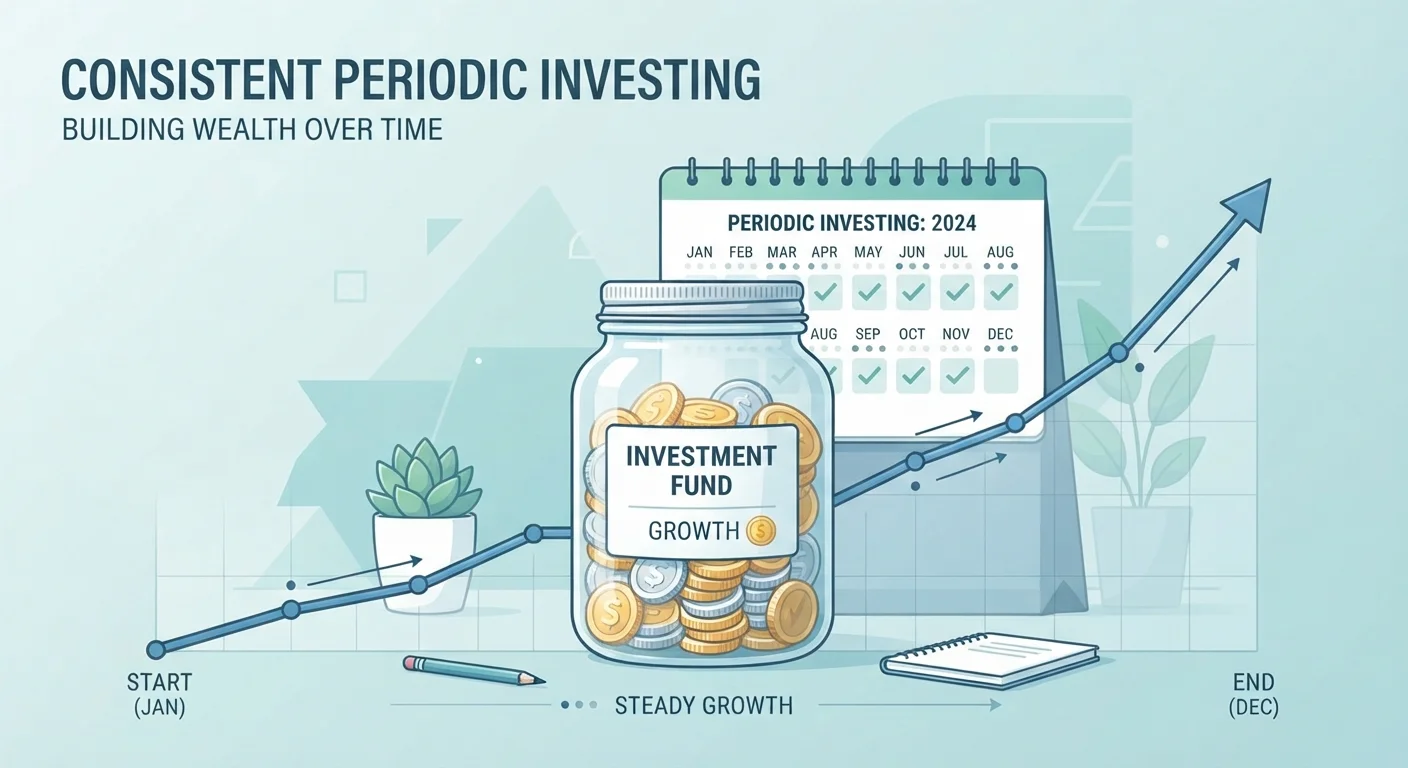
How Dollar-Cost Averaging Works
The mechanics are straightforward. Suppose you decide to invest $200 every month into a diversified fund. In month one, shares cost $20 each — your $200 buys 10 shares. In month two, the price falls to $16 — your $200 now buys 12.5 shares. In month three, the price recovers to $25 — your $200 buys 8 shares. After three months you've invested $600 and hold 30.5 shares, at an average cost of roughly $19.67 per share, even though prices ranged from $16 to $25.
That smoothing effect is the core appeal. Rather than committing all available funds at one potentially unfavorable moment, you spread purchases across different price points. This doesn't manufacture returns, but it can prevent the painful outcome of investing a large lump sum just before a significant market decline.
If you're new to the fundamentals of investing, our foundational investing guide covers the essential concepts and account types worth knowing before you start.
~70%
Of 10-year periods lump-sum investing outperformed DCA
According to Vanguard research analyzing global markets, lump-sum investing beat dollar-cost averaging roughly two-thirds of the time over rolling 10-year windows — though DCA still reduced short-term volatility risk.
$22.5T
Assets held in U.S. defined-contribution retirement plans
The Investment Company Institute estimated U.S. defined-contribution plan assets at approximately $22.5 trillion, representing millions of Americans effectively using DCA through automatic payroll contributions.
Why Consistency Matters More Than Timing
One of the most persistent investing myths is that patient, disciplined investors consistently outperform those who try to time the market. In practice, predicting short-term price movements is extraordinarily difficult — even for professional portfolio managers. Missing just a handful of the market's best-performing days over a decade can significantly reduce long-term returns.
Dollar-cost averaging sidesteps this problem by making the schedule the strategy. By committing to invest on a set date each month regardless of headlines, you remove the emotional trap of waiting for the "right" moment — which often never feels like it arrives. This is directly related to a broader principle: separating investing fact from fiction is one of the most valuable skills a new investor can develop.
Automate to Protect Your Consistency
The single most effective way to sustain a dollar-cost averaging strategy is to automate contributions. Set up automatic transfers from your paycheck or bank account so that investing happens before you have a chance to second-guess it. Consistency — not perfect timing — is what the strategy depends on.
DCA also pairs naturally with compound interest: the earlier and more consistently you invest, the longer compounding has to work in your favor.
Where Dollar-Cost Averaging Shows Up in Everyday Life
Many Americans already practice DCA without labeling it that way. The most common example is a workplace retirement account such as a 401(k), where a fixed percentage of each paycheck is automatically directed into investment funds. The same dollar amount is invested every pay period, rain or shine.
Outside of employer plans, investors can set up automatic monthly contributions to an IRA or a taxable brokerage account. Automating the process is key — it removes the decision from each cycle, making the discipline self-sustaining. Building a budget that earmarks a specific monthly investment amount is often the practical first step toward making DCA a consistent habit.
For a deeper look at the types of funds commonly used in DCA plans, see how index funds and actively managed funds differ.
This article is for general informational and educational purposes only. It does not constitute personalized financial, investment, or tax advice. All investing involves risk, including the possible loss of principal. Past performance does not guarantee future results. Consult a licensed financial adviser or other qualified professional before making investment decisions based on your individual circumstances.
Frequently Asked Questions
Dollar-cost averaging means investing the same dollar amount at regular intervals, regardless of market conditions. When prices drop, your fixed amount buys more shares; when prices rise, it buys fewer. The goal is a smoother average purchase price over time.
Neither approach is universally superior. Research has shown that lump-sum investing outperforms DCA more often when markets trend upward over time. However, DCA reduces the emotional and financial risk of investing just before a significant downturn, which makes it practical for people who invest from regular income.
DCA is most commonly applied to diversified investment vehicles such as index funds or mutual funds. It can technically be applied to individual stocks, but concentration in a single security carries higher risk. Always consult a qualified financial professional before making investment decisions.
Contributing a fixed percentage of each paycheck to a workplace retirement account like a 401(k) is one of the most common examples. The same dollar amount is invested every pay period, automatically buying more fund shares when prices are lower and fewer when prices are higher.
No. DCA reduces the timing risk of investing all your money at an inopportune moment, but it cannot protect you from sustained market declines or losses in the underlying investments. All investing involves risk, including the possible loss of principal.
DCA is often described as the practical alternative to market timing. Instead of trying to predict the best moment to invest, DCA commits to a consistent schedule. This removes the guesswork and helps investors avoid reactive decisions driven by short-term market swings.
The content on this site is for informational purposes only and is not a substitute for professional advice. Always consult a qualified professional for guidance specific to your situation.