

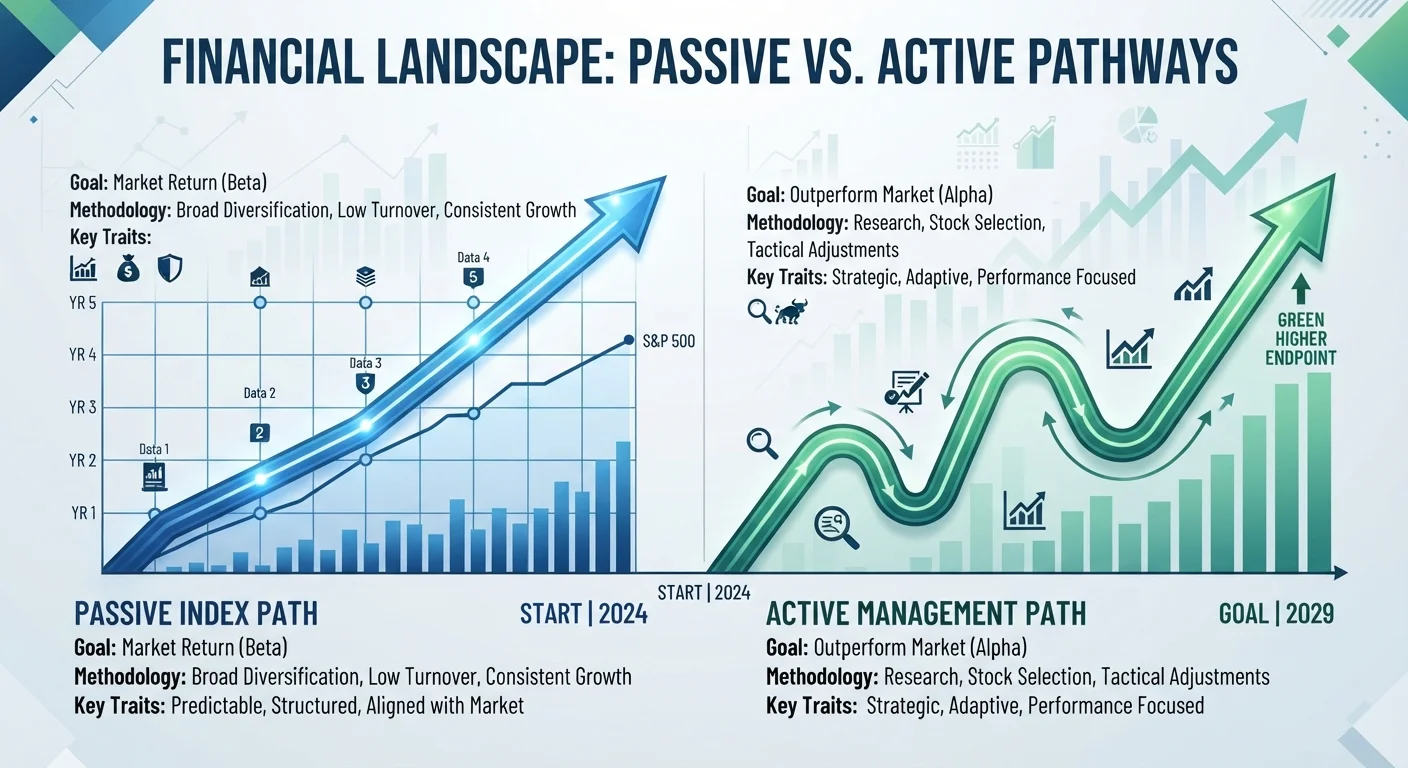
Option A
Index Funds
The low-cost, market-tracking approach.
Best for: Investors who prioritize cost efficiency, simplicity, and broad market exposure over time.
Option B
Actively Managed Funds
The research-driven, manager-guided strategy.
Best for: Investors seeking targeted market opportunities or specialized strategies through professional portfolio oversight.
How Each Fund Type Works
An index fund is designed to replicate the performance of a specific market benchmark — such as a broad stock market index — by holding the same securities in the same proportions. There is no team of analysts deciding what to buy or sell. The fund simply follows its index mechanically, which keeps costs low and turnover minimal.
An actively managed fund, by contrast, employs a portfolio manager and research team whose goal is to outperform a benchmark through deliberate security selection, sector rotation, or market timing. These decisions require ongoing analysis, trading activity, and oversight — all of which generate costs passed on to investors.
Understanding these structural differences is foundational. For a broader look at the underlying assets both fund types use, see our guide on the building blocks of an investment portfolio.
| Criterion | Index Funds | Actively Managed Funds |
|---|---|---|
| Management Style | Passive — mirrors a benchmark | Active — manager makes decisions |
| Typical Expense Ratio | Often below 0.20% | Often 0.50%–1.00%+ |
| Long-Term Benchmark Performance | Matches index (minus fees) | Majority underperform over 10+ years |
| Portfolio Turnover | Low | Typically higher |
| Tax Efficiency | Generally more tax-efficient | More taxable distributions likely |
| Complexity for Investor | Low — straightforward to evaluate | Higher — requires manager evaluation |
| Market Risk | Mirrors full market swings | Varies by strategy; not risk-free |
What the Performance Evidence Shows
The long-term performance record of actively managed funds relative to index funds has been extensively studied. Broad industry analyses — including the widely cited S&P Indices Versus Active (SPIVA) reports — have consistently found that the majority of actively managed funds underperform their benchmark index over periods of five, ten, and fifteen years, after accounting for fees.
This doesn't mean active management never adds value. Some managers have demonstrated skill over sustained periods, and active strategies have shown relative strength in certain niche or less-efficient markets where information advantages are more plausible. However, identifying in advance which managers will outperform — and sustaining that outperformance — has proven difficult in practice.
~85%
Active large-cap funds underperforming index over 15 years
SPIVA U.S. Scorecards have repeatedly found that around 80–90% of actively managed large-cap U.S. equity funds underperform the S&P 500 over 15-year periods.
0.03%–1.5%
Typical expense ratio range across fund types
Expense ratios vary widely; broad market index funds often sit near the low end, while specialized active funds can exceed 1% annually.
~1% annually
Fee drag impact on 30-year portfolio growth
Financial research broadly estimates that a 1% annual fee difference can reduce ending portfolio value by 20–25% over a 30-year horizon due to compounding.
It's also worth noting that past performance is not a reliable indicator of future results. A fund that outperformed its benchmark last year may simply have benefited from favorable conditions rather than repeatable skill. Investors are generally cautioned against chasing recent performance when selecting funds.
Keeping realistic expectations about both approaches matters — especially when paired with consistent habits like dollar-cost averaging, which can help reduce the emotional impact of market swings regardless of the fund type you choose.
The Cost Gap and Why It Compounds
One of the most concrete distinctions between index and active funds is cost, measured by the expense ratio — the annual percentage of assets deducted to cover fund operating expenses. Index funds typically carry expense ratios well below 0.20%, while actively managed funds often range from 0.50% to over 1.00% annually.
That gap may appear small, but compounded over a 20- or 30-year investment horizon, the difference in fees meaningfully reduces ending wealth. A higher-cost fund must outperform a lower-cost alternative by at least its fee difference each year just to break even — a consistent hurdle that many active funds fail to clear.
Expense Ratios: A Small Number With Big Impact
An expense ratio of 1% versus 0.05% may look trivial on paper. But on a $50,000 portfolio growing over 25 years, that difference can translate to tens of thousands of dollars in lost compounding. When evaluating any fund, the expense ratio is one of the most reliable data points available — unlike future returns, it is known in advance. Always check the fund's prospectus or official documentation for its current expense ratio.
Beyond expense ratios, actively managed funds tend to generate more taxable events through frequent trading. In a taxable brokerage account, this can create capital gains distributions that shareholders owe taxes on, even if they didn't sell any shares themselves. Index funds, with their lower turnover, typically produce fewer such distributions.
For a fuller picture of how costs and returns interact over time, our article on savings rate vs. investment returns explores which lever often has the biggest impact on long-term wealth building.
Making an Informed Choice
Neither index funds nor actively managed funds are inherently right for every investor or every situation. The decision depends on your goals, time horizon, tax situation, and comfort with complexity — not on which option sounds more sophisticated.
For most everyday investors building long-term portfolios, the structural cost advantage and consistent relative performance of index funds represent a compelling starting point. That said, some investors may find a role for active strategies in specific allocations — for instance, in asset classes where market inefficiencies may be more pronounced.
What matters most is understanding what you own, what it costs, and why it fits your plan. Decisions that seem minor — like expense ratios or turnover rates — can have outsized effects over decades. Our overview of principles for long-term investors covers the broader framework that makes individual fund choices more meaningful in context.
As always, this article is general financial education, not personalized investment advice. Before making decisions about your own portfolio, consider consulting a licensed financial adviser who can account for your complete financial picture.
This article is for general informational and educational purposes only and does not constitute personalized financial, investment, tax, or legal advice. Consult a qualified financial professional before making investment decisions.
The content on this site is for informational purposes only and is not a substitute for professional advice. Always consult a qualified professional for guidance specific to your situation.