

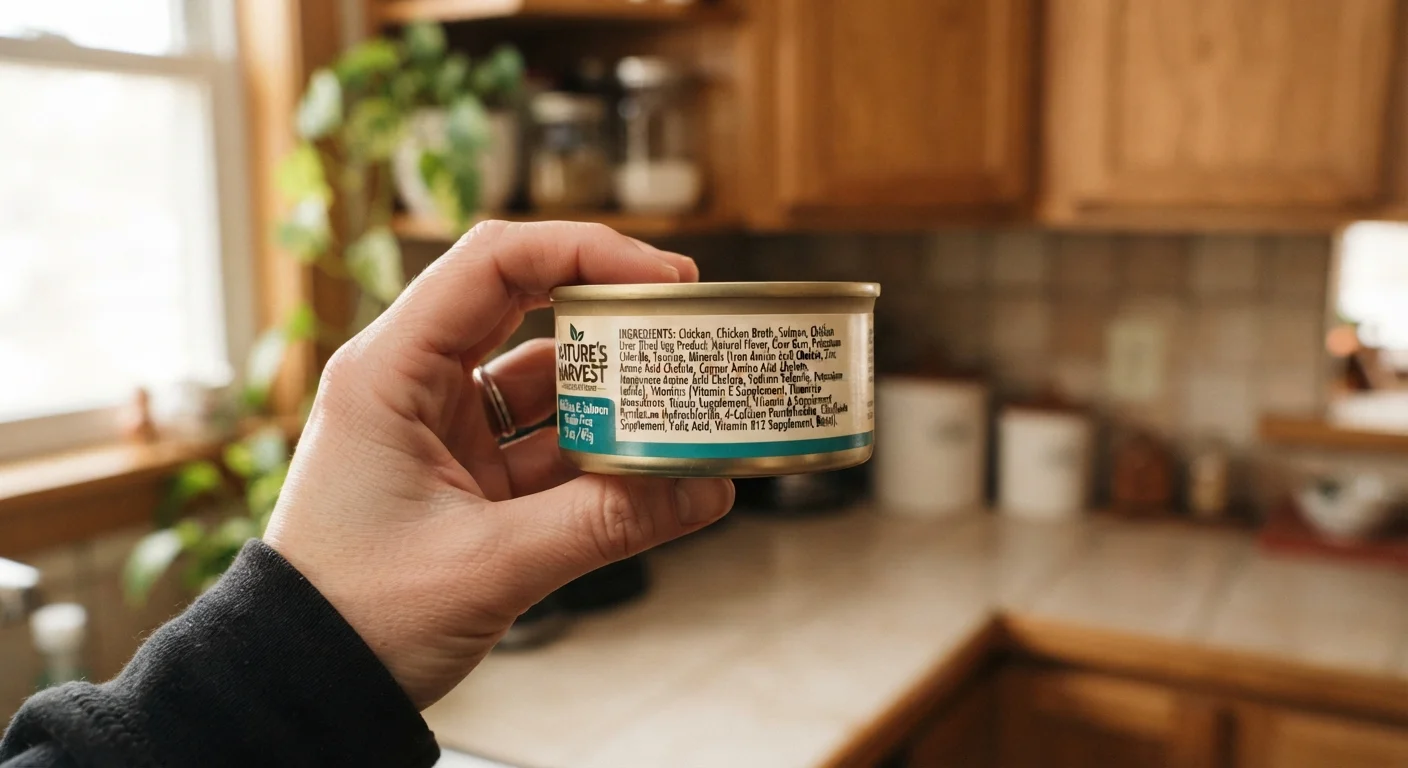
Why Cat Food Labels Feel Confusing
Pick up almost any bag or can of cat food and the ingredient list reads like an organic chemistry exam. Polyphosphates, taurine, menadione sodium bisulfite complex — the terminology is technical by design. In the United States, the Association of American Feed Control Officials (AAFCO) sets standardized definitions for ingredient names and nutritional claims, which is why the language is precise but rarely plain.
Understanding the structure of the label — rather than memorizing every ingredient — is what actually helps you evaluate a food confidently. For a broader look at how all pet food labels are organized, see our guide on how to interpret pet food packaging. This article walks through the label section by section so you know what you're looking at before you start comparing foods.
What you will need
How to Read a Cat Food Label Step by Step
Follow these steps each time you evaluate a new food. With practice, the process takes only a few minutes.
Locate the Ingredient List
By law, the ingredient list must appear on the information panel of the package — typically the back or side. It is separate from the guaranteed analysis panel, which shows minimum and maximum nutrient percentages. Find the list that begins with a protein or grain and runs through preservatives and vitamins.
Identify the First Five Ingredients
Ingredients are listed in descending order by pre-cooking weight. The first five ingredients make up the bulk of the food by weight. For cats — obligate carnivores who require animal protein to survive — a named animal protein ("chicken," "salmon," "turkey liver") should appear at or near the top. Vague terms like "meat" without a species name offer less transparency.
Check for the AAFCO Nutritional Adequacy Statement
Look for a sentence that reads something like: "[Product name] is formulated to meet the nutritional levels established by the AAFCO Cat Food Nutrient Profiles for all life stages." This statement tells you two things: whether the food was formulated to a nutrient profile or tested through a feeding trial, and which life stage it is intended for (kitten, adult, all life stages). A food without this statement has not been evaluated against any recognized nutritional standard.
Review Carbohydrate Sources
Unlike dogs, cats have a limited ability to digest large amounts of starch. Carbohydrate sources — such as peas, potatoes, rice, or corn — are commonly used in dry foods to hold kibble together. Their presence isn't automatically harmful in moderate amounts, but a label dominated by multiple starch sources before any named protein is worth scrutinizing.
Scan for Additives and Preservatives
Preservatives keep fat from going rancid. Some, like mixed tocopherols (a form of vitamin E), are derived from natural sources. Others, like BHA and BHT, are synthetic antioxidants that have been used in pet food for decades and remain permitted under current regulations, though some owners prefer to avoid them. Artificial colors serve no nutritional purpose in cat food. Functional additives like taurine, tryptophan, and niacin are often necessary supplements rather than filler ingredients.
Cross-Reference with the Guaranteed Analysis
The guaranteed analysis lists minimum crude protein, minimum crude fat, maximum crude fiber, and maximum moisture. These are regulatory minimums and maximums, not exact values. To compare foods on a like-for-like basis — especially wet versus dry — you may need to convert to a dry-matter basis by removing the moisture percentage from the calculation. This makes nutritional comparison more accurate across different food formats.
Compare Foods on a Dry-Matter Basis
When comparing wet and dry cat foods, raw percentages on the label can be misleading because moisture levels differ dramatically. Converting both foods to a dry-matter basis — by dividing each nutrient percentage by the dry matter percentage (100 minus moisture) — gives you a fair nutritional comparison. Your veterinarian or a veterinary nutritionist can help you work through this calculation if needed.
Terms That Trip Cat Owners Up Most Often
A few specific terms generate the most confusion and are worth addressing directly.
- Meat meal: This is a concentrated, dry-rendered protein source. Because moisture is removed, meat meal can actually deliver more protein per pound than a whole-muscle meat listed above it. It is not inherently a lower-quality ingredient.
- By-products: AAFCO defines poultry by-products as clean parts of the carcass other than meat — such as organs, necks, and feet. Organ meats like liver and kidney are nutrient-dense and appropriate for cats. The word "by-product" does not automatically indicate poor quality.
- Natural flavors / digest: Digest refers to material treated with heat, enzymes, or acid to create a palatability enhancer. It is used in small amounts and is a common, regulated ingredient.
- Ingredient splitting: If a manufacturer lists "ground corn," "corn gluten meal," and "corn flour" as separate items, each ranks lower on the list individually — but combined they may outweigh the protein source. This is a known labeling practice to be aware of.
Cats have unique nutritional needs compared to dogs or humans. They require preformed taurine, arachidonic acid, and vitamin A from animal sources — needs that vegetable-only ingredients cannot fully satisfy. This is why the format of the food matters, not just its ingredient list.
Grain-Free Doesn't Mean Low-Carbohydrate
"Grain-free" labels have become common, but many grain-free cat foods substitute legumes, potatoes, or tapioca — which are also carbohydrate sources. The absence of grains does not guarantee a lower-carb formulation. Evaluate the full ingredient list rather than relying on front-of-package claims alone.
Putting It All Together
No single ingredient makes or breaks a cat food. What matters is the overall nutritional profile, confirmed by an AAFCO adequacy statement, backed by appropriate protein sources, and suited to your individual cat's age, health status, and activity level. A food labeled "complete and balanced" for adult maintenance may not be appropriate for a kitten or a cat managing a health condition — always confirm life-stage suitability.
If you have questions about a specific food or your cat's dietary needs, your veterinarian is the most reliable resource. Label literacy is a tool for narrowing your choices and asking better questions — not a substitute for professional guidance.
This article is for general informational purposes only and does not constitute veterinary or nutritional advice. Consult a licensed veterinarian before making significant changes to your cat's diet, especially if your cat has a health condition.
The content on this site is for informational purposes only and is not a substitute for professional advice. Always consult a qualified professional for guidance specific to your situation.