

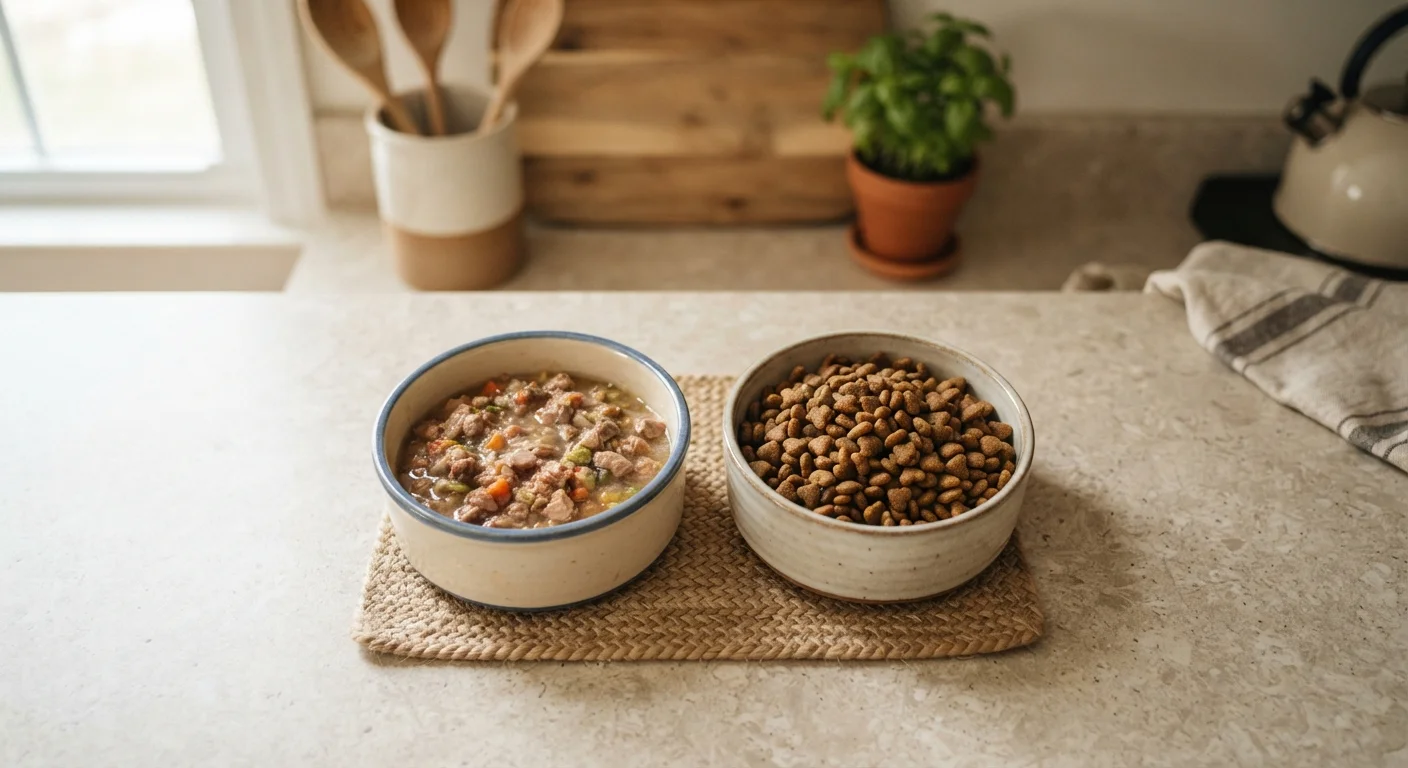
Option A
Wet Cat Food
The moisture-rich, protein-forward option.
Best for: Cats who need extra hydration, have urinary tract concerns, or are reluctant drinkers.
Option B
Dry Cat Food (Kibble)
The convenient, calorie-dense everyday staple.
Best for: Owners seeking ease of storage, measured feeding, and cost-effective daily nutrition.
Why Moisture Content Is the Core Difference
Cats evolved as desert predators who obtained most of their hydration through prey — not from standing water. This biological history means most cats have a naturally low thirst drive, which makes the moisture content of their food genuinely important for long-term health.
Wet cat food typically contains 70–80% water by weight, closely mimicking the moisture profile of whole prey. Dry kibble, by contrast, contains just 6–10% moisture. That gap has real consequences: a cat eating only dry food must compensate by drinking significantly more water, which many cats simply don't do reliably.
Chronic low-level dehydration is associated with increased risk of urinary tract infections, feline idiopathic cystitis, and kidney disease — conditions that are unfortunately common in domestic cats. Wet food's hydration contribution is one of the most consistent arguments veterinary nutritionists make in its favor.
| Criterion | Wet Cat Food | Dry Cat Food (Kibble) |
|---|---|---|
| Moisture content | 70–80% | 6–10% |
| Hydration support | High — contributes significantly | Low — relies on separate drinking |
| Caloric density | Lower per volume | Higher per volume |
| Dental abrasion benefit | Minimal | Moderate (formula-dependent) |
| Storage convenience | Refrigerate once opened | Shelf-stable, easy to store |
| Palatability for picky eaters | Often higher | Variable |
| Typical cost per serving | Higher | Lower |
| Suitability for urinary health | Strongly supported | Requires increased water intake |
Protein, Fat, and Caloric Density
Beyond moisture, the macronutrient profiles of wet and dry food differ in ways that matter nutritionally. Because wet food is mostly water, its dry matter protein and fat concentrations are often comparable to — or higher than — many kibble formulas. Comparing labels on an as-fed basis can be misleading; checking dry-matter percentages gives a clearer picture. Our guide to reading a cat food ingredient label walks through how to decode those numbers accurately.
Dry food is calorie-dense by design. A small volume of kibble delivers a higher calorie count than the same volume of wet food, which can be an advantage for portion control but also a risk factor for overfeeding if measuring isn't precise. Cats prone to weight gain may benefit from wet food's natural satiety effect — they consume greater volume for fewer calories.
~70%
Water content in typical wet cat food
AAFCO guidelines define wet (canned) food as containing at least 65% moisture, compared to dry food's maximum of around 12%.
1 in 3
Cats affected by kidney disease in their lifetime
Feline chronic kidney disease is one of the most prevalent conditions in older cats, according to veterinary medicine literature, making hydration a lifelong dietary priority.
3–4×
More water consumed via wet food daily
Studies in feline nutrition have found that cats eating wet food have measurably higher total water intake than cats fed exclusively dry kibble.
Cats are obligate carnivores, requiring specific nutrients — including taurine and arachidonic acid — that must come from animal-sourced ingredients. Both wet and dry foods formulated to meet AAFCO (Association of American Feed Control Officials) nutritional profiles will include these, but ingredient quality and sourcing still vary widely across products.
Dental Health, Convenience, and Cost
Dry food is often cited as better for dental health because chewing kibble creates mechanical abrasion against tooth surfaces. There is some evidence this can reduce tartar accumulation, particularly in kibble formulas specifically designed for dental support. However, veterinary dental organizations note that kibble alone is not a substitute for professional cleanings or active dental care routines — wet food isn't uniquely harmful to feline teeth, and gingivitis can develop in cats eating either format.
From a practical standpoint, dry food wins on convenience: it doesn't spoil within minutes of serving, stores easily, and fits naturally into puzzle feeders and timed dispensers — useful tools explored in our article on feeding approaches for multi-cat households. Wet food requires refrigeration once opened and must be removed from the bowl within a few hours.
Puzzle Feeders Work With Both Formats
Puzzle feeders and slow-feed bowls are commonly associated with kibble, but wet food-compatible puzzle bowls are widely available. Using either format with enrichment feeding tools supports mental stimulation and reduces the risk of eating too quickly. If your household includes multiple cats, these tools can also help manage competition at mealtimes.
Cost differences vary by region and brand tier, but wet food is generally more expensive per calorie than dry. For owners managing multiple cats or tight budgets, this is a real consideration — though the long-term cost of managing preventable urinary or kidney conditions can be significant, making food choice a nuanced financial decision as well.
For a broader look at how these decisions fit into overall feline wellness, the Pet Wellness hub covers preventive care across all life stages.
Making the Right Call for Your Individual Cat
There is no single correct answer to the wet-versus-dry debate. A young, healthy, active cat with good water-drinking habits faces a different risk profile than a senior cat with early kidney disease or a neutered male with a history of urinary blockages. Your veterinarian is the most important voice in this decision, particularly if your cat has any diagnosed health condition.
Many vets recommend a mixed feeding approach for healthy adult cats — wet food as the primary meal to support hydration, with a measured kibble portion for convenience and dental benefit. This approach isn't universally right either, but it addresses several concerns simultaneously.
Regardless of format, look for foods meeting AAFCO nutritional adequacy standards appropriate for your cat's life stage (kitten, adult, or senior). If you're uncertain how to evaluate options, learning to read a cat food label is a practical first step.
This article is for general informational purposes only and does not constitute veterinary or medical advice. Always consult a licensed veterinarian before making changes to your cat's diet, especially if your cat has an existing health condition.
The content on this site is for informational purposes only and is not a substitute for professional advice. Always consult a qualified professional for guidance specific to your situation.