

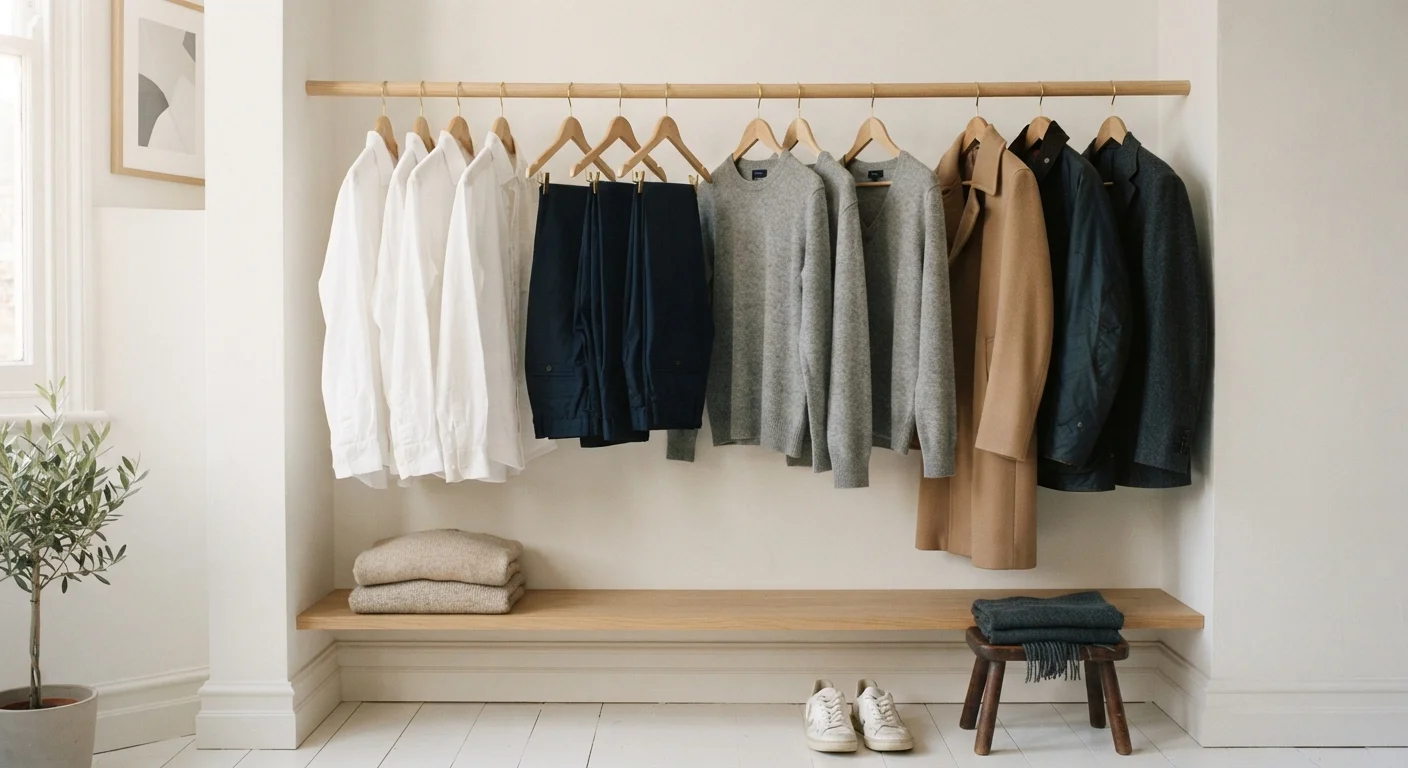
Why Most Closets Feel Full But Unwearable
The average American closet holds far more clothing than its owner regularly wears. Research by the Bureau of Labor Statistics and independent wardrobe consultants consistently finds that most people rotate through a fraction of what they own — often as little as 20% of their wardrobe covers 80% of their outfits. The rest hangs unused, creating visual noise and daily frustration.
The problem usually isn't a lack of clothes — it's a lack of cohesion. Impulse purchases, one-occasion pieces, and trend-driven buys accumulate over time without a guiding logic. The result: a closet full of individual items that don't work together. For a deeper look at how common habits contribute to this, see wardrobe habits that make getting dressed harder.
A capsule wardrobe solves the cohesion problem at its root by reversing the default approach: instead of accumulating first and editing rarely, you define what you need, curate to that standard, and buy only to fill genuine gaps.
~20%
Portion of wardrobe worn regularly
Wardrobe consultants and behavioral researchers consistently estimate that most people wear roughly 20% of their clothing 80% of the time.
33
Items in a common capsule wardrobe
Project 333, a popular capsule framework developed by minimalism advocate Courtney Carver, challenges participants to dress with 33 items for three months.
Cost-per-wear
The smarter way to evaluate clothing value
Dividing a garment's price by the number of times it's worn reveals its true cost — a concept widely endorsed by stylists and personal finance advisers alike.
The Core Logic: Versatility Over Volume
The capsule wardrobe framework rests on one principle — every item should work with multiple others. A white button-down that pairs with trousers, jeans, and a skirt earns its space. A sequined top that only works for one specific occasion probably doesn't, unless that occasion is frequent enough in your life to justify the hanger space.
Practitioners typically build in layers. The foundation is a set of neutral anchors: pieces in black, white, navy, grey, tan, or camel that mix with almost anything. On top of these sit secondary pieces in muted patterns or one or two personal accent colors. Finally, a small number of statement items add personality without overwhelming the system.
Start With Fit, Not Shopping
Before adding anything new to your wardrobe, identify items you already own that don't fit well and consider whether simple tailoring could save them. A tapered hem or taken-in waist can transform a rarely-worn piece into a go-to. Alterations on key basics often cost far less than replacing them.
Fit matters more than any other single variable. A well-fitted item in a basic fabric will look more polished — and get worn more — than an expensive piece that doesn't sit right on your body. Tailoring even a few key items can transform how much of your existing wardrobe you actually reach for.
Once you know the logic, outfit formulas make daily dressing automatic — you stop starting from scratch every morning.
How to Actually Build One
The process starts with what you already own, not a shopping list. Begin with a wardrobe audit — pulling everything out and evaluating each item honestly: Does it fit? Does it work with at least three other things you own? Have you worn it in the past year? Items that fail these questions are candidates for donation, consignment, or removal.
After the audit, many people discover they already own more workable pieces than they thought. Shopping your own closet first often reveals combinations that were buried under clutter. Only after this step should you identify genuine gaps — specific categories or functions your wardrobe doesn't currently cover.
When filling those gaps, apply a cost-per-wear calculation rather than a sticker-price judgment. A durable, well-constructed item worn 150 times costs far less per use than a cheap item worn five times before it loses shape or falls apart. This is also where thinking about clothing as a budget line item becomes practical — deliberate, infrequent purchases are easier to plan for than constant low-level impulse spending.
Maintaining and Evolving Your Capsule
A capsule wardrobe isn't a one-time project — it's an ongoing editing practice. Seasonal transitions are a natural checkpoint. Rather than overhauling your entire closet twice a year, transitioning seasonally with minimal disruption means rotating a targeted set of pieces while keeping your core intact.
The most sustainable version of this system is personal. Your capsule should reflect your actual life — your commute, your social calendar, your climate, your personal aesthetic — not an aspirational version of it. A wardrobe optimized for an office you don't work in, or a social life you don't have, will always feel wrong.
Capsule Wardrobes Are Personal, Not Prescriptive
There's no single correct capsule. Guides that specify exact item counts or colors are starting points, not rules. The right capsule for someone in Minnesota in January looks very different from one suited to Southern California year-round. Build around your actual climate, lifestyle, and aesthetic — not someone else's framework imposed wholesale.
The measure of success isn't owning fewer things for its own sake. It's opening your closet in the morning and being able to get dressed without friction — because every option in front of you is one you actually want to wear.
Frequently Asked Questions
There's no universal rule. Common frameworks suggest 30–50 pieces, but what matters more is that every item earns its place. A capsule wardrobe sized for your actual life — your job, climate, and social occasions — will always outperform a rigid count.
No. Building a capsule wardrobe is fundamentally about editing what you own, not spending more. You start by identifying what already works, fill genuine gaps strategically, and prioritize durability over trendiness when you do buy. Thrift stores and secondhand markets are entirely valid sources.
Yes. The principles apply whether you dress for a corporate office, a creative workplace, or a casual lifestyle. The specific items change, but the logic — versatile pieces that mix freely — stays the same. Many people build separate mini-capsules for work and weekend.
They overlap but aren't identical. Minimalism is a philosophy about owning less. A capsule wardrobe is a functional strategy about owning smarter. You can build a capsule wardrobe without subscribing to minimalism as a lifestyle.
Many capsule wardrobe practitioners maintain seasonal rotations — a core of year-round pieces supplemented by a small seasonal layer. Transitional items like lightweight knits and medium-weight jackets reduce the volume needed for each rotation.
The content on this site is for informational purposes only and is not a substitute for professional advice. Always consult a qualified professional for guidance specific to your situation.