

Why Your Closet Feels Full but Useless
Most people don't struggle to own clothes. They struggle to combine them into an outfit before their coffee cools down. The problem usually isn't quantity — it's the absence of a system. An outfit formula solves this by giving you a repeatable structure: a specific combination of clothing categories that reliably works, regardless of which individual pieces you plug in.
Think of a formula less like a uniform and more like a sentence structure. The grammar stays constant; the words change. Once you internalize a handful of these structures, getting dressed becomes a low-stakes fill-in-the-blank exercise rather than a creative test you're too tired to take.
If your wardrobe currently feels like a collection of individual items rather than a coordinated system, the capsule wardrobe approach offers a useful foundation to build from. The formulas below work especially well when your closet already contains pieces that coordinate with one another.
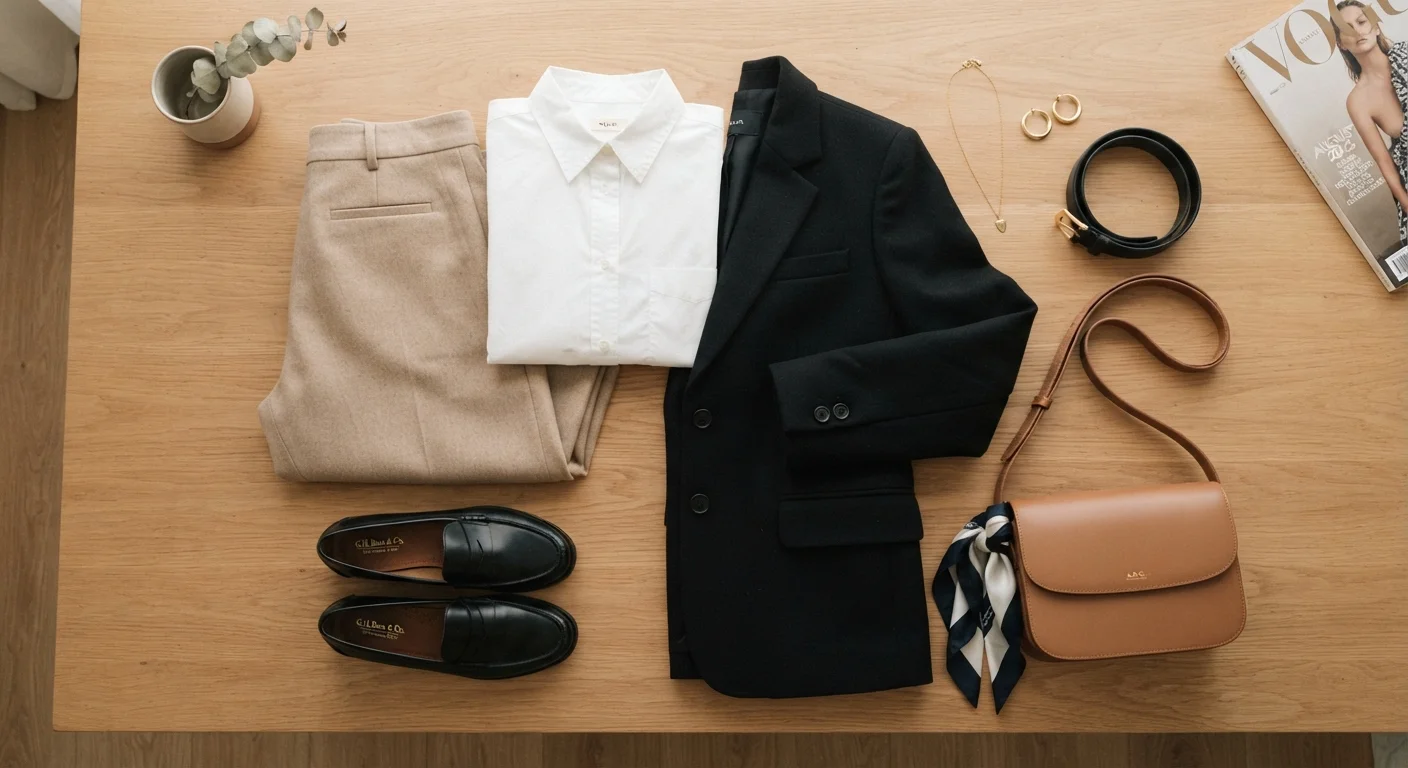
Straight-leg trousers + tucked top + loafers
This is the workhorse formula for anyone navigating an environment that's somewhere between casual and professional. Straight-leg trousers in a neutral — navy, khaki, charcoal, or cream — pair with almost any tucked-in top, from a fitted crewneck to a button-down. Loafers or similar low-profile shoes keep the silhouette clean without requiring effort.
The tuck is the non-negotiable element here. A full tuck or a half-tuck both work, but leaving the top entirely untucked collapses the polished effect that makes this formula versatile enough for an office meeting and a dinner out.
A full or half-tuck is what elevates this formula from casual to intentionally put-together.
Dark jeans + a structured layer + clean sneakers or ankle boots
Dark-wash jeans act as a visual neutral — they read dressier than light or distressed denim while remaining genuinely comfortable. The structured layer (a blazer, a longline cardigan, or a tailored overshirt) lifts a simple base of a plain tee or tank into an outfit that reads as considered rather than thrown-together.
Footwear decides the register: low-profile leather sneakers keep it casual-smart; ankle boots shift it toward evening or polished-casual. This formula handles roughly 60 to 70 percent of everyday American life scenarios — casual Fridays, weekend errands, informal dates — without modification.
Dark-wash jeans act as a visual neutral that bridges casual comfort and dressed-up intention.
Monochromatic tonal dressing
Wearing one color family head to toe — varying shades of tan, grey, navy, or olive, for instance — is one of the most reliable no-decision formulas in existence. Because the palette is already decided, the only choices are fit and texture. A camel turtleneck with tobacco-brown trousers and tan boots takes about thirty seconds to assemble and looks deliberately styled.
The key is variation in shade or texture within the same color family. All-black in a single flat fabric reads simple but not necessarily intentional; all-black mixing matte and slightly shiny or textured fabrics reads refined. This formula also has the useful side effect of making a smaller wardrobe feel more expansive.
Tonal dressing eliminates color coordination entirely — the only decisions left are fit and texture.
Midi skirt or wide-leg trousers + fitted top + one statement piece
Volume on the bottom paired with something fitted on top creates a balanced silhouette that reads as fashion-aware without requiring trend knowledge. A fitted ribbed top, a simple cotton tee, or a slim-cut knit all work. The formula's adaptability comes from the single statement piece: a bold bag, an interesting shoe, a printed scarf, or a distinctive jacket rotates in to change the outfit's character entirely.
This formula is particularly effective for people who want to incorporate more expressive pieces without building entire outfits around them. The statement element does the personality work; the rest of the outfit provides the structure. For guidance on navigating bolder patterns within formulas like this, see our piece on mixing patterns with confidence.
A single statement piece rotates in to change an outfit's entire character with minimal effort.
Tailored shorts or trousers + a linen or breathable top + sandals or mules
Warm-weather dressing collapses for many people into either overdressed or underdressed territory. This formula solves that by keeping the bottom tailored — shorts with a defined hem and clean silhouette, or lightweight wide-leg trousers — and pairing it with a breathable top that isn't a graphic tee or a tank worn as outerwear.
A linen button-down left open over a fitted crewneck, a breezy woven top, or a structured linen blouse all qualify. Mules or strappy flat sandals complete the look in seconds. The result is comfortable enough for summer heat but intentional enough for a restaurant, a workday, or a casual social event — the kind of versatility that makes a formula genuinely useful rather than situationally specific.
Keeping warm-weather bottoms tailored is the difference between a summer outfit and summer dressing.
The elevated basics stack: quality basics layered deliberately
A fitted white or neutral tee, well-cut chinos or straight trousers, and a lightweight overshirt or bomber jacket is arguably the most context-flexible formula on this list. It can dress down with canvas sneakers or dress up with leather shoes or boots. It reads appropriately in creative-professional environments, casual workplaces, weekend settings, and low-key social occasions.
What makes the formula work is fit consistency across all three layers — none should overwhelm the others. A boxy tee under slim chinos under an oversized jacket creates visual conflict; a slim tee under relaxed-fit chinos under a relaxed overshirt creates coherence. The distinction between relaxed and visually undone often comes down to exactly this proportion logic.
Fit consistency across all three layers is what separates a polished casual stack from accidental layering.
Making the Formulas Work for You
Outfit formulas aren't one-size-fits-all in a literal sense — but the underlying logic is universal. The goal is to identify which combinations consistently make you feel put-together, then repeat them with variations rather than starting from scratch each morning.
Test Your Formulas Before You Need Them
Try building and photographing three outfits using each formula on a day when you're not rushing. A quick photo on your phone takes ten seconds and gives you a reference library you can pull from on mornings when decision-making feels hardest. Even five or six reference photos can meaningfully reduce the cognitive load of getting dressed under time pressure.
If you suspect untapped combinations are already hanging in your closet, shopping your own wardrobe first is worth the hour it takes. You may find that three or four of these formulas are already within reach. And if color coordination feels uncertain, a primer on combining colors without formal training can sharpen your eye quickly.
Once you've identified your two or three go-to formulas, the only maintenance required is periodically checking that each piece you add to your wardrobe actually slots into at least one of them. That single habit prevents the impulse purchases that make closets feel chaotic — a pattern explored in depth in our look at common wardrobe habits that make dressing harder.
The content on this site is for informational purposes only and is not a substitute for professional advice. Always consult a qualified professional for guidance specific to your situation.