

Why Hair Type Is More Than Curl Pattern
Most people learn to classify their hair as straight, wavy, or curly — and stop there. But that single dimension explains surprisingly little about how your hair actually behaves. Two people with identically shaped curls can find that the same product leaves one person's hair defined and moisturized while the other's looks weighed down or frizzy. The reason usually comes down to porosity and density, two characteristics that shape how hair absorbs moisture, holds style, and responds to ingredients.
Understanding these three axes — curl pattern, porosity, and density — gives you a diagnostic framework rather than a label. Just as skin type identification helps you choose the right cleanser or moisturizer, knowing your hair type helps you make genuinely informed choices about products, techniques, and routines. This is foundational grooming knowledge, not trend-chasing.
| Curl classification system | Types 1–4 with a, b, c subcategories |
| Porosity categories | Low, medium (normal), high |
| Density range | Low, medium, high (strands per square inch) |
| Strand width options | Fine, medium, coarse |
| Main cause of high porosity | Heat styling, chemical processing, or genetic factors |
| Cuticle role | Controls moisture absorption and surface shine |
Curl Pattern: The Shape of Your Strand
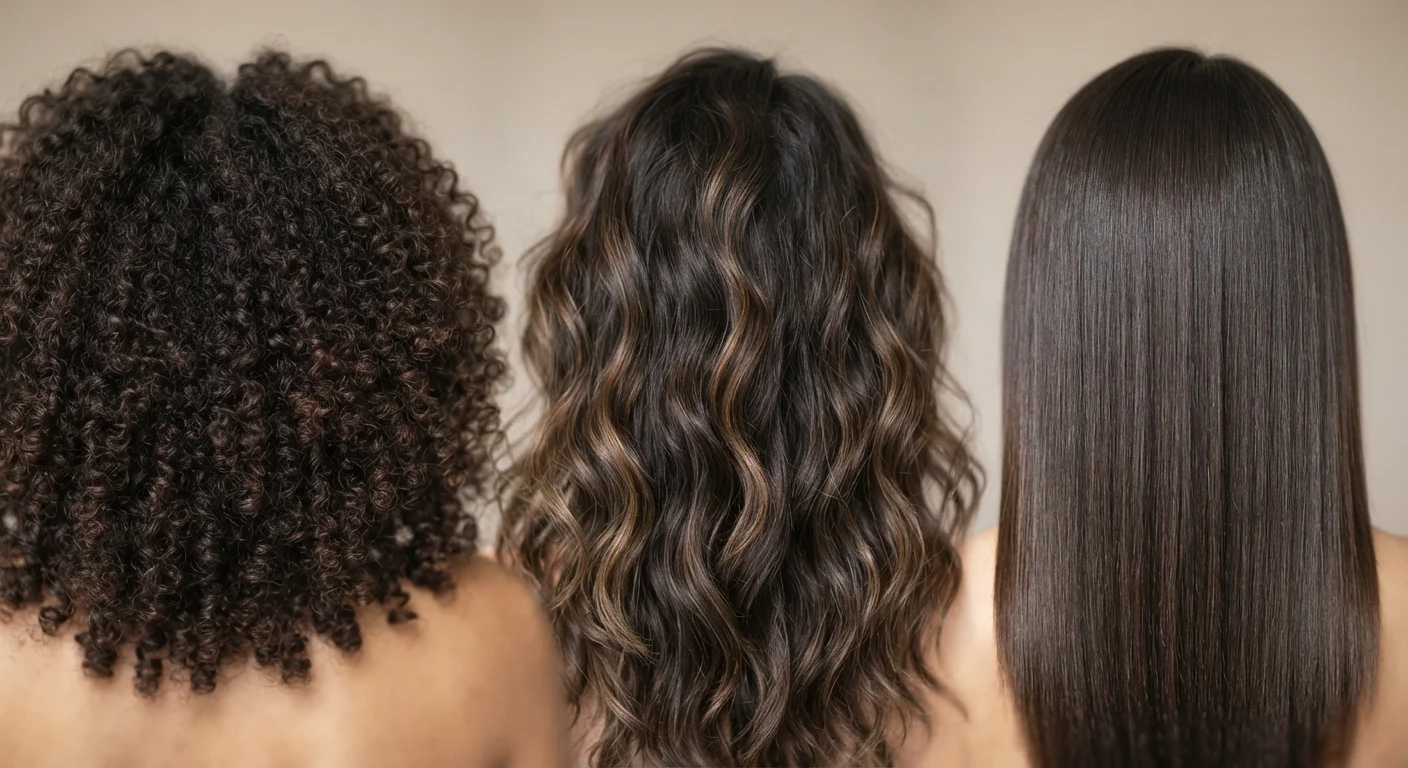
The most widely referenced classification system groups hair into four broad categories, each subdivided into a, b, and c variations based on tightness:
- Type 1 (Straight): No natural curl or wave. Tends to be shiny because sebum travels easily down the shaft. Can become oily at the roots faster than other types.
- Type 2 (Wavy): Falls between straight and curly — an S-shaped pattern. Fine waves (2a) are subtle; coarser waves (2c) approach loose curls. Prone to frizz in humidity.
- Type 3 (Curly): Defined loops or spirals ranging from loose (3a) to tight corkscrew (3c). More prone to dryness because the curl shape slows sebum distribution from scalp to tip.
- Type 4 (Coily/Kinky): Tightly coiled or zig-zag patterned hair. 4a coils have a visible curl; 4c has minimal definition and the most shrinkage. Highly susceptible to dryness and breakage without adequate moisture retention.
Curl pattern is largely genetic and can change with hormonal shifts, medication, or significant health events. It's also worth noting that most people have more than one pattern on their head.
Curl Pattern
The natural shape a hair strand takes as it grows, ranging from straight (Type 1) to tightly coiled (Type 4). Determined primarily by the shape of the hair follicle.
Porosity
A measure of how easily the hair cuticle absorbs and retains moisture. Low porosity hair resists moisture entry; high porosity hair absorbs quickly but loses moisture just as fast.
Hair Density
The number of individual hair strands per square inch of scalp. High-density hair appears fuller regardless of individual strand thickness.
Strand Width
The diameter of a single hair strand — fine, medium, or coarse. Affects how much product a strand can hold without being weighed down or feeling brittle.
Cuticle
The outermost layer of a hair strand, made up of overlapping scale-like cells. Its condition governs both porosity and how light reflects off the hair surface.
Sebum
The natural oil produced by scalp sebaceous glands. It travels down the hair shaft to condition it, but in curlier patterns this journey is slower, contributing to dryness at the ends.
Porosity: How Your Hair Absorbs and Holds Moisture
Porosity describes how readily your hair's cuticle layer — the outermost scale-like covering — opens to absorb water and closes to retain it. It's one of the most practically useful things to understand about your hair.
Low Porosity
The cuticle lies flat and tightly overlapping. Water and products sit on the surface rather than penetrating quickly. Hair can feel coated or product-heavy. Heat (steam, warm water) helps open the cuticle temporarily during conditioning. Lightweight, water-based products typically work better than thick butters or heavy oils.
Normal (Medium) Porosity
The cuticle allows moisture in and holds it reasonably well. This is often considered the most manageable range — products absorb and hair responds predictably to most routines.
High Porosity
The cuticle has gaps or raised scales, whether from genetics or cumulative damage (heat, chemical processing, mechanical stress). Hair absorbs moisture quickly but loses it just as fast, leading to dryness, frizz, and brittleness. Protein treatments and heavier sealants can help close gaps and slow moisture loss.
A simple float test — dropping a clean strand in a glass of water and watching whether it sinks quickly (high porosity) or floats (low porosity) — is a commonly cited DIY method, though results can vary. Professional porosity assessments exist but aren't necessary for most people.
Porosity is closely linked to scalp health; healthy scalp practices can reduce the buildup and damage that shifts hair toward high porosity over time.
Density and Width: Volume and Strand Thickness
Density refers to how many individual strands grow per square inch of scalp — low, medium, or high. It's distinct from curl pattern and determines how much product volume you need, not necessarily what kind. High-density hair can look thick even if each individual strand is fine.
Strand width (sometimes called hair texture in a narrower sense) describes the diameter of a single strand — fine, medium, or coarse. Fine strands are more vulnerable to breakage and can become weighed down easily. Coarse strands are generally more resilient but can be resistant to moisture penetration.
These two factors combine in important ways. Fine, high-density hair needs lightweight volumizing support. Coarse, low-density hair benefits from richer conditioning without heavy layering. Most product formulation logic — how much, how often, and in what order — is really an answer to density and strand width as much as curl pattern.
For those considering color treatments, understanding your porosity and strand width first is critical. Our guide before you try at-home hair color explains why these factors directly affect developer choice and processing time. See also the full picture on grooming and hair health for how these habits connect to long-term hair condition.
The content on this site is for informational purposes only and is not a substitute for professional advice. Always consult a qualified professional for guidance specific to your situation.