

Our Verdict
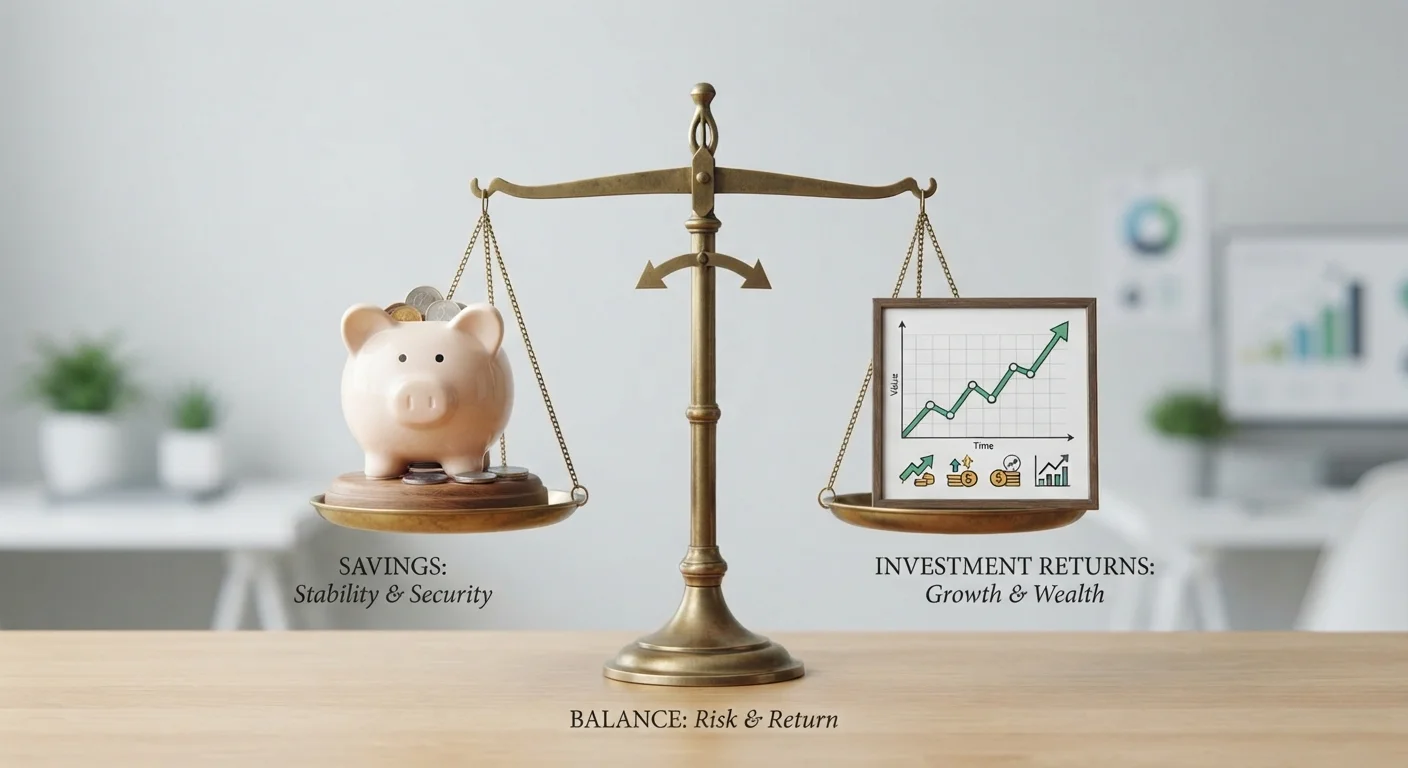
For most people in the early stages of building wealth, the savings rate is the more powerful lever — it is controllable, immediate, and compounds over time. As a portfolio grows into the tens or hundreds of thousands of dollars, investment returns gradually take on greater importance. Rather than treating these as rivals, treating them as complementary forces yields the strongest long-term outcome.
| Best for | Recommended |
|---|---|
| Those just starting to build wealth with modest balances | Prioritizing Savings Rate |
| Those with substantial portfolios seeking to optimize growth | Focusing on Investment Returns |
| Those seeking the most resilient long-term strategy | Balancing Both Simultaneously |
Understanding the Two Levers
When it comes to growing wealth over time, two variables do most of the heavy lifting: how much you save and how well those savings grow. Your savings rate is the share of your income you consistently set aside rather than spend. Your investment return is the annualized percentage gain your invested money earns over time.
Both matter — but they don't matter equally at every stage of your financial life. Understanding how each one operates helps you decide where to direct your energy. For a deeper look at how growth compounds over time, see our guide to compound interest.
| Savings Rate | Investment Returns | |
|---|---|---|
| Degree of personal control | High — directly adjustable | Low — market-dependent |
| Impact when portfolio is small | High — contributions dominate growth | Low — small base limits dollar gains |
| Impact when portfolio is large | Moderate — contributions less dominant | High — compounding multiplies gains |
| Primary risk | Lifestyle inflation, income limits | Market volatility, fees, poor allocation |
| Time to see meaningful effect | Immediate — adds to base right away | Long-term — requires years of compounding |
| Best early-stage strategy | Maximize first | Optimize structure and costs early |
Why Savings Rate Dominates Early On
When your invested balance is small — say, a few thousand dollars — even an exceptional annual return has limited dollar impact. A 10% return on $5,000 produces $500. Meanwhile, finding an extra $200 per month to save adds $2,400 per year directly to your base. That additional principal then earns returns of its own going forward.
This is why personal finance researchers and educators consistently emphasize that the savings rate is the primary driver of wealth accumulation in the early years. It is also the variable you can control most directly. Market returns fluctuate; your monthly contribution does not have to.
Raising your savings rate by even a few percentage points — whether by trimming discretionary spending or increasing income — creates a durable advantage. As noted in our article on why delaying saving is costly, starting earlier and saving more consistently tends to produce better outcomes than waiting for a higher-return environment.
Small Rate Increases Add Up Quickly
Raising your savings rate by just 2–3 percentage points can meaningfully accelerate wealth accumulation over a decade. One practical approach: direct a portion of any raise or bonus directly into savings before adjusting your lifestyle. This 'pay yourself first' habit builds the savings rate without requiring spending cuts. Automating the transfer removes the temptation to spend the difference.
When Investment Returns Start to Pull More Weight
As a portfolio grows, the math shifts. A 7% annual return on a $300,000 portfolio generates $21,000 — an amount that eclipses what many households can realistically add through savings alone in a single year. At this stage, the composition and cost structure of your investments begin to matter substantially.
This is where decisions like choosing low-cost index funds over higher-fee alternatives can have meaningful compounding effects over decades. Our comparison of index funds vs. actively managed funds covers the evidence on how costs and structure affect long-run performance.
Even so, the lesson isn't to abandon savings discipline once a portfolio grows — it's to recognize that both inputs are now working in tandem, and neither should be neglected.
1%
Annual fee drag on returns over 30 years
Research from financial planning academia suggests a 1% higher annual expense ratio can reduce a portfolio's ending value by roughly 20% or more over a 30-year horizon, depending on assumptions.
15–20%
Savings rate range often cited for financial independence
Many financial planning frameworks suggest saving 15–20% of gross income as a target range for retiring around traditional retirement age, though individual circumstances vary widely.
$0
Return earned on money never invested
Regardless of market performance, money that stays in a non-interest-bearing account earns nothing — reinforcing that the decision to save and invest precedes any return discussion.
Making Both Work Together
The most practical approach isn't choosing one lever over the other — it's sequencing your attention appropriately. Early on, focus relentlessly on building your savings rate. Automate contributions so the decision isn't revisited each month. Our editorial on automating your savings explores both the benefits and the trade-offs of that approach.
Once your savings habit is established and your portfolio has meaningful scale, shift some attention toward investment hygiene: keeping costs low, maintaining appropriate diversification, and avoiding reactive decisions during market swings. Separating myth from sound strategy is also useful — see our piece on common investing myths for context.
Neither lever operates in isolation. A high savings rate invested poorly erodes returns. Strong returns on a negligible balance produce negligible wealth. The combination — steady contributions, sensible allocation — is where long-term financial security is actually built.
This article provides general financial education and is not personalized financial or investment advice. Please consult a qualified financial professional for guidance specific to your situation.
The content on this site is for informational purposes only and is not a substitute for professional advice. Always consult a qualified professional for guidance specific to your situation.