

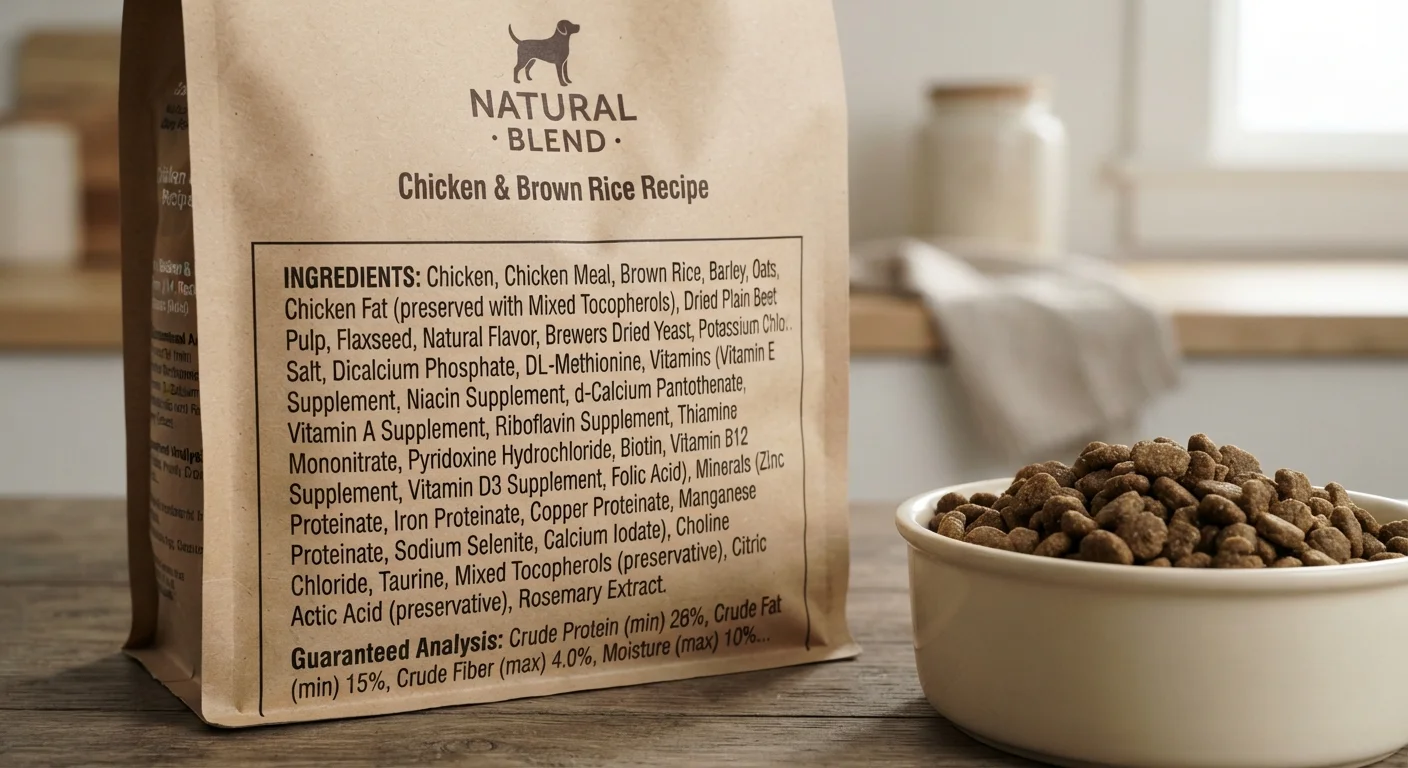
How the Ingredient List Is Structured
U.S. dog food labels are governed by AAFCO guidelines and the FDA, meaning manufacturers must follow standardized naming and ordering conventions. Every ingredient is listed in descending order by weight as added — before cooking or processing. This is a critical detail because a fresh protein like chicken contains roughly 70–75% water, so its pre-cooking weight ranks it highly even if its contribution after cooking is smaller than it appears.
For a fuller picture of how to interpret the entire label — including the guaranteed analysis panel and AAFCO nutritional adequacy statement — see our guide to nutrition labels on pet food.
70–75%
Moisture in fresh chicken before processing
This high water content is why fresh meats rank highly by pre-processing weight but contribute proportionally less protein after cooking compared to concentrated meals.
~40%
Of U.S. dog food sales are now grain-free
Industry market data has tracked the rapid rise of grain-free formulas over the past decade, coinciding with broader consumer interest in ingredient transparency.
Protein Sources: Named, Generic, and Meals
Protein is typically the cornerstone of a dog's diet, and how it appears on the label tells you a lot. Named whole proteins — such as 'chicken,' 'beef,' or 'salmon' — identify a single species and cut. Generic terms like 'meat' or 'poultry' are less specific and come from a less traceable mix of animal sources.
Meals (e.g., chicken meal, salmon meal) are rendered proteins with moisture removed, making them calorie- and protein-dense by weight. Despite a common misconception, a named meal can represent a significant and nutritious protein contribution. By contrast, 'meat and bone meal' or 'animal meal' are generic and offer less transparency about origin.
By-products — such as chicken by-products — include organ meats, feet, and similar parts. Organs are nutrient-dense, but the quality and consistency of by-product ingredients varies; named by-products are more reliable than generic ones.
Carbohydrates, Grains, and Fillers
Carbohydrates in dog food supply energy and often provide fiber that supports digestion. Common sources include whole grains (brown rice, oatmeal, barley), legumes (peas, lentils, chickpeas), and starches (sweet potato, tapioca). None of these are automatically problematic, though the FDA has been investigating a potential link between certain legume-heavy, grain-free formulas and dilated cardiomyopathy (DCM) in dogs — a topic worth discussing with your veterinarian if you're considering a grain-free option.
The word 'filler' is commonly used informally to imply low-value carbohydrate additions, but it has no regulatory definition. Whether a carbohydrate is useful depends on its digestibility and how it fits your dog's individual energy needs. Understanding your dog's healthy weight can help you assess whether a formula's caloric density is appropriate.
Watch for Ingredient Splitting
Some manufacturers list the same base ingredient in multiple forms — for example, 'peas,' 'pea protein,' and 'pea flour' — to make each appear lower on the list individually. When you suspect splitting, mentally combine related ingredients to estimate their true collective contribution. This gives a clearer view of what's actually dominating the formula.
Fats, Additives, and Preservatives
Dietary fats supply essential fatty acids and fat-soluble vitamins. Named fat sources — 'chicken fat,' 'salmon oil' — are preferable to generic 'animal fat' because they're more traceable. Omega-3 and omega-6 fatty acids, often from fish oil or flaxseed, support coat health and inflammation regulation.
Preservatives keep fat from going rancid and extend shelf life. Natural preservatives include mixed tocopherols (a form of vitamin E) and rosemary extract. Synthetic preservatives such as BHA, BHT, and ethoxyquin are effective but carry more debate among researchers and veterinary nutritionists. Many manufacturers have moved toward natural options.
Vitamins and mineral supplements (listed individually near the end of the ingredient list) are typically added to meet AAFCO nutritional profiles, especially in processed formulas where cooking can reduce naturally occurring micronutrients. Their presence is expected and appropriate.
If you find ingredient-label reading useful and want to apply similar skills to cat food, reading a cat food ingredient label follows a comparable framework.
AAFCO Nutritional Adequacy Statements Matter
Beyond the ingredient list, look for the AAFCO nutritional adequacy statement on the label. It specifies which life stage the food is formulated for (puppy, adult, all life stages) and whether that was established through feeding trials or laboratory nutrient analysis. A food that meets AAFCO standards via feeding trials has cleared a higher bar of real-world validation. Your veterinarian can help you interpret what this means for your specific dog.
This article provides general information for educational purposes and is not a substitute for personalized veterinary advice. Always consult your veterinarian before making significant changes to your dog's diet, particularly if your dog has a health condition or is at a sensitive life stage.
Frequently Asked Questions
A 'meal' (such as chicken meal) is a rendered, dehydrated form of an animal protein source with most moisture removed. This makes it a concentrated protein source by weight. Meals are not inherently lower quality than whole meats, though named meals (e.g., 'salmon meal') are more traceable than generic ones (e.g., 'poultry meal').
Grains are not inherently harmful to most dogs. They supply carbohydrates, fiber, and some micronutrients. Grain-free diets are sometimes appropriate for dogs with confirmed grain sensitivities, but that determination should be made with a veterinarian's guidance rather than assumed.
Common preservatives include natural options like mixed tocopherols (vitamin E) and rosemary extract, and synthetic ones such as BHA, BHT, and ethoxyquin. Natural preservatives are generally regarded as preferable, though they may result in shorter shelf lives. Your veterinarian can help you weigh options.
By-products are secondary animal parts not commonly consumed by humans, such as organs, lungs, or cartilage. They are not automatically low quality — organ meats, for example, can be nutritionally dense. Named by-products (e.g., 'chicken by-products') are more traceable than generic ones.
The first ingredient is significant but not the whole picture. A formula with whole chicken first may still contain several lower-quality ingredients further down the list. Evaluating the full ingredient list and the guaranteed analysis panel together gives a more complete view.
Look for an AAFCO nutritional adequacy statement on the label. It indicates whether the food meets established nutrient profiles for a specific life stage and whether that was verified through feeding trials or nutrient analysis. Consulting your veterinarian remains the most reliable guide for your individual dog.
The content on this site is for informational purposes only and is not a substitute for professional advice. Always consult a qualified professional for guidance specific to your situation.