

The Real Meaning of Casual
Casual dress is widely misunderstood. Many people treat it as the absence of rules — a free pass to wear whatever requires the least thought. But casual dressing, done well, still involves decision-making. The difference is that those decisions are just less visible.
When an outfit looks effortlessly relaxed, it's usually because someone made deliberate — if quick — choices about fit, condition, and context. When it looks sloppy, it's usually because those choices weren't made at all. The gap between the two is smaller than it seems, and mostly comes down to a handful of concrete, learnable habits.
Understanding where that line falls is especially useful given how much of American daily life now calls for casual attire — remote work, weekend errands, informal social gatherings, and casual Fridays all require you to navigate this territory regularly. For a broader look at how dress codes actually work in different settings, see dress codes decoded.
Fit: The Factor That Does Most of the Work
Nothing communicates sloppy faster than clothes that don't fit. This is true across every clothing category — a well-fitted t-shirt reads as intentional; an oversized, shapeless one reads as an afterthought. The distinction isn't about tight vs. loose (relaxed silhouettes are perfectly valid), but about whether the garment looks chosen or just grabbed.
The Volume Balance Rule
When one part of your outfit is loose or oversized, keep the other part more fitted. Pairing wide-leg pants with a boxy top head-to-toe creates shapelessness, not style. One relaxed element balanced by one more structured element is the formula most stylists rely on for casual looks that still have shape.
Proportions matter in casual dressing just as they do in formal wear. If your top is oversized, balance it with a more fitted bottom. If you're wearing wide-leg trousers, keep the upper half cleaner and more structured. Contrast in volume — rather than volume everywhere — is what keeps a relaxed look from becoming shapeless.
Common fit issues that pull casual into sloppy territory include: sleeves that are too long, shoulders that fall past the shoulder seam, or jeans that bunch heavily at the ankle without intention. These details are easy to miss but immediately apparent to others. For more on common wardrobe pitfalls, wardrobe mistakes worth knowing covers the habits most worth correcting.
Condition: What Wear and Tear Signals
The condition of your clothing is the second major variable. A basic crewneck in excellent condition will consistently outperform a theoretically nicer piece that's heavily pilled, faded unevenly, or carrying a stain. Condition signals care — and care is the visible evidence of intention.
~80%
Of outfit impressions formed in seconds
Research in social psychology consistently shows that first impressions — including those based on clothing — form within seconds of meeting someone, underscoring why visible condition and fit matter even in casual settings.
3–5 wears
Typical lifespan reduction from poor garment care
Textile care guides from major fabric associations note that improper washing, storage, and over-wearing can reduce a garment's usable lifespan by 40–60% compared to well-maintained equivalents.
Items to regularly audit in your casual rotation: pilling on fleece or knitwear, collar stretching on t-shirts, significant fading at knees or cuffs, and any staining that hasn't responded to washing. These aren't minor details. Individually they're small; collectively they shift an outfit from relaxed to visually undone.
This doesn't require a large wardrobe. It requires a maintained one. Fewer pieces in good condition will reliably serve you better than a large collection of degraded basics — a principle that connects directly to common wardrobe mistakes many people make without realizing it.
Cohesion: Making the Pieces Work Together
Even well-fitting, well-maintained pieces can produce a sloppy result if they don't share a visual logic. Cohesion in casual dressing doesn't demand color-wheel precision — it just means the pieces have something in common: a shared palette, a consistent level of formality, or a complementary weight and texture.
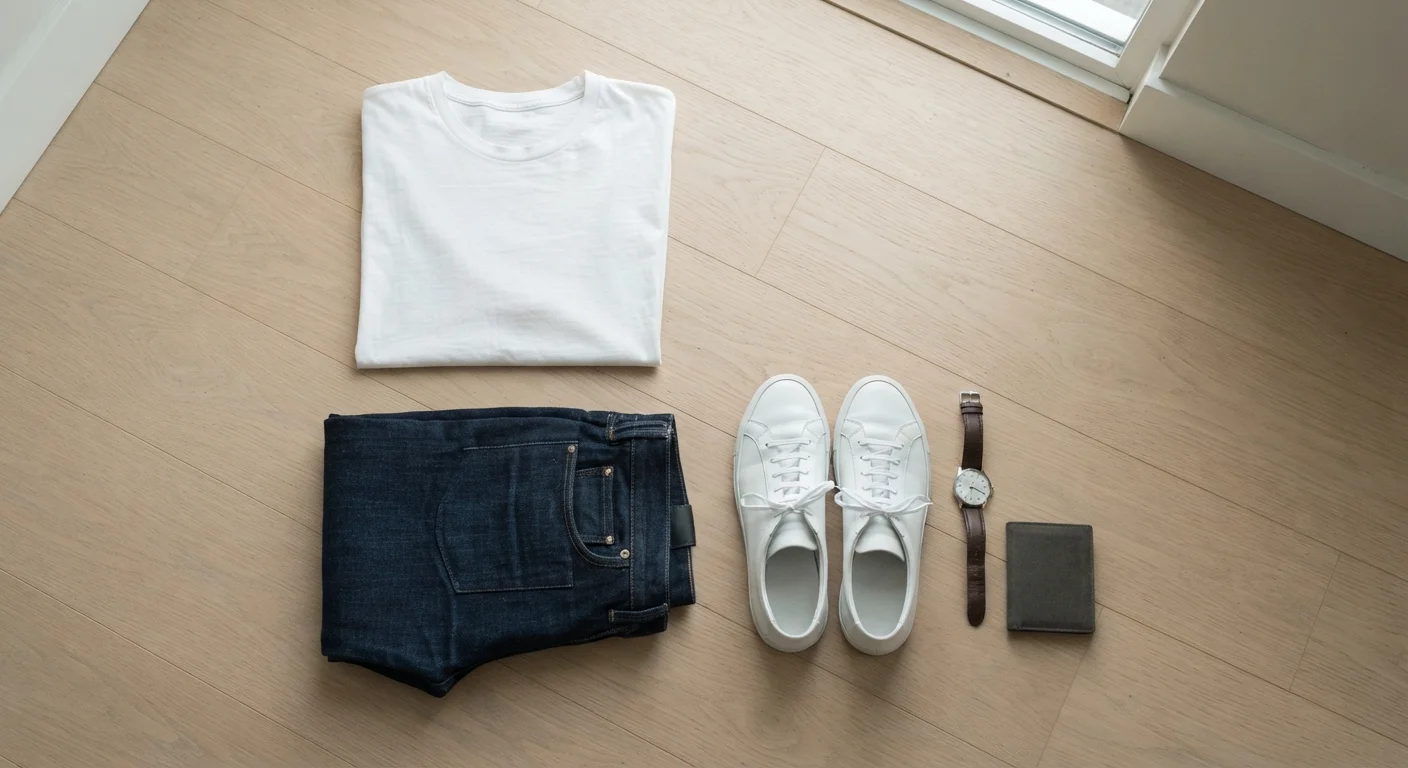
The simplest approach is to build outfits around neutral anchors. A reliable casual foundation might be dark or mid-wash denim, a clean neutral tee, and footwear that matches the general register of the outfit — sneakers for relaxed, loafers if slightly elevated. From there, a single point of interest (a pattern, an accent color, a textural layer) can add dimension without creating visual noise.
For those interested in adding patterns to casual looks, wearing patterns without looking chaotic explains when it works and when it doesn't. And if you want proven combinations that take the guesswork out of daily dressing entirely, outfit formulas that work is worth bookmarking.
Frequently Asked Questions
The main culprits are poor fit, visible wear and tear, and pieces that don't visually belong together. Clothing that's too large, stained, heavily pilled, or paired without any shared color or style logic tends to read as unintentional. Casual outfits that work have a clear through-line — even if that line is simply 'clean, well-fitted basics.'
Yes, with attention to fit and condition. Matching sets, fitted joggers in neutral tones, or a structured hoodie paired with clean sneakers can look deliberate. The key is avoiding overly stretched, faded, or mismatched pieces that signal 'I didn't think about this.'
For most casual contexts, the threshold is simply whether your clothes are clean, in good condition, and appropriate for public settings. Sleepwear, visibly stained items, and extremely worn pieces typically cross the line. At work, even on casual Fridays, check whether your workplace has an implicit standard.
Not entirely. You don't need a precise color theory approach, but clashing or chaotic combinations still read as unplanned. Sticking to neutrals with one accent color, or wearing tonal outfits, is the easiest way to look coordinated without much effort.
Focus on a core of well-fitting basics in neutral or versatile colors — quality over quantity applies here too. Fewer pieces that all work together will serve you far better than a full closet of impulse purchases that don't coordinate. See our <a href="/style-beauty/everyday-fashion/outfit-formulas-that-actually-solve-getting-dressed-in-the-morning">outfit formulas guide</a> for practical starting points.
The content on this site is for informational purposes only and is not a substitute for professional advice. Always consult a qualified professional for guidance specific to your situation.