

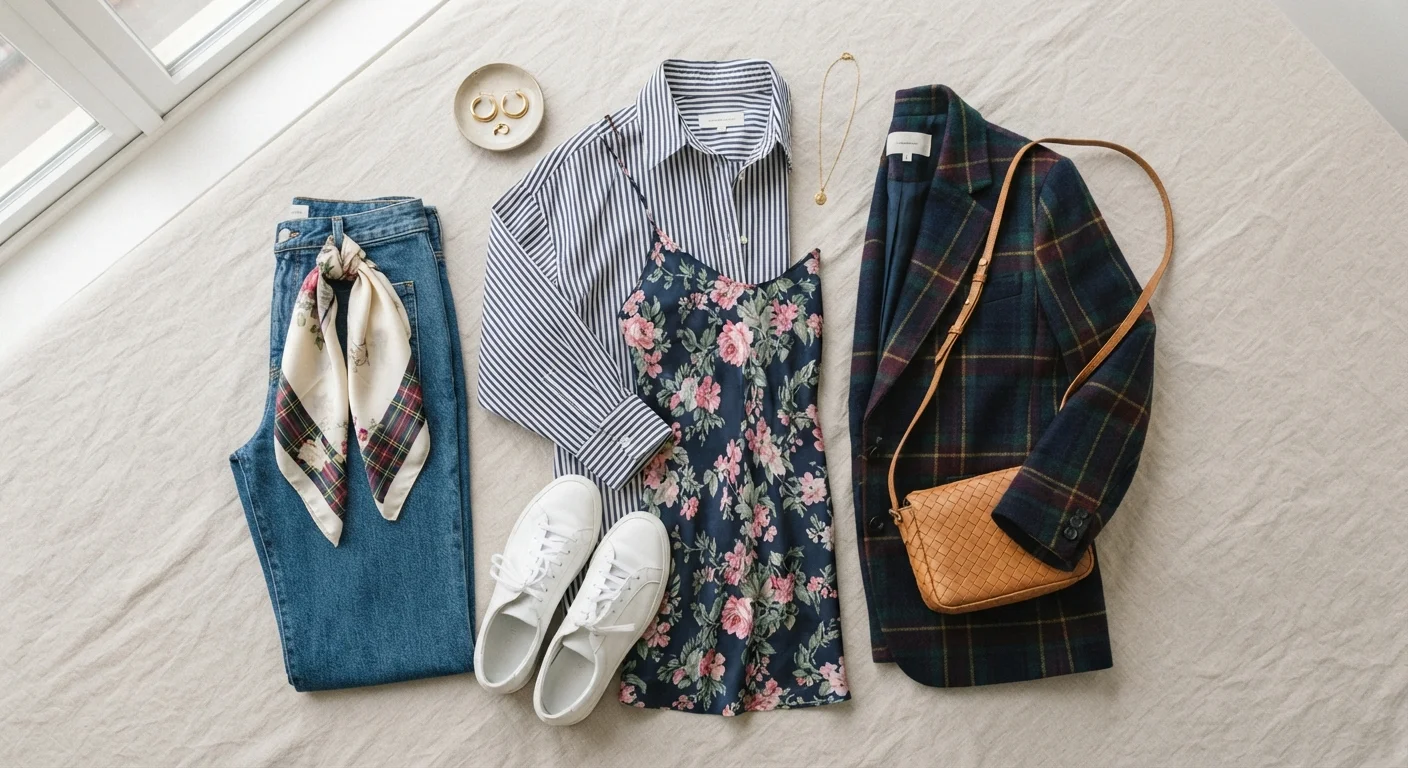
Why Pattern Mixing Fails — and Why It Doesn't Have To
Most pattern-mixing mistakes come from treating prints as neutral, swappable pieces. They aren't. Patterns carry visual weight, mood, and scale — and when two competing prints fight for attention with no common ground, the outfit reads as accidental rather than deliberate. The fix isn't avoiding pattern mixing altogether; it's understanding what makes a combination land.
The good news is that the rules are genuinely learnable, and they work across price points and body types. Whether you're mining your existing closet or shopping new pieces, these principles apply equally.
The Core Principles That Make Patterns Work Together
Pattern mixing isn't a free-for-all — it operates on a handful of consistent visual principles that stylists and editors apply whether they're working with luxury pieces or budget finds. Internalizing even two or three of these will change how you see your wardrobe.
Start With Prints That Share a Color Family
Before worrying about scale or category, check whether your two patterns share even one color. This single step eliminates most pattern-mixing failures. Lay the pieces next to each other in natural light — if you can point to a color that appears in both, you have a workable starting point. Build outward from there.
Color is often the most immediate connector. When a floral and a stripe share even one color — say, both contain a dusty rose — the eye reads them as part of the same intentional palette. This is why understanding basic color coordination pays dividends well beyond solid-on-solid dressing.
2 prints
Maximum for most effective pattern mixing
Style educators and wardrobe consultants broadly recommend limiting combinations to two patterns for everyday dressing, reserving three-print looks for more advanced styling contexts.
Scale contrast
Top visual factor in successful pattern pairings
Fashion design curricula consistently identify scale variation — not color alone — as the primary differentiator between pattern combinations that work and those that appear random.
Building an Outfit: From Anchor Pattern to Finished Look
Start every mixed-pattern outfit by designating an anchor piece — the print that commands the most attention and sets the tone. This is usually the item with the largest or boldest pattern: a wide-stripe shirt, a printed maxi skirt, a plaid overcoat. Everything else supports it rather than competing.
From the anchor, introduce a secondary pattern that is noticeably smaller in scale. A chunky plaid pairs well with a thin pinstripe; a large botanical print works alongside a small polka dot or micro-check. The contrast in scale is what keeps each pattern visually distinct instead of muddled.
If the combination still feels busy, add a solid element — a structured blazer, plain belt, or unadorned shoe — to give the eye a place to rest. This is a technique that works just as well when you're building reliable daily outfit formulas around simpler pieces.
When to Trust Your Eye and When to Step Back
Developing an instinct for pattern mixing takes repetition. A useful practice: lay the pieces flat on a bed before putting them on. Distance gives you the same view a stranger gets — you'll notice quickly whether the prints feel cohesive or chaotic at a glance.
It's also worth noting that casual doesn't mean careless — a relaxed outfit built on mixed patterns still benefits from deliberate choices in fit and proportion. Ill-fitting clothes in clashing prints compound the problem; well-fitted pieces in thoughtful combinations earn the look. Good fit is still the foundation regardless of what you're wearing.
“The best-dressed people are those who look like they made choices — not people who followed rules, but people who clearly decided.”
— Tim Gunn, Fashion educator and longtime mentor on Project Runway
Give yourself permission to experiment, but also to edit. Not every combination will work, and that's not failure — it's how a reliable eye gets built. The goal is an outfit that looks like a decision, not a coincidence.
The content on this site is for informational purposes only and is not a substitute for professional advice. Always consult a qualified professional for guidance specific to your situation.